Zanele Muholi
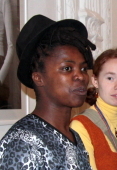
A South African visual activist whose photography transforms testimony into monument, insisting that Black queer lives be seen on their own terms.
Zanele Muholi has spent more than two decades building a photographic archive of South Africa's Black LGBTQI+ communities — an act they describe not as art-making but as visual activism. Their images move between intimate documentary and high-contrast self-portraiture, insisting that visibility is itself a form of justice.
Origins and formation
Muholi was born in 1972 in Umlazi, a township outside Durban, the youngest of eight children. Their mother worked as a domestic worker; the texture of that labour — unseen, undervalued — runs through Muholi's understanding of whose lives are recorded and whose are erased. After moving to Johannesburg, Muholi studied at the Market Photo Workshop, founded by David Goldblatt, where documentary photography was taught as social practice. They later studied at Ryerson University in Toronto, and at the University of the Witwatersrand.
Muholi began photographing in the early 2000s, at a moment when South Africa had some of the world's most progressive constitutional protections for LGBTQI+ people alongside some of the highest rates of homophobic violence. The gap between legal protection and lived reality was the space Muholi entered.
Faces and Phases, and documentary work
The project Faces and Phases, begun in 2006 and continued across more than a decade, is a sustained portrait series of Black lesbian, gay, transgender, and intersex South Africans. Shot in consistent black-and-white, against plain backgrounds, each image gives its subject direct address — to the camera, to the viewer. The cumulative effect is archival and political: a record that resists the erasure visited on these communities by both violence and official neglect.
Muholi's documentary practice extended to video and installation, addressing hate crimes, corrective rape, and the lives of those who survived or mourned. The work sits deliberately between journalism and memorial.
Somnyama Ngonyama
Beginning around 2012, Muholi turned the camera on themselves in a series titled Somnyama Ngonyama — Zulu for "Hail, the Dark Lioness." In these photographs, Muholi appears in extreme high-contrast black-and-white self-portraits, adopting elaborate headpieces assembled from found materials: rubber gloves, steel wool, rope, electrical cables. Each image carries a title and a location.
I want people to see blackness in all its beauty, complexity, and pain.
The series operates on several registers simultaneously: it references the long history of Black bodies being objectified and exoticised; it reclaims that gaze through deliberate self-construction; and it insists on the specificity of each setting — Geneva, New York, Paris — placing a Black queer South African body in spaces where it has historically been rendered invisible. The formal severity of the images gives them an icon-like authority.
Recognition and legacy
Muholi has been exhibited at major international institutions including the Tate Modern in London, the Stedelijk Museum in Amsterdam, and the Brooklyn Museum. In 2020, Tate Modern dedicated a major solo exhibition to their work. They have received numerous international awards and fellowships, and their photographs are held in significant public collections.
Muholi's practice has been influential not only as visual work but as a model of what it means to document a community from within it — with accountability, sustained presence, and explicit political intent.