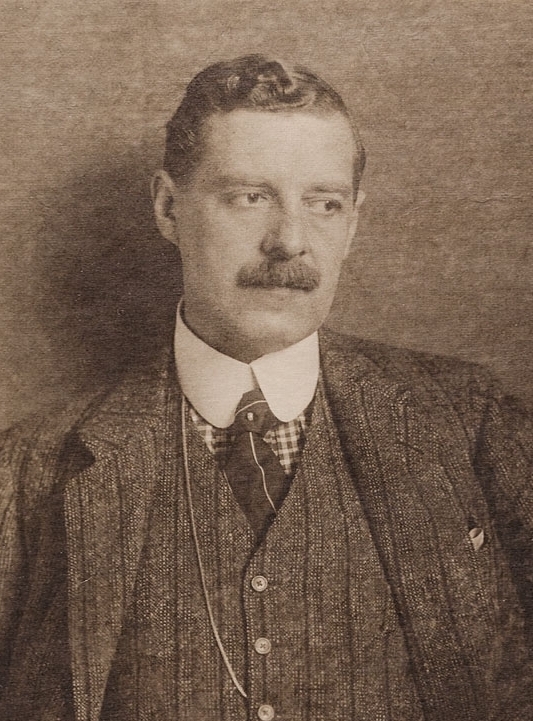
Adolf Loos
The architect who argued that ornament was not embellishment but crime — and built plain, tightly reasoned spaces that still feel modern a century later.
Adolf Loos arrived at modernism not through abstract theory but through argument — polemical essays and provocative buildings that stripped away decoration and demanded that each element of a structure justify itself by use. His essay "Ornament and Crime" (1910) and the Looshaus on the Michaelerplatz in Vienna (1911) together announced a position that influenced the course of European architecture, even as they made him enemies in his own city.
Origins
Loos was born in Brno in 1870, the son of a stonemason. He studied at the Dresden University of Technology before spending three years in the United States, from 1893 to 1896, working various jobs and absorbing American pragmatism — particularly the Chicago architecture of Louis Sullivan, whose dictum that form follows function registered in Loos as something close to a moral principle. Returning to Vienna, he began writing criticism and building interiors that were conspicuously unornamented in a city addicted to Historicist and Jugendstil surface.
Defining work
The Goldman & Salatsch building on the Michaelerplatz — the Looshaus — was completed in 1911 and caused immediate scandal. Its facade, facing the Imperial Palace, was stripped of ornament above a marble base; Emperor Franz Joseph is said to have had the windows facing it kept shuttered. Loos had already argued in "Ornament and Crime" that applied decoration was the mark of a degenerate culture, that modern man had evolved beyond it. The building enacted that argument in stone. The Villa Müller in Prague (1930) is his residential masterwork: the Raumplan — his spatial concept of interlocking rooms at different levels — is here at its most resolved, each volume sized to its precise human function.
Method and style
Loos's Raumplan (spatial plan) distinguished him from the flat-floor arrangements of mainstream modernism. Rather than stacking identical floor plates, he designed spaces that ascended and interlocked, with ceilings calibrated to the activity they sheltered — low for intimacy, high for gathering. Surfaces were finished in rare marbles, rich woods, and brass: luxury of material, not of ornament. The apparent austerity was, on the interior, a considered sensuality.
Legacy
Loos influenced Le Corbusier, who met him in Vienna, and his arguments about surface and structure ran through the International Style and beyond. His essay "Ornament and Crime" has been reprinted, debated, and revised in design discourse for over a century. The Looshaus in Vienna and the Villa Müller in Prague are both protected monuments and remain among the most visited buildings of early European modernism. He died in Kalksburg, near Vienna, in August 1933.
"The evolution of culture is synonymous with the removal of ornament from utilitarian objects."