Albert Einstein
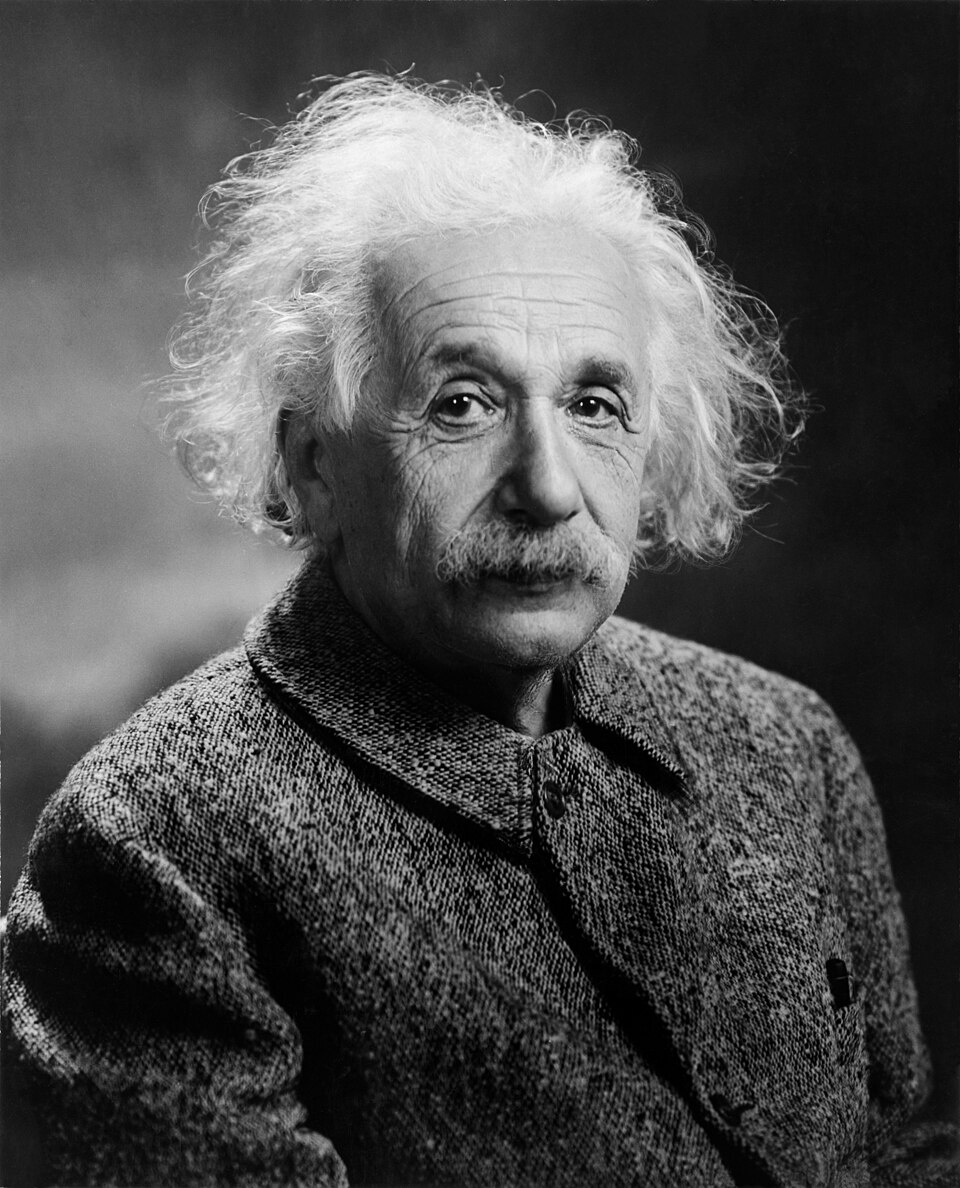
The architect of modern physics whose theories of relativity dismantled Newtonian certainties and reshaped humanity's understanding of space, time, and energy.
Albert Einstein overturned three centuries of classical physics with two papers published in 1905 and a decade of further theoretical work culminating in general relativity. His name became synonymous with genius, yet his deepest achievement was a rigorous insistence on physical intuition over mathematical convenience — a discipline that produced the most consequential scientific framework of the twentieth century.
Early life and formation
Einstein was born in Ulm, in the Kingdom of Württemberg, on 14 March 1879. His family moved to Munich, where his father and uncle ran an electrical-equipment company; the proximity to applied science shaped him early. He showed no signs of the prodigy stereotype — he was a slow talker as a child, and famously clashed with the rote-learning methods of Bavarian schooling. After the family relocated to Italy and he finished his secondary education in Aarau, Switzerland, he enrolled at the Polytechnic in Zurich (ETH), graduating in 1900.
Unable to find an academic post, Einstein accepted a position as a patent clerk in Bern. The intellectual freedom the job provided — examining inventions while remaining outside university orthodoxy — proved unexpectedly fertile.
The miracle year and special relativity
In 1905, Einstein published four papers that each would have secured a major scientific reputation. The first explained Brownian motion, confirming the existence of atoms. The second proposed that light travels in discrete packets — quanta — an explanation of the photoelectric effect for which he eventually received the Nobel Prize. The third introduced the special theory of relativity, dissolving the absolute status of simultaneous time and establishing that the laws of physics are identical for all observers in uniform motion. The fourth derived the equivalence of mass and energy: E = mc².1
General relativity and its confirmation
Special relativity addressed observers moving at constant velocity; Einstein spent the following decade extending it to accelerating frames and gravitation. The general theory of relativity, published in 1915, reconceived gravity not as a force but as the curvature of spacetime caused by mass and energy. The prediction was stark and testable: light should bend around massive objects. In 1919, British expeditions led by Arthur Eddington observed starlight deflecting around the sun during a solar eclipse, confirming the theory. Einstein became an international celebrity almost overnight.
Later work and legacy
Einstein spent his remaining decades at the Institute for Advanced Study in Princeton, pursuing a unified field theory that would reconcile electromagnetism and gravity — a project he never completed. He was troubled by the probabilistic foundations of quantum mechanics, famously writing to Max Born that "God does not play dice." The debate has never been fully resolved on philosophical grounds, though quantum mechanics has proved overwhelmingly successful experimentally. His 1939 letter to President Roosevelt warning of the feasibility of a nuclear weapon indirectly helped launch the Manhattan Project, a consequence that haunted him.
God does not play dice with the universe.
Footnotes
- The four 1905 papers appeared in volumes 17 and 18 of Annalen der Physik. The year is sometimes called Annus Mirabilis by analogy with Newton's plague-year productivity in 1666. ↩