Alfred Hitchcock
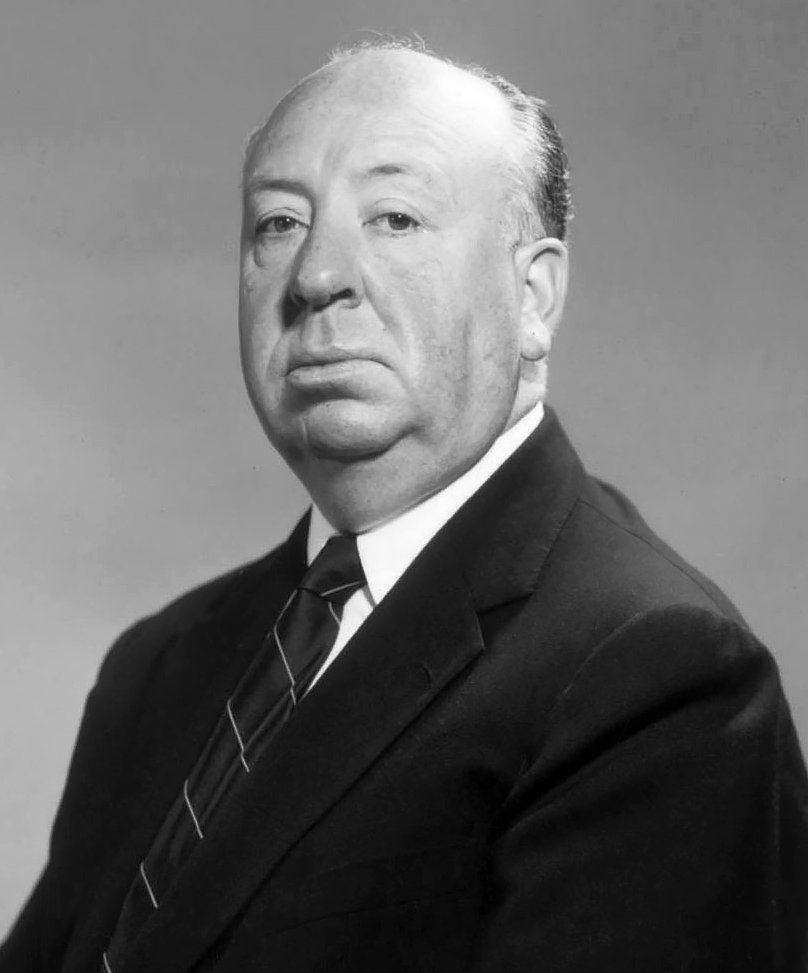
The English filmmaker who industrialised dread, building from silent thrillers to colour masterworks a body of work that permanently altered the grammar of screen suspense.
Alfred Hitchcock directed more than fifty feature films across five decades, building the thriller genre into a serious artistic form and making the manipulation of audience emotion as technically precise as any craft in cinema. His name became an adjective before his career was over.
Origins and the British period
Hitchcock was born in Leytonstone, east London, in 1899, the son of a greengrocer. He entered the film industry in 1919, writing intertitles for silent films at the Islington studios of the American firm Famous Players-Lasky. He worked his way through design, scriptwriting, and assistant directing before making his directorial debut with The Pleasure Garden (1925). His breakthrough came with The Lodger (1927), a silent thriller about a serial killer in London fog that established many of the visual strategies — subjective camera, staircase geometry, the ordinary world invaded by menace — that would define his subsequent career.
He moved through sound with facility: Blackmail (1929) was among the first British sound films. The 1930s produced a sequence of polished thrillers — The 39 Steps (1935), Sabotage (1936), The Lady Vanishes (1938) — that made him the most commercially successful director working in Britain.
Hollywood and the classical period
Producer David O. Selznick brought Hitchcock to Hollywood in 1939. The first American film, Rebecca (1940), won the Academy Award for Best Picture. The decades that followed were the most productive: in the 1950s alone Hitchcock made Strangers on a Train (1951), Rear Window (1954), To Catch a Thief (1955), The Man Who Knew Too Much (1956), Vertigo (1958), North by Northwest (1959), and Psycho (1960).
Vertigo — a film about obsession, identity, and the male gaze, initially received as a flawed thriller — was voted the greatest film ever made in the 2012 Sight & Sound poll, displacing Citizen Kane from a position it had held for fifty years. Psycho, shot cheaply in black and white with a television crew, broke narrative conventions by killing its apparent protagonist in the first act. Its shower scene remains the most analysed sequence in film history.1
Method
Hitchcock was a meticulous planner. He storyboarded sequences before production and claimed, with some exaggeration, that the actual shooting was an anticlimax — the real film existed in the preparation. He worked closely with cinematographers, notably Robert Burks (his director of photography on twelve films), composer Bernard Herrmann (who scored eight films, including Psycho), and editor George Tomasini. His collaborations were long and productive; he distrusted improvisation.
| Collaborator | Role | Films together |
|---|---|---|
| Robert Burks | Cinematography | 12 |
| Bernard Herrmann | Music | 8 |
| Grace Kelly | Actor | 3 |
| Cary Grant | Actor | 4 |
He used actors instrumentally and made no secret of this. His relationship with Tippi Hedren during The Birds (1963) and Marnie (1964) became the subject of sustained critical and biographical scrutiny after his death.
Television and public persona
Alfred Hitchcock Presents (1955–62), which continued as The Alfred Hitchcock Hour (1962–65), gave him a weekly presence in American living rooms. His introductions — delivered in deadpan, with a sardonic detachment that was itself a performance — made him the rare filmmaker recognisable on sight to a mass public. He appeared in cameo in almost every film he made, a private joke that became a public ritual.
There is no terror in the bang, only in the anticipation of it.
Footnotes
- The shower scene in Psycho was shot over seven days with seventy camera set-ups. Herrmann's string score was composed after Hitchcock had screened the sequence without music. ↩