Anton Bruckner
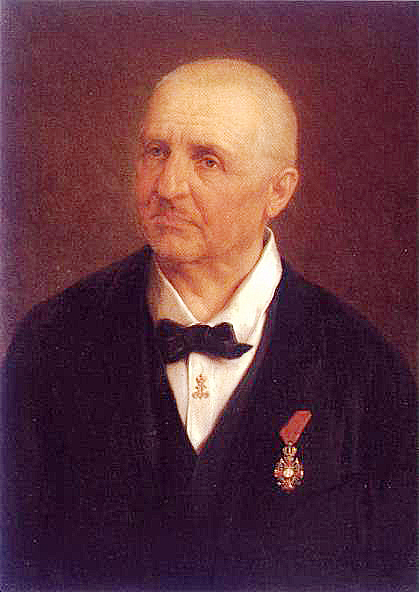
The Austrian organist who arrived at the symphony late and made it vast — long-breathed movements of granite weight and sudden luminous stillness, the most distinctive orchestral voice of the late Romantic era.
Anton Bruckner spent his first forty years as a church organist in provincial Austria, arriving at the symphony only in his late thirties and writing his first mature example at forty. The works that followed — nine symphonies of extraordinary length and structural density — were immediately divisive. The Brahms faction found them shapeless; the Wagner faction claimed them as the orchestral fulfilment of the same harmonic revolution. Neither was entirely right. Bruckner's music is its own thing: a solitary, devout craftsman's attempt to make the symphony the equivalent of the Gothic cathedral.
Origins and formation
Bruckner was born in 1824 in Ansfelden, a small village in Upper Austria, the son of a schoolteacher. He followed his father into teaching and music; from the age of thirteen he served as a court musician at the Augustine monastery of St Florian, near Linz, as an organist. He remained connected to St Florian throughout his life, and it was there he asked to be buried, beneath the great organ.
His formal training came late and was systematic to the point of obsession. He studied counterpoint with Simon Sechter in Vienna into his thirties, and harmony and form with Otto Kitzler in Linz in his early forties — a period during which he also absorbed Wagner's Tannhäuser and Lohengrin, which transformed his sense of orchestral possibility. He did not compose his First Symphony until he was around forty.
The symphonies
Bruckner's mature symphonies — he revised several of them repeatedly, and the question of which edition to perform remains contested — are distinguished by their scale, their slow tempo markings, and their structural method. Large blocks of orchestral sound alternate with sudden silences or quiet passages; development sections work through harmonic transition rather than motivic fragmentation; finales are the most demanding movements, often the longest, required to resolve vast amounts of accumulated tension. The Seventh Symphony (1883), whose slow movement was composed during Wagner's last illness and is widely understood as an elegy, was his greatest popular success during his lifetime.
His sacred choral works — three Masses, a Te Deum, and several motets — were composed alongside the symphonies and are of equal quality. The Te Deum in C major he considered among his finest achievements.
I want to see God.
Personality and reception
Bruckner was by temperament humble, devout, and socially awkward — a combination that made him an easy target in the venomous musical politics of Vienna, where the Brahms faction used his deference and anxiety against him. He revised his symphonies in response to criticism in ways that sometimes improved and sometimes harmed them. The versions he authorised late in life were long considered definitive; scholarship since the mid-twentieth century has increasingly preferred his original versions.
He was appointed professor of harmony and counterpoint at the Vienna Conservatory in 1868 and lectured there until 1891; he also taught at the University of Vienna, where he attracted devoted students who became the core of his advocacy in the years after his death.
Legacy
Bruckner's reputation rested for decades on the advocacy of conductors — Hans Richter, Arthur Nikisch, Wilhelm Furtwängler — rather than on widespread repertoire inclusion. He is now performed in every major concert hall. His structural method — the long-prepared climax, the sudden silence, the chorale-like brass passage — directly influenced the symphonic thinking of Sibelius and Shostakovich. His sacred choral music, particularly the motets and the Te Deum, has never left the choral repertoire.