Anton Chekhov
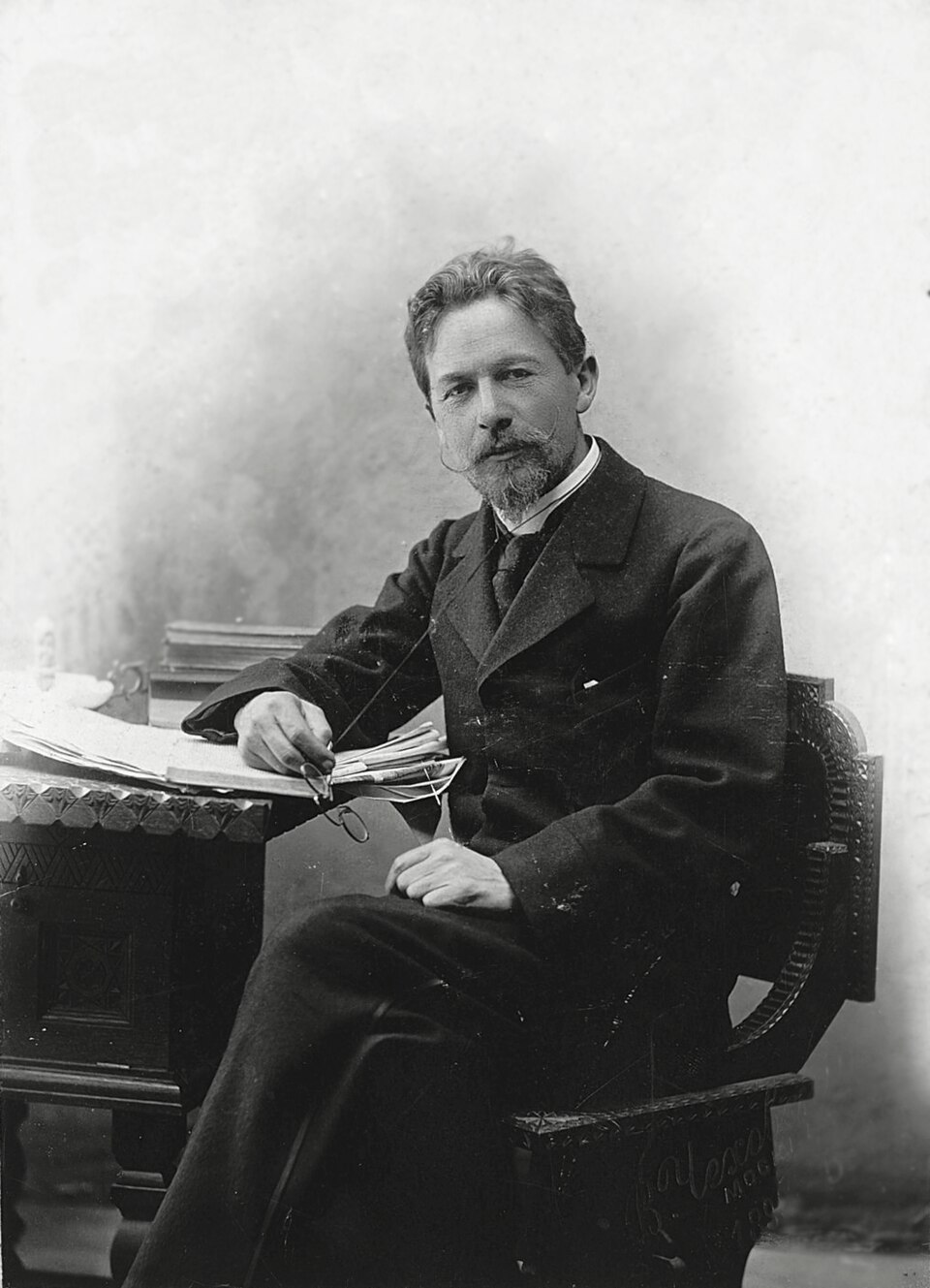
A Russian physician who wrote plays and stories with the diagnostic precision of his first profession — and in doing so redefined what drama and short fiction could honestly hold.
Anton Chekhov trained as a physician and never stopped practising. His fiction carried the same habits: close observation, suspended judgment, and a refusal to prescribe. The four major plays he left behind — written in the last eight years of his life — changed what theatre was willing to say and how slowly it was willing to say it.
Origins and the double life
Chekhov was born in 1860 in Taganrog, a port town on the Sea of Azov, the son of a grocer and grandson of a serf who had bought his own freedom. The family moved to Moscow in 1876 after his father's bankruptcy; Chekhov followed in 1879 to study medicine. He qualified as a physician from Moscow University in 1884. Throughout his student years he had already been selling comic sketches and short stories to newspapers under pseudonyms to support himself and his family. Medicine and writing ran in parallel for the rest of his life — a fact he described without ambiguity: "Medicine is my lawful wife and literature is my mistress."
The stories
Chekhov wrote several hundred short stories across his career. The early work was largely comic and formulaic, shaped by the commercial outlets that published it. The shift came gradually: stories like Ward No. 6 (1892), The Black Monk (1894), The Lady with the Dog (1899), and The Bishop (1902) abandoned the neat resolution the genre conventionally demanded. His characters inhabit situations that do not resolve — longing, inertia, the gap between what people feel and what they can say. The form he refined, often called the Chekhovian short story, influenced virtually every writer of short fiction who came after him, from Katherine Mansfield to Raymond Carver.
The plays
Chekhov came to the theatre reluctantly. The Seagull (1896) was a disaster at its St Petersburg premiere; the audience's hostility drove him to swear off playwriting. Two years later the Moscow Art Theatre, under Konstantin Stanislavski and Vladimir Nemirovich-Danchenko, produced a revival that was received as a revelation. The collaboration that followed yielded Uncle Vanya (1897), Three Sisters (1900), and The Cherry Orchard (1904) — four plays in which action yields to mood, plot to atmosphere, and resolution to the quiet persistence of ordinary life. Characters speak past one another, nurse private failures, and fail to act on what they feel. The effect, misread as inaction at the time, has since been recognised as a precise account of how people actually inhabit time.
The role of the artist is to ask questions, not answer them.
Method and the Chekhov gun
Chekhov's craft principles circulated through his letters and have become standard reference points in discussions of narrative economy. The most cited: if a gun is shown in the first act, it must go off before the play is over — meaning that every element in a work should be necessary, and nothing present should be inert. The principle, applied in reverse, describes his actual practice: Chekhov kept the gun on the wall and let the characters talk around it.
He worked closely with Stanislavski on the Moscow Art Theatre productions, though the two men frequently disagreed about tone. Chekhov insisted the plays were comedies; Stanislavski staged them as tragedies. The argument has not been settled.
Death
Chekhov was diagnosed with tuberculosis as early as 1884. He managed the illness while continuing to write and practice medicine, including a trip to Sakhalin Island in 1890 to document prison conditions — a journey that produced a work of non-fiction journalism. By 1904 the disease had advanced. He died in Badenweiler, Germany, on 2 July 1904, aged 44, while taking a cure. He is buried in Moscow.