Antonín Dvořák
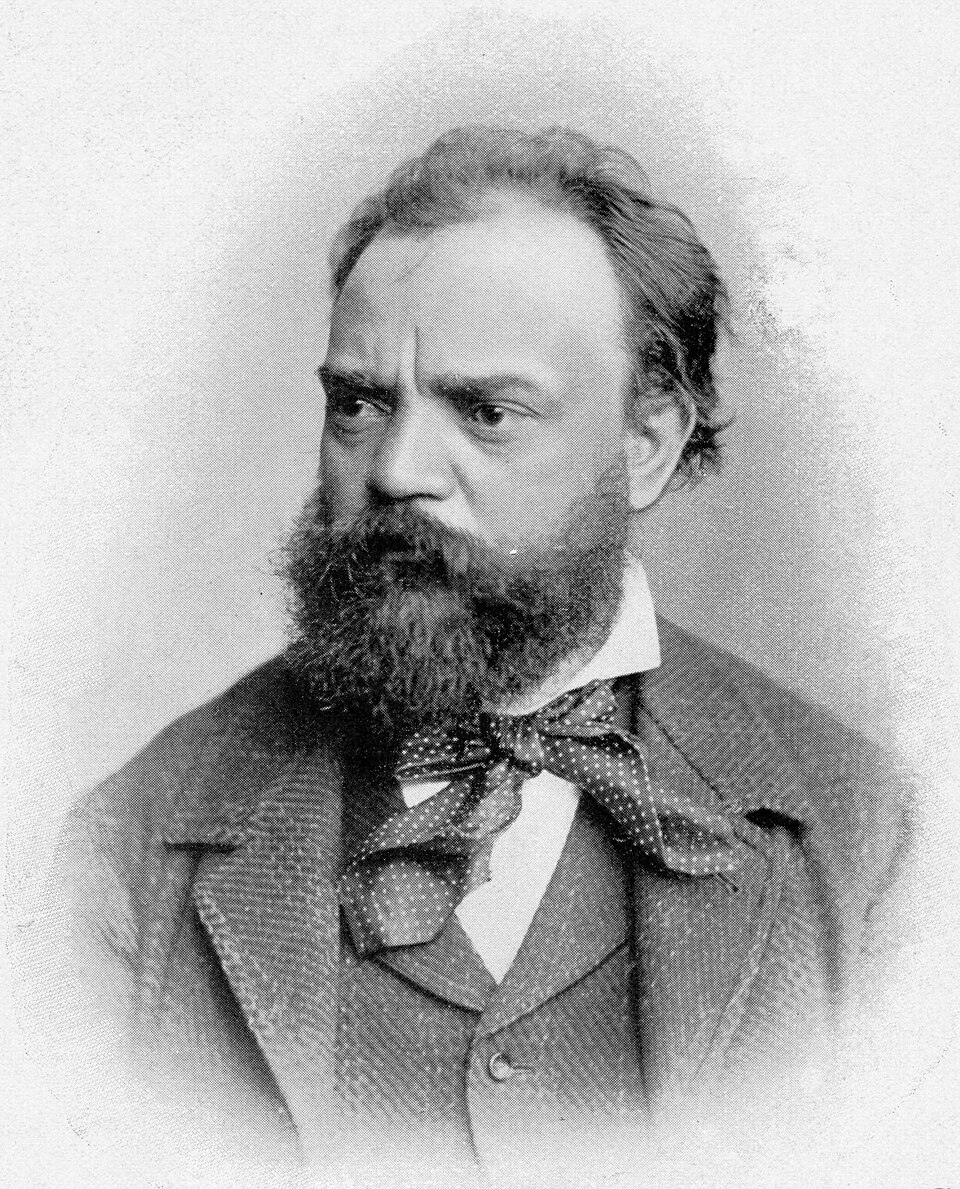
The Czech master who blended Bohemian folk colour with Viennese symphonic discipline to create some of the most joyful and deeply felt music of the nineteenth century.
Antonín Dvořák was the most internationally successful Czech composer of his time — a musician who grew up in a village butcher's household, learned his craft playing viola in theatre orchestras, and produced nine symphonies, concertos, chamber music, and operas that combined the harmonic richness of the Austro-German tradition with an unmistakable Bohemian rhythmic and melodic personality.
Origins in Bohemia
Dvořák was born in 1841 in Nelahozeves, a village on the Vltava north of Prague, the son of a butcher and innkeeper who also played the zither. Music surrounded him from birth. He showed talent early and was sent to the organ school in Prague at sixteen, after which he joined the orchestra of the Provisional Theatre as a viola player, an ensemble that eventually became the Czech National Theatre orchestra. He played under Bedřich Smetana, an encounter that strengthened his conviction that Czech music needed its own voice.
The breakthrough came when Brahms, serving on the jury for the Austrian State Prize, encountered Dvořák's work and brought him to the attention of his own publisher, Fritz Simrock. The relationship with Simrock produced the Slavonic Dances (1878), sixteen dances for piano duet (later orchestrated) built on Bohemian and Moravian dance rhythms. They were an immediate popular success across Europe and made Dvořák internationally known.
The symphonies and concertos
Dvořák's nine symphonies trace a development from Beethovenian models through the influence of Wagner and Brahms to a mature synthesis that is entirely his own. The Seventh Symphony (1885) is his most formally rigorous; the Eighth (1889) his most lyrical. The Ninth, From the New World (1893), composed during his time as director of the National Conservatory of Music in New York, became the most performed of all his works. It absorbs impressions of African-American spiritual melody and Native American music into a fundamentally Bohemian symphonic argument.
The Cello Concerto (1895) is widely regarded as the finest concerto ever written for the instrument — a work of sustained melodic beauty and architectural completeness that Brahms, on hearing it, reportedly said he would have composed himself had he known such a cello concerto was possible.
The future music of this country must be founded upon what are called the negro melodies. This must be the real foundation of any serious and original school of composition to be developed in the United States.
Chamber music and the American period
Dvořák was a prolific chamber composer. The string quartets, piano trios, and piano quintet form a body of work second in importance only to Brahms in the late nineteenth century. The American Quartet (String Quartet No. 12 in F major, 1893), composed in the Iowa village of Spillville during a summer retreat, absorbed the same American musical materials as the New World Symphony into an intimate form.
He returned to Bohemia in 1895 and spent his final years in Prague, directing the conservatory and composing operas — of which Rusalka (1901), with its aria "Song to the Moon," became the most enduring.