Antonio Vivaldi
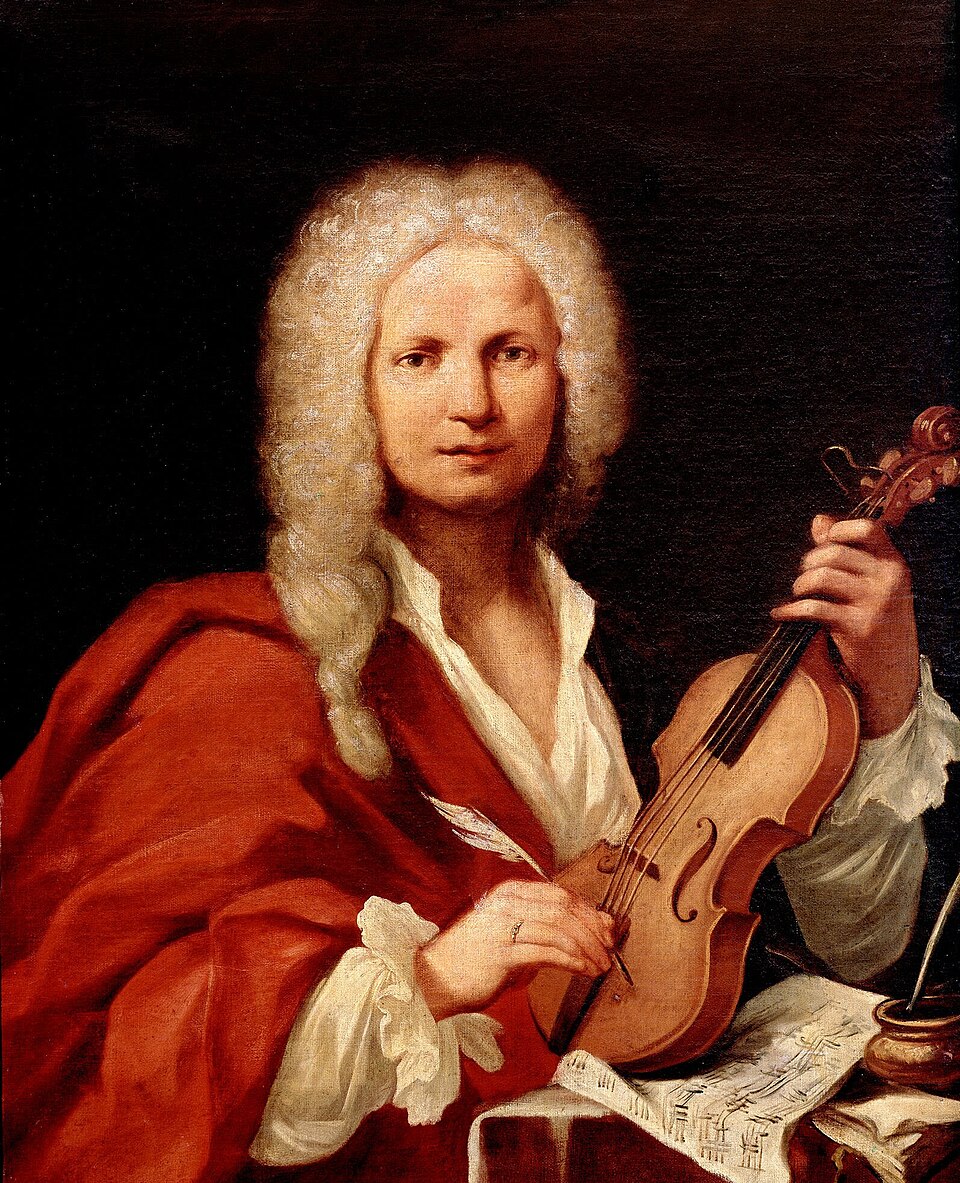
The Venetian priest-composer who wrote roughly five hundred concertos, reinvented the form, and watched his fame collapse before he died in poverty in Vienna.
Antonio Vivaldi almost single-handedly established the solo concerto as European music's dominant instrumental form. Working from a Venetian orphanage and travelling between opera houses, he produced an extraordinary volume of work — concertos, operas, sacred music — whose influence spread faster than his reputation could protect him. By the time he died, the fashion had already moved on.
Priest and teacher
Vivaldi was born in Venice in 1678, the son of a barber-turned-violinist who played at the Basilica of San Marco. He was baptised immediately after birth, apparently due to fear for his survival — he suffered throughout his life from what contemporary documents describe as "tightness of the chest," now believed to have been asthma. Ordained as a priest in 1703, he was known among Venetians as il Prete Rosso — the Red Priest — for his vivid hair.
Within months of ordination he was appointed violin teacher at the Ospedale della Pietà, one of four Venetian institutions that provided musical education to orphaned, illegitimate, or otherwise displaced girls. The Pietà had an exceptional orchestra and choir; foreign visitors noted that its Sunday concerts were among the finest music available anywhere in Europe. Vivaldi held the teaching post, on and off, for most of his life, and wrote a substantial portion of his concertos specifically for the Pietà's ensemble — testing, practical compositions for known players.
The concerto form
Vivaldi's most consequential contribution was his consolidation of the ritornello form for the concerto — a structural principle in which a recurring tutti passage (the ritornello) alternates with solo episodes that develop and modulate away from the home key. The pattern gave the solo concerto its characteristic drama: the soloist pressing outward against the gravitational pull of the ensemble's refrain.
L'Estro Armonico, Op. 3 (1711), published in Amsterdam by Estienne Roger, announced this approach to all of Europe in twelve concertos for one, two, and four violins. The collection circulated widely: J. S. Bach transcribed six of the concertos for keyboard and organ, an act of careful study that shows precisely how influential the collection was among northern European musicians.
The Four Seasons (Le quattro stagioni, c. 1720, published 1725 as part of Op. 8) extended the concerto into explicitly programmatic territory. Each of the four violin concertos is prefaced by a sonnet — possibly written by Vivaldi himself — describing scenes from the season in question, and specific musical passages are keyed to lines of verse. The cuckoo, the barking dog, the frozen winter landscape, the summer thunderstorm: Vivaldi asked his listeners to hear a story, not merely a structure. The work is now among the most performed in the classical repertoire.
I always finish a concerto, with all its parts, more quickly than a copyist can copy it.
Opera and decline
Beyond the concertos, Vivaldi composed approximately forty-six operas, working with librettists and managing productions in Venice, Mantua, Rome, and Vienna. Opera was where the money was; the concertos, however extraordinary, circulated in manuscript and print with limited direct income to the composer. His attempts to establish himself as an opera impresario were partly successful, partly exhausting, and ultimately did not secure his financial position.
By the 1730s, musical taste in northern Europe was shifting toward the galant style — simpler textures, singing melody, fewer counterpoint obligations. Vivaldi's dense, virtuosic concerto idiom began to feel unfashionable to the audiences and patrons who had sustained him. In 1740 he travelled to Vienna, apparently hoping for imperial patronage from Charles VI, who had received him well before. Charles died that year. Vivaldi died in Vienna in July 1741, under circumstances that remain unclear; he was buried in a pauper's grave.