Arata Isozaki
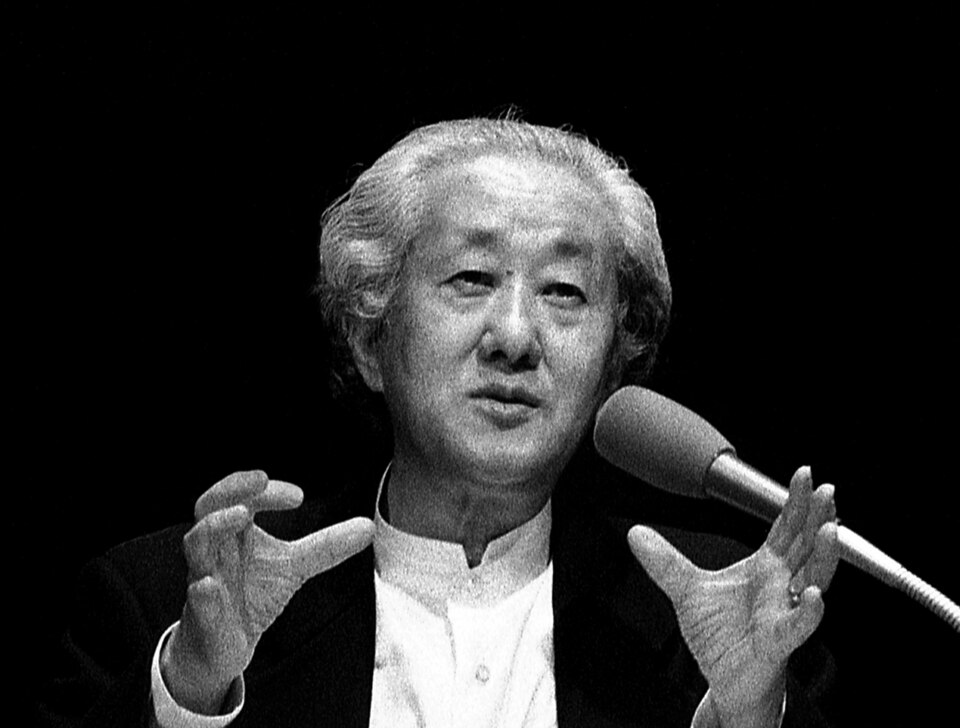
The Japanese architect who trained under Kenzo Tange, coined a concept of spatial time, and won the Pritzker Prize at 87 — after building on five continents.
Arata Isozaki spent six decades building on five continents, theorising Japanese spatial concepts for an international audience, and resisting easy categorisation — a position the Pritzker Prize jury eventually confirmed by awarding him architecture's highest honour at the age of 87.
Formation under Tange
Isozaki was born in Ōita-shi in 1931, on the island of Kyushu, and spent his early years in a city that was devastated by American bombing in the final months of the Second World War. The experience of destruction and reconstruction at the scale of an entire urban fabric shaped his early thinking about architecture, ruins, and time.
He studied at the University of Tokyo, where he came under the influence of Kenzo Tange — the figure who more than any other defined Japanese modernist architecture and urban planning. Isozaki worked in Tange's office before establishing his own practice in 1963. His formation was simultaneously metropolitan and provincial: Tokyo's internationalism met the specific cultural memory of Kyushu.
Metabolism and Its Critique
Isozaki was associated in the early 1960s with the Metabolist movement, the Japanese architectural tendency that proposed buildings as organic systems with replaceable parts, capable of growth and change over time. His own position was critical rather than orthodox: he produced a series of drawings and projects that imagined city infrastructure not as permanent framework but as ruin — the City in the Air project (1960–1962) showed raised urban platforms gradually falling apart, questioning whether permanence was a valid architectural ideal.
The Ōita Prefectural Library (1966) was his first major built work — a monumental concrete structure whose cubic geometry and powerful massing announced an architecture of weight and deliberation.
Ma is the consciousness of place in the Japanese sense — a pause, an interval, the pregnant void between events.
Ma: Space, Time, and Cultural Theory
Through the 1970s and 1980s Isozaki engaged extensively with questions of Japanese spatial concepts and their relationship to Western architecture. He developed the concept of Ma (間) — a Japanese term for the interval or pause between spatial or temporal events — as a theoretical framework, curating a major exhibition on the subject that travelled internationally. The concept offered an alternative to both Western perspectival space and the continuous flow of modernist planning, proposing instead an architecture of meaningful threshold and caesura.
He taught at Columbia University, Harvard University, and Yale University, bringing this theoretical perspective to the formation of American architects.
International Practice
The Museum of Contemporary Art in Los Angeles (MOCA, 1986) brought Isozaki's work to a major American audience. The building — a complex of geometric volumes in Indian sandstone, with barrel-vaulted skylights illuminating the gallery spaces — was recognised as a sophisticated response to the problems of museum design: how to light art naturally without direct sunlight, how to create a civic presence on a difficult urban site. MOCA established him as a figure of international stature beyond Japan.
For the 1992 Barcelona Olympics, Isozaki designed the Palau Sant Jordi indoor arena, a vast elliptical structure with a steel roof assembled on the ground and raised into position. It demonstrated structural ambition at urban scale.
Later built works included the Domus Museum in A Coruña (1995), the Qatar National Convention Centre (2011), and cultural buildings across China as that country's construction boom attracted major international architects.
Recognition and Late Career
Isozaki received the Royal Gold Medal from the Royal Institute of British Architects in 1986 and the Pritzker Architecture Prize in 2019 — the latter citation acknowledging his role in bridging Eastern and Western architectural thought, his theoretical contributions, and his built work across five decades.
He died in Okinawa on 28 December 2022, aged 91.