Arvo Pärt
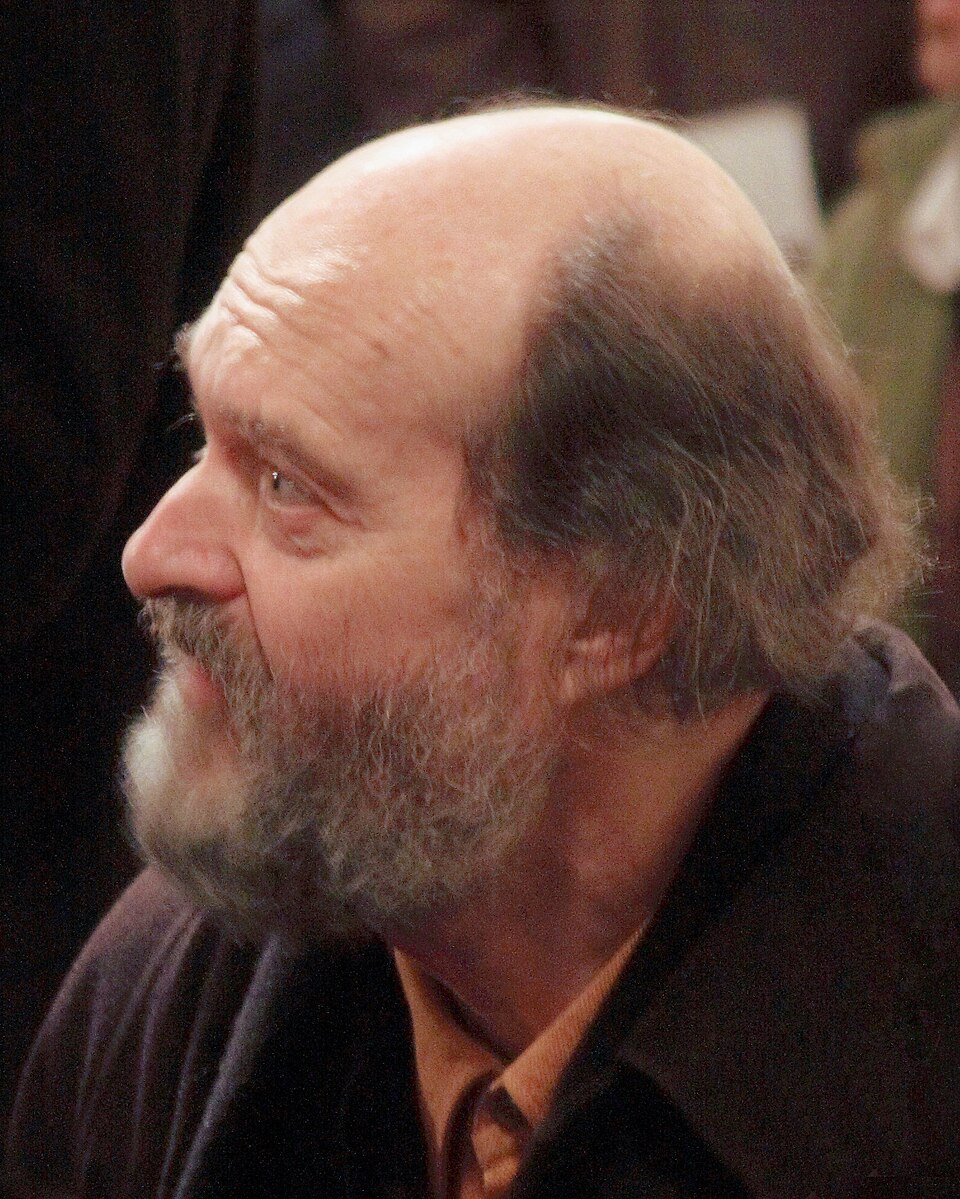
The Estonian composer who passed through serialism and silence and emerged with tintinnabuli — a technique of such stripped economy that it made stillness structural.
Arvo Pärt spent the first part of his career writing music of increasing complexity — neoclassical, then serial, then a collage style that got him into trouble with Soviet authorities. Then he stopped composing for eight years. When he returned, he brought a technique he called tintinnabuli: two voices, a melody line and an arpeggio of the triad, moving in near-total simplicity. The music that followed has been performed more than any other living composer's.
Early work and the Soviet context
Pärt was born in Paide, Estonia, in 1935, and studied at the Tallinn Conservatory under Heino Eller. His early works were neoclassical in orientation, but the exposure to Western twelve-tone technique transformed his compositional ambitions. Nekrolog (1960) — a short orchestral work in a serial idiom — was the first twelve-tone composition by an Estonian composer, and Soviet cultural authorities received it poorly. Music that followed Western modernist models was ideologically suspect.
He continued composing in a serial vein through the early 1960s, but by the mid-decade was experimenting with collage techniques, placing tonal quotations inside atonal or aleatory frameworks. Collage on B-A-C-H (1964) used this approach self-consciously; Credo (1968), a work that set a Christian text and quoted Bach's C major prelude, brought direct censure from Soviet officials. After Credo, Pärt effectively stopped composing in public.
Silence and study
From 1968 to 1976, Pärt composed very little. He spent those years studying medieval and Renaissance music — Gregorian chant, early polyphony, Franco-Flemish counterpoint — at the library of the Tallinn Conservatory. It was a sustained act of withdrawal and reorientation, moving away from the structural complexity of the avant-garde toward the transparency and modal simplicity of earlier centuries.
The method he developed out of this study he named tintinnabuli, from the Latin for bell (tintinnabulum). The technique is binary: one voice (the M-voice, melody) moves stepwise or by small intervals through a scale; the other (the T-voice, tintinnabuli) arpeggios through the notes of a triad. The two voices move together but by different rules, producing a sound that is at once simple and resonant — less like composition in the conventional sense than like the sound of an instrument decaying in a room.
I have discovered that it is enough when a single note is beautifully played. This one note, or a silent beat, or a moment of silence, comforts me.
Tintinnabuli works
Für Alina (1976) is the first tintinnabuli work — a piece for solo piano so stripped of activity that its silences carry as much weight as its notes. Tabula Rasa (1977), a double concerto for two violins, prepared piano, and string orchestra, extends the method across a larger architecture. Fratres (1977) exists in a dozen instrumental arrangements, each adapting the same harmonic material to different forces. Spiegel im Spiegel (1978) — "Mirror in the Mirror" — pairs piano and violin in a work of sustained tonal stasis that has become one of the most frequently performed pieces of the late twentieth century.1
Emigration and international recognition
Pärt emigrated from Soviet Estonia to Vienna in 1980, and then to Berlin, where he lived for three decades. The distance from Tallinn did not sever his connection to Estonian culture; it intensified it by making that connection a matter of choice. His work was taken up by the ECM Records label — whose producer Manfred Eicher had an ear for music that existed outside genre categories — and disseminated to audiences who had no particular classical-music allegiances but recognised something in the sound.
From 2011 to 2018, and again in 2022 and 2025, Pärt was the most performed living composer in the world, according to Bachtrack statistics. The Arvo Pärt Centre, a purpose-built research and cultural facility in Laulasmaa on the Estonian coast, opened to the public in 2018, housing his archive and hosting concerts.
Footnotes
- Spiegel im Spiegel was composed in a single afternoon in 1978, reportedly as a relaxation exercise between other projects. Its apparent simplicity is also a structural description: each phrase mirrors itself, the piano's arpeggios reflecting the violin's long tones, and the whole piece contained within a narrow harmonic field. ↩