Billie Holiday
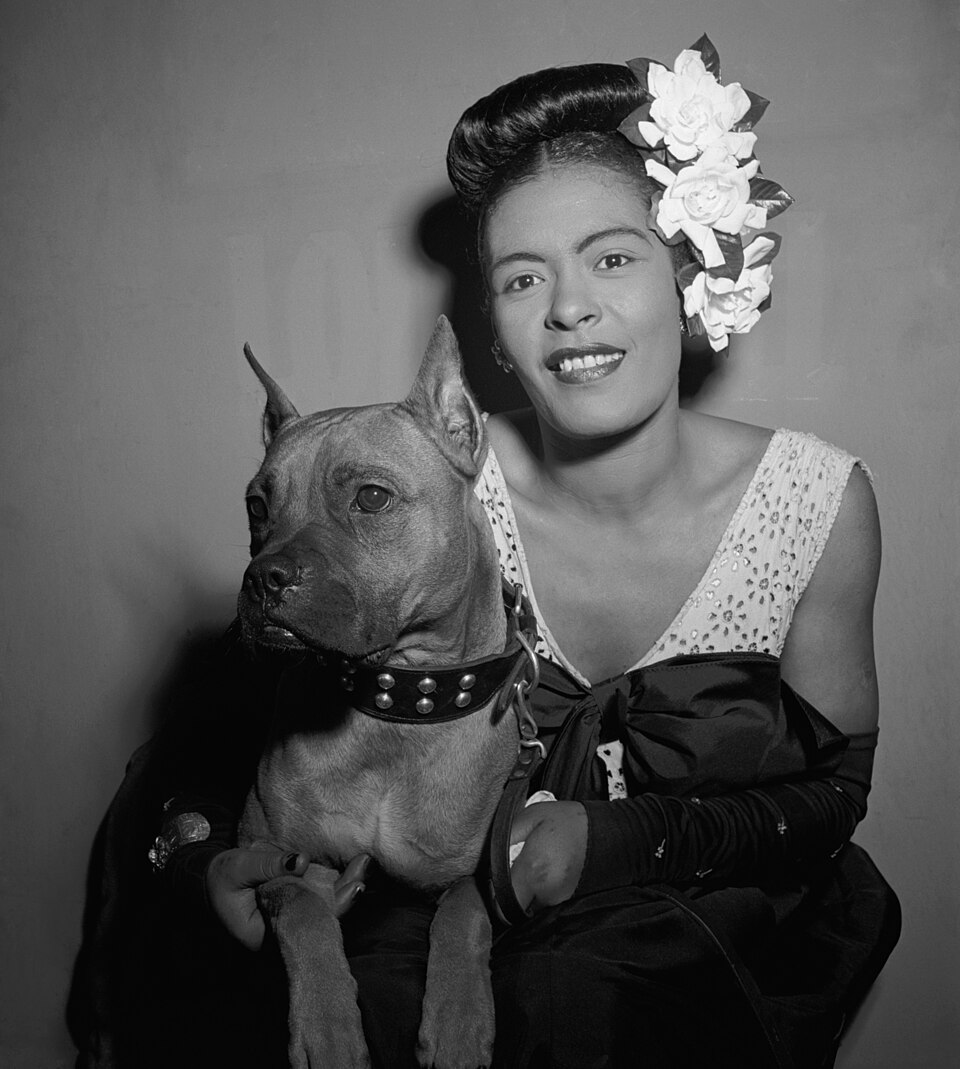
The jazz singer who transformed phrasing into autobiography and made a protest song into an anthem.
Billie Holiday — born Eleanora Fagan — reshaped what a voice could do. Strongly influenced by jazz instrumentalists rather than classical vocal technique, she bent melody to emotion, arriving late on the beat or ahead of it, until phrasing itself became the story. In a career spanning little more than two decades she left recordings that remain the benchmark for jazz and popular singing.
From Baltimore to Harlem
Holiday was born on 7 April 1915 in Philadelphia and raised in Baltimore under difficult circumstances. She moved to New York City as a teenager and began singing in Harlem clubs in the early 1930s. Producer John Hammond heard her in 1933 and arranged her first recordings. By the mid-1930s she was recording alongside Teddy Wilson and Benny Goodman, releasing a series of sides that introduced her extraordinary sense of time to a wider audience.
Lady Day and Lester Young
Her partnership with tenor saxophonist Lester Young defined both their careers. Young gave her the name "Lady Day"; she called him "Prez." Their musical conversation — voice answering horn, horn answering voice — produced some of the most intimate small-group recordings in jazz history. The rapport was built on shared phrasing instincts: both delayed resolutions, stretched vowels, and implied notes rather than stating them outright.
Strange Fruit
In 1939 Holiday recorded "Strange Fruit," a song written by schoolteacher Abel Meeropol as a response to the lynching of Black Americans in the South. Her label at the time, Columbia, refused to release it; she recorded it instead for the independent Commodore label. The performance — spare, slow, unflinching — became one of the most politically significant recordings of the twentieth century. Time magazine later named it the song of the century.
Legacy and Decline
Holiday published her autobiography, Lady Sings the Blues, co-written with William Dufty, in 1956. The book documented not only her career but her long struggle with heroin addiction and the legal troubles that followed, including a federal narcotics conviction in 1947 that cost her the New York City cabaret card she needed to perform in clubs. She continued to tour internationally and record into the late 1950s. She died on 17 July 1959 in New York City, aged 44. Her influence on singers from Frank Sinatra to Nina Simone to Amy Winehouse remains direct and acknowledged.
"I can't stand to sing the same song the same way two nights in succession, let alone two years or ten years. If you can, then it ain't music, it's close-order drill or exercise or yodeling or something, not music." — Billie Holiday, Lady Sings the Blues