Blaise Pascal
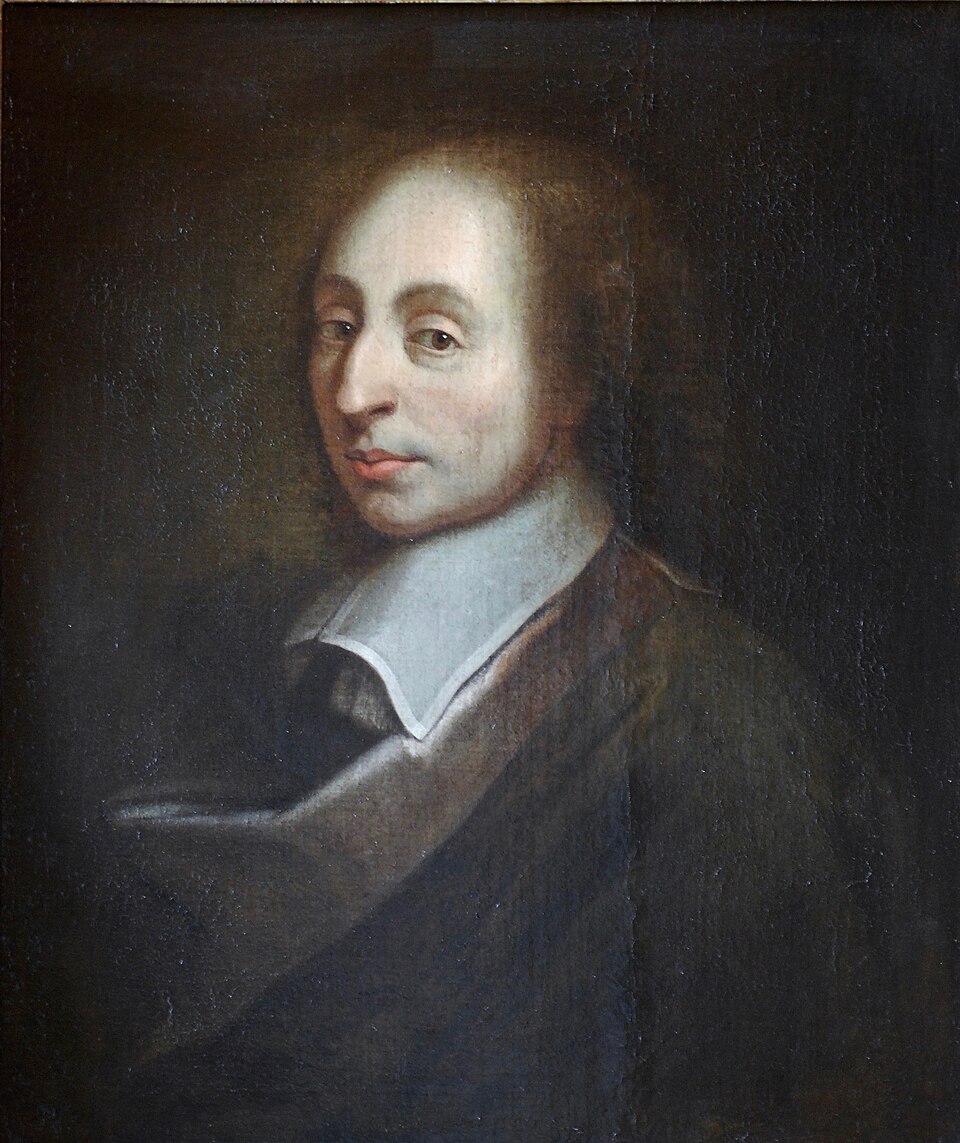
A mathematician who built one of the first mechanical calculators at nineteen, co-founded probability theory, and then turned the same analytical mind on the problem of faith.
Blaise Pascal compressed several careers into thirty-nine years. He was a calculating prodigy who built a working arithmetic machine as a teenager, a physicist who demonstrated the existence of atmospheric pressure and the vacuum, a mathematician who laid the foundations of probability theory, and a religious writer whose unfinished apology for Christianity has been read as philosophy, as literature, and as spiritual autobiography ever since it was assembled and published after his death.
Early life and the Pascaline
Pascal was born on 19 June 1623 in Clermont-Ferrand, in the Auvergne region of France. His mother died when he was three; he was educated at home by his father Étienne, a tax official and mathematician who believed that his son should not study mathematics before the age of fifteen, a prohibition Pascal circumvented by working out Euclidean propositions for himself on the floor of his room. By twelve he had reportedly rediscovered the first thirty-two propositions of Euclid independently.
At sixteen he wrote a significant treatise on conic sections, impressing the mathematician Gilles de Roberval and the philosopher René Descartes. Between 1642 and 1644, watching his father labour through the arithmetic demands of his tax work, Pascal designed and built one of the first functional mechanical calculators — the Pascaline — capable of performing addition and subtraction directly, with carry operations automated through interlocking gears. He produced roughly fifty machines; it remains one of the earliest mechanical computing devices.
Physics and the vacuum
In 1646 Pascal encountered the work of Evangelista Torricelli, who had demonstrated that mercury in an inverted tube is supported by atmospheric pressure. Pascal extended this line of inquiry with a series of experiments, most notably arranging for a barometer to be carried to the summit of the Puy de Dôme volcano in 1648. The mercury column dropped as altitude increased, confirming that atmospheric pressure varies with height and settling a long-standing dispute about whether a vacuum could exist. His Traité de l'équilibre des liqueurs and Traité de la pesanteur de la masse de l'air (both published posthumously) systematise his hydrostatic and atmospheric findings.
The unit of pressure in the International System of Units is named the pascal in his honour.
Probability theory
In 1654 the gambler and amateur mathematician Antoine Gombaud, known as the Chevalier de Méré, posed Pascal a series of questions about fair division of stakes in interrupted games of chance. Pascal corresponded with Pierre de Fermat about these problems, and the exchange produced the first systematic treatment of probability theory — laying the mathematical groundwork for actuarial science, statistical inference, and decision theory. Pascal also developed what is now called Pascal's triangle, a numerical array encoding binomial coefficients, which he explored in the Traité du triangle arithmétique (1654).
Conversion and the Pensées
In November 1654 Pascal underwent an intense religious experience, which he recorded on a scrap of parchment found sewn into his coat after his death. He entered the orbit of the Jansenist movement centred at Port-Royal and largely withdrew from scientific and mathematical work, devoting himself to religious writing. He wrote the Lettres provinciales (1656–57), a polemical defence of Jansenist theology against the Jesuits, celebrated for the clarity and wit of their French prose.
His projected apology for Christianity remained unfinished at his death. The fragments were assembled by his family and friends and published in 1670 as the Pensées. The text is a collection of numbered fragments ranging from brief notes to extended arguments, held together by the search for a foundation for religious commitment in the face of human wretchedness and uncertainty. The most famous argument in the Pensées — later called Pascal's Wager — proposes that if God's existence cannot be established by reason alone, the rational strategy is still to believe: if God exists and you believe, you gain everything; if God does not exist and you believe, you lose little. The argument has been analysed and contested continuously in the philosophy of religion.
Pascal died on 19 August 1662, after months of severe illness, at the age of thirty-nine.
The heart has its reasons, which reason does not know.