Brian Eno
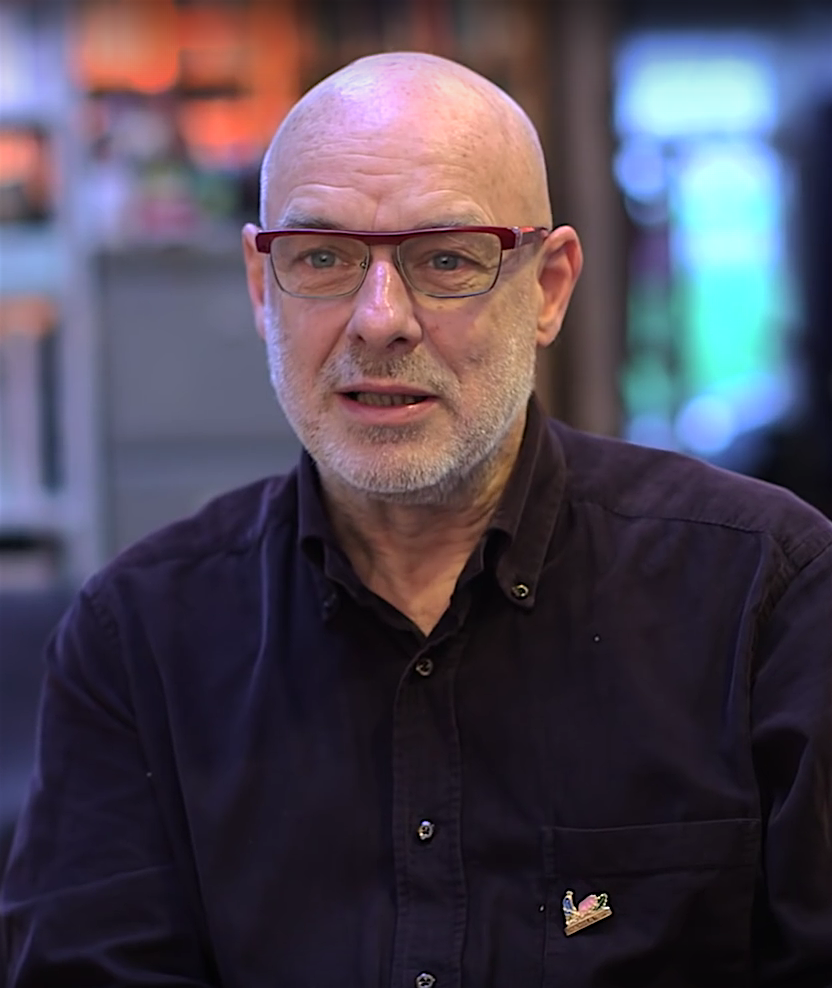
The English musician who invented ambient music, reinvented the record producer as creative agent, and changed how artists think about process.
Brian Eno studied painting, not music, and this background shaped everything that followed: a career built around systems, chance, process, and the idea that a record studio is itself a musical instrument. He coined the term "ambient music," produced some of the most commercially successful rock albums of the late twentieth century, and developed a philosophy of creativity — the "scenius" model of collective intelligence — that has influenced practitioners well beyond music.
Art School and Roxy Music
Eno studied at Ipswich Art School and Winchester School of Art in the late 1960s, encountering the ideas of John Cage and Cornelius Cardew, and developing an interest in avant-garde tape composition. He joined Roxy Music in 1971 as a non-playing synthesiser manipulator — famously describing himself as a "non-musician" — and his treatments of the band's sound gave their early albums their alien, disorienting edge. The tension between his experimental instincts and Bryan Ferry's more song-centred vision led to his departure in 1973, after two albums.
Solo Records and Ambient Music
The solo records that followed — Here Come the Warm Jets (1974), Taking Tiger Mountain (By Strategy) (1974), Another Green World (1975), Before and After Science (1977) — developed a mode of oblique, textural rock informed by tape experiments, and the collaborations with Robert Fripp (No Pussyfooting, 1973; Evening Star, 1975) established looping as a compositional method.1 The pivot to ambient music came in 1978 with Ambient 1: Music for Airports, an album designed to blend with and enhance any surrounding environment rather than demand attention. The liner note defining ambient music — that it must be as ignorable as it is interesting — became one of the most cited formulations in the history of recorded sound. Three further Ambient albums followed, and the series opened a space that is now occupied by an enormous range of music.
Production Work
Eno's productions are as significant as his solo recordings. Working with David Bowie on the Berlin trilogy — Low (1977), "Heroes" (1977), Lodger (1979) — he co-wrote material and shaped a sonic aesthetic that influenced post-punk and new wave for a decade. His productions for Talking Heads (More Songs About Buildings and Food, 1978; Fear of Music, 1979; Remain in Light, 1980) brought Afrobeat-influenced rhythmic complexity into downtown New York art-rock. Later, his work with U2 — from The Unforgettable Fire (1984) through to Achtung Baby (1991) and beyond — demonstrated his ability to operate within mainstream commercial structures without compromising a distinctly expansive approach to studio texture.
| Artist | Album | Year |
|---|---|---|
| David Bowie | Low | 1977 |
| Talking Heads | Remain in Light | 1980 |
| U2 | The Unforgettable Fire | 1984 |
| U2 | Achtung Baby | 1991 |
Systems, Process, and Legacy
With the artist Peter Schmidt, Eno published Oblique Strategies (1975), a card deck of aphoristic instructions designed to break creative deadlock — prompts such as "Use an old idea" or "What would your closest friend do?" The deck has been used in recording studios from its first edition to the present. Eno's lectures and essays articulated a concept of "scenius" — collective genius, the intelligence of a scene or community rather than the romantic individual — that has been widely adopted in thinking about innovation and creativity.
Ambient music must be able to accommodate many levels of listening attention without enforcing one in particular; it must be as ignorable as it is interesting.
Footnotes
- The looping technique Eno and Fripp used on No Pussyfooting employed two reel-to-reel tape machines set at different speeds to create slowly evolving textural layers — a method that anticipated the digital loop and sample culture of the 1990s. ↩