Claude Debussy
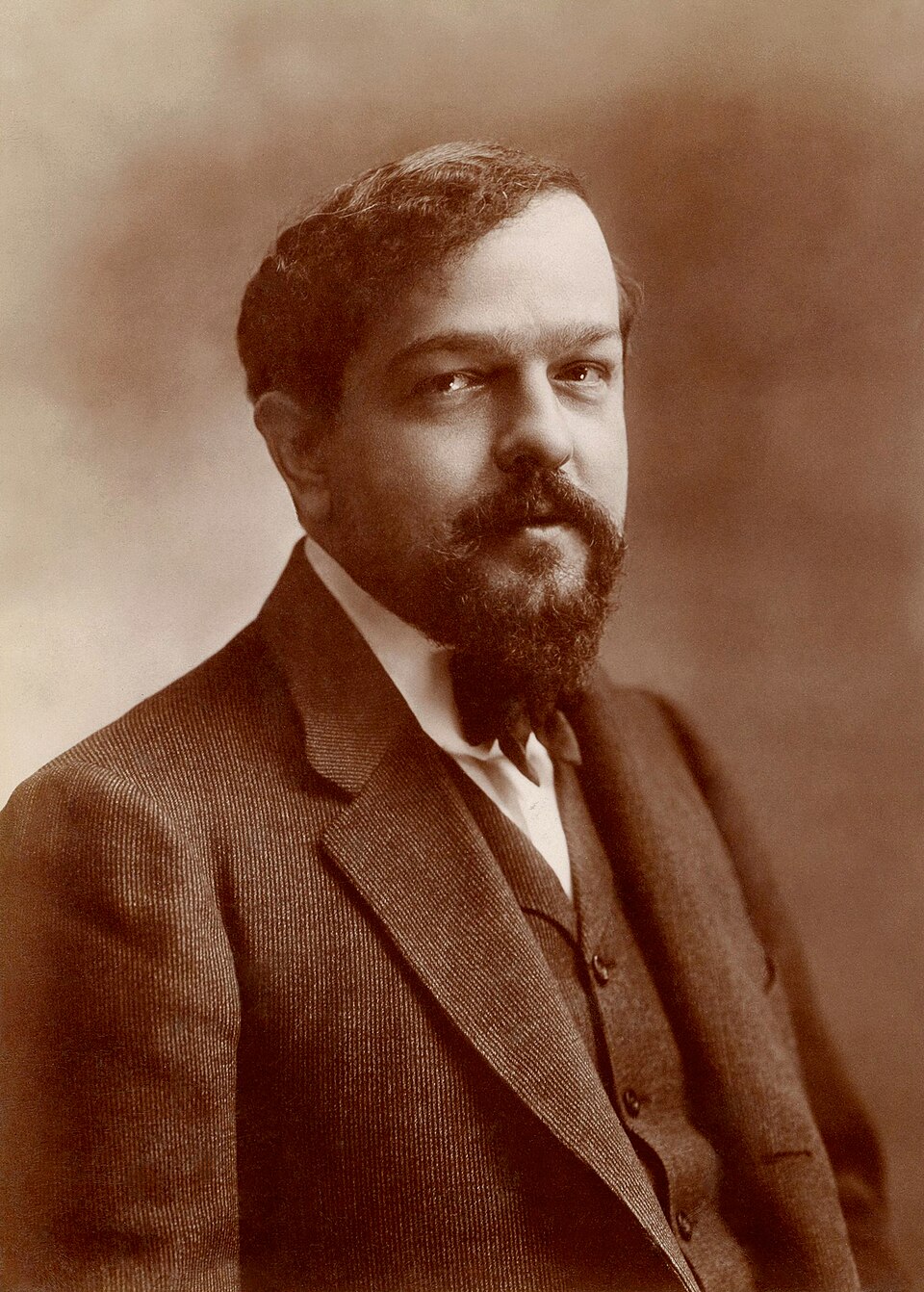
A composer who dissolved the harmonic certainties of the 19th century into colour and texture — then spent his career resisting the label critics pinned on the result.
Claude Debussy is the composer most responsible for breaking Western music free from the gravitational pull of Germanic harmony. He did it by treating chords as objects of colour rather than steps in an argument — and spent his career vigorously denying the "Impressionist" label critics used to describe the outcome.
Formation at the Conservatoire
Debussy entered the Paris Conservatoire at the age of ten, studying piano and later composition. He was an awkward, restless student — drawn to harmonic experiments that irritated his teachers — but talented enough to win a series of prizes. In 1884 he was awarded the Prix de Rome, the French state's highest musical honour for a student, which funded two years of study at the Villa Medici in Rome. He found Rome uninspiring and returned to Paris early, but the prize confirmed his standing.
The decisive outside influence came not from the academic curriculum but from the 1889 Paris Exposition Universelle, where Debussy encountered a Javanese gamelan ensemble. The interlocking metallophones and gongs, operating on pentatonic scales entirely outside European tradition, suggested to him that harmony could work through resonance and layering rather than tension and resolution. That lesson runs through virtually everything he wrote afterwards.
A new harmonic language
The orchestral prelude Prélude à l'après-midi d'un faune (1894), inspired by a poem by Stéphane Mallarmé, is the conventional marker of Debussy's mature voice arriving. The flute melody dissolves rather than develops; the harmony drifts through whole-tone and chromatic regions without ever resolving in the expected way. Conductor Pierre Boulez would later call it the beginning of modern music.1
The opera Pelléas et Mélisande (1902), after Maurice Maeterlinck's symbolist play, took ten years to compose and premiered to bewilderment and then acclaim. It is almost without conventional arias — the voices move in a kind of heightened speech over an orchestra that carries the emotional weight. La mer (1905), three orchestral sketches depicting the sea, pushed the same approach into pure instrumental form and remains the most performed of his orchestral works.
The piano writing
Debussy's piano music forms a body of work as significant as his orchestral output. Clair de lune, the third movement of the Suite bergamasque (composed c. 1890, published 1905), became his most widely recognised piece. The two sets of Préludes (1910 and 1913), twenty-four pieces in total, are his most ambitious piano project — each carries an evocative title placed after rather than before the score, so the music is heard before the image is named. Works from Images (Books I and II, 1905 and 1907) and Estampes (1903) extended the same approach, treating the piano as a resonating body rather than a percussive instrument.
Final years and legacy
Debussy was diagnosed with colorectal cancer in 1909 and his health deteriorated steadily. He continued composing through the early years of the First World War — works including the Études for piano (1915) and the three sonatas for various instruments — but died in Paris on 25 March 1918, while German shells were falling on the city. He was 55.
The "Impressionist" label he rejected so strongly stuck partly because it was useful and partly because critics had no better word for music that subordinated narrative logic to atmosphere. Composers from Ravel to Messiaen to the Japanese minimalists of the late 20th century drew directly on his example. His dissolution of functional harmony was, for better or worse, one of the load-bearing events of musical modernism.
I am trying to do something different — an effect of reality, of what I call reality in music. It is something the fools call Impressionism, a term employed as inaccurately as possible, especially by the critics.
Footnotes
- Boulez made this claim in several lectures and writings during the 1960s and 1970s; it became a standard reference point in 20th-century music historiography. ↩