Claudio Monteverdi
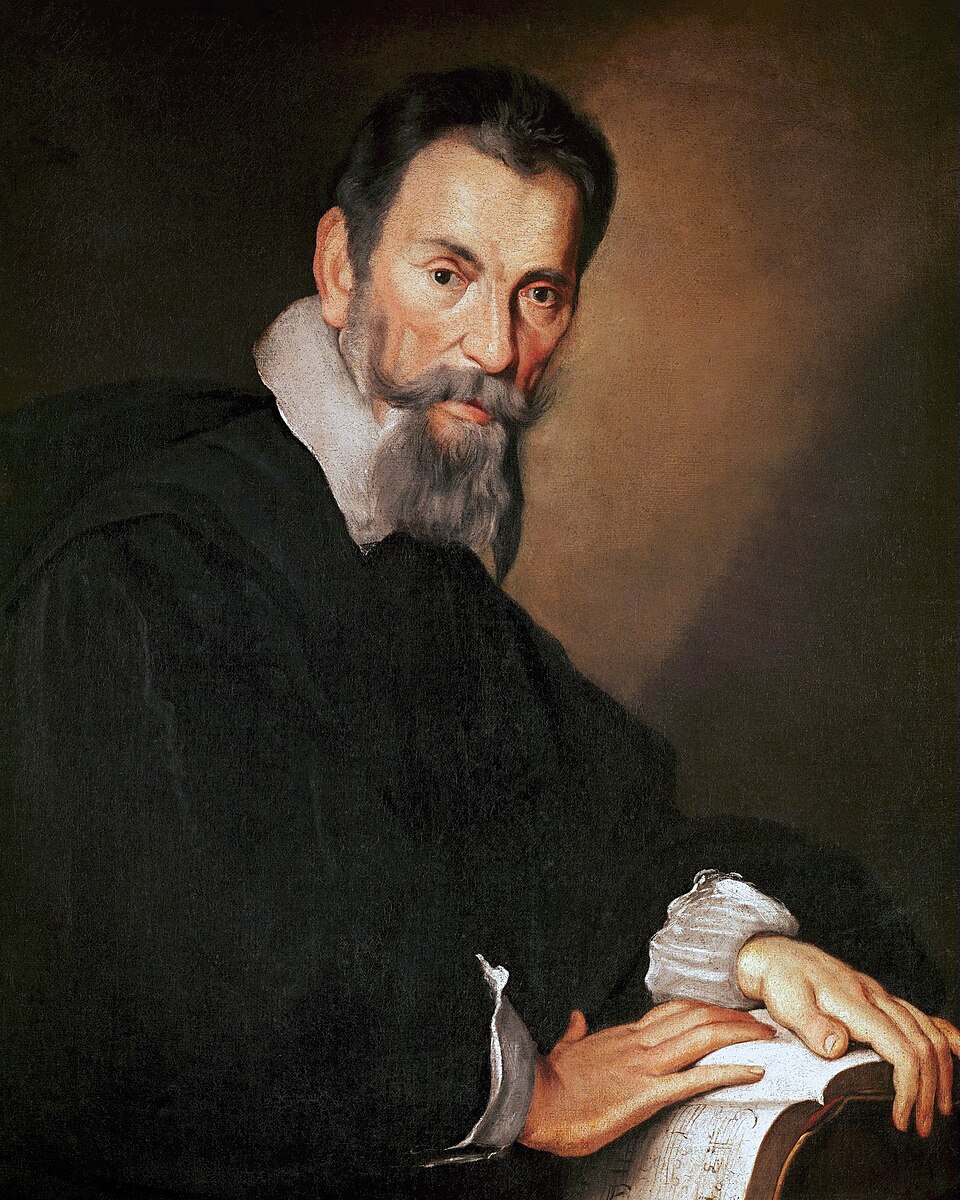
The Cremonese composer who wrote the first opera still regularly performed, served the Gonzaga court and then St Mark's Venice, and bridged the Renaissance madrigal tradition and the Baroque world that replaced it.
Claudio Monteverdi was active at one of the most consequential junctures in Western music — the passage from Renaissance polyphony to the Baroque forms that would dominate the next two centuries. He did not merely observe the transition; he drove it. In the madrigal he pushed chromaticism and emotional directness to extremes that outran his contemporaries and invited polemic; in opera, a form barely invented when he turned to it, he produced work of such theatrical and musical intelligence that it has survived in performance for more than four hundred years.
Cremona and early formation
Monteverdi was born in Cremona in 1567, in the Duchy of Milan, a city already distinguished by its instrument-making and musical culture. He studied under Marc'Antonio Ingegneri, maestro di cappella at the Cremona cathedral, a thorough training in counterpoint, sacred music, and the practical demands of liturgical composition.
His first published work — a collection of three-voice sacred pieces — appeared when he was fifteen. The first book of madrigals followed in 1587, when he was nineteen. Five further books of madrigals appeared before 1600, each demonstrating a restless refinement of technique and an increasing willingness to use dissonance and harmonic surprise for emotional rather than purely contrapuntal ends.
Mantua and the theatre of the emotions
Around 1590 Monteverdi entered the service of the Gonzaga court at Mantua, initially as a string player. He rose to become maestro della musica and remained in Mantuan service until the death of Duke Vincenzo I in 1612. The Gonzaga court was among the most musically ambitious in Italy, and the environment suited Monteverdi's ambitions.
The fourth and fifth books of madrigals (1603, 1605) generated controversy: the theorist Giovanni Maria Artusi published an attack on what he called the arbitrary use of unprepared dissonances. Monteverdi, through his brother Giulio Cesare, responded with a defence of what he called the seconda prattica — a second practice, in which the demands of text and emotional expression could override the strictures of established counterpoint. The exchange defined the aesthetic argument of the period.
In 1607, Monteverdi produced L'Orfeo, staged at the Gonzaga court during carnival. The Orpheus legend — musician descends to the underworld, negotiates for his dead wife, loses her through a backward glance — was well chosen: it gave music a mythological justification for its own powers. L'Orfeo deployed the full resources of the Mantuan court: a large instrumental ensemble, solo voices, chorus, and the nascent conventions of theatrical staging that the new form of opera required. It is the earliest opera still regularly performed.
The second practice I call modern, because it was recently discovered.
Venice: St Mark's and the late operas
After the Gonzaga court dismissed him following the Duke's death in 1612, Monteverdi was appointed maestro di cappella at St Mark's Basilica in Venice in 1613 — the most prestigious musical post in Italy. He held it for thirty years, composing sacred music in quantity, revising and expanding his madrigal output, and taking holy orders as a priest in 1632.
Venice had by the 1630s developed the world's first commercial opera houses, open to paying audiences rather than court guests. Monteverdi, now in his seventies, wrote for this new public context. Il ritorno d'Ulisse in patria (1640) and L'incoronazione di Poppea (1643) — the latter composed in the year of his death — represent a late style of extraordinary compression and dramatic intelligence. L'incoronazione is remarkable for its subject: not mythology but Roman history, not virtuous resolution but the success of ambition and desire over moral order.
Monteverdi died in Venice on 29 November 1643, a few months after the premiere of L'incoronazione.