Dmitri Shostakovich
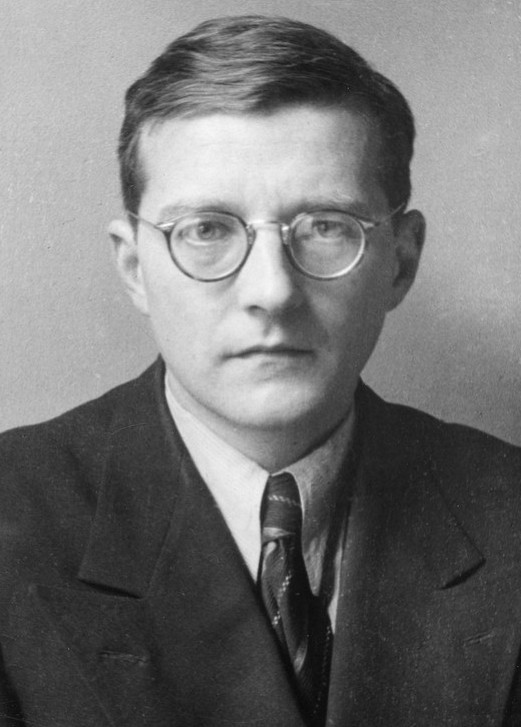
The Soviet composer who wrote music of devastating emotional directness under a regime that demanded he celebrate it — and found ways to mean more than he was permitted to say.
Dmitri Shostakovich composed fifteen symphonies and fifteen string quartets under a Soviet state that monitored, censured, and at times threatened him. The music he produced is among the most emotionally complex of the twentieth century — capable of passage between grandeur and desolation, between the apparently triumphant and the secretly devastated, often within a single movement.
Petrograd to international recognition
Shostakovich was born in Saint Petersburg in 1906, the son of an engineer. He entered the Petrograd Conservatory at thirteen, studying piano and composition. His First Symphony, completed as his graduation piece in 1925 and premiered the following year, was received as a major debut by international critics and conductors. He was twenty when it was performed; the work circulated rapidly through Europe and the United States and established him as a significant new voice in Western music.
The early years were productive and relatively unrestricted. His opera Lady Macbeth of the Mtsensk District, premiered in 1934, was initially acclaimed. Stalin attended a performance in January 1936, and shortly thereafter the Soviet newspaper Pravda published a denunciation of the opera as "Muddle instead of Music." The article, widely understood to be authorised by Stalin himself, threatened the composer's position and possibly his life.
Survival and the Fifth Symphony
Shostakovich withdrew his Fourth Symphony, already in rehearsal, before its premiere. In 1937 he produced his Fifth Symphony — a work that navigated the required language of Soviet heroism while, for many listeners, encoding something far more ambiguous in its forced triumphalism. Whether the Fifth's finale is genuine affirmation or ironic submission remains one of the central interpretive questions in twentieth-century music. The Soviet authorities accepted it; audiences around the world have heard it differently.
I think it is clear to everyone what happens in the Fifth. The rejoicing is forced, created under a threat, as in Boris Godunov. It's as if someone were beating you with a stick and saying, "Your business is rejoicing, your business is rejoicing."
This characterisation — drawn from Solomon Volkov's controversial memoir Testimony (1979), whose authenticity has been disputed — captures a reading of the symphony that many listeners arrive at independently of the attribution debate.
The war symphonies and late quartets
His Seventh Symphony, the "Leningrad," was composed partly during the German siege of the city and became an international symbol of Soviet resistance. His later symphonies — the Tenth (1953), completed after Stalin's death and widely read as an exorcism — and the chamber music of his final years moved increasingly inward: the Eighth String Quartet (1960), dedicated "to the victims of fascism and war," is among the most concentrated and sorrowful works in the chamber repertoire.