Edward Elgar
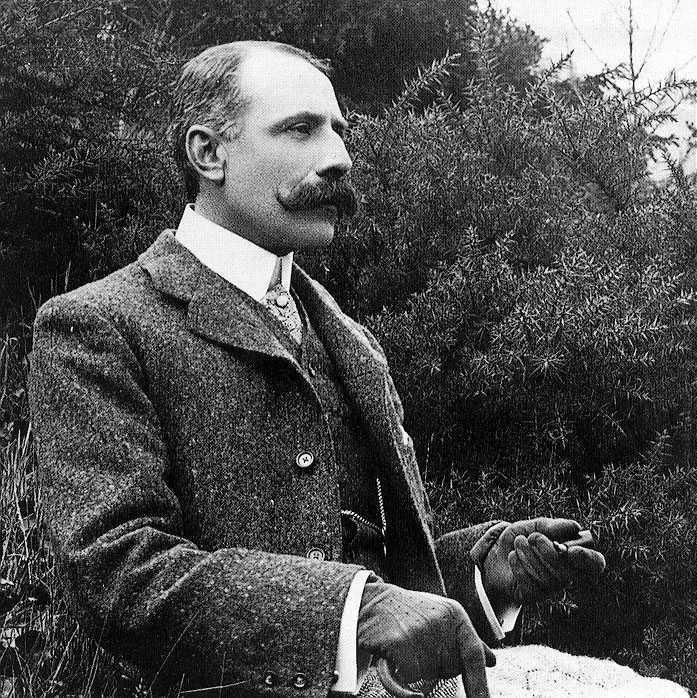
The self-taught English composer who emerged from provincial obscurity to become the voice of late-Victorian and Edwardian Britain — and then its most searching critic.
Edward Elgar was the most significant English composer between Purcell and Vaughan Williams — a largely self-taught musician from rural Worcestershire who reached the summit of the Edwardian musical establishment and then, after the death of his wife in 1920, fell effectively silent for the last fourteen years of his life. The tension between his public ceremonial manner and the introspective melancholy visible in his greatest works is the central paradox of his career.
A provincial formation
Elgar was born in 1857 in Lower Broadheath, a village west of Worcester. His father owned a music shop and was organist of St George's Roman Catholic Church in Worcester; Elgar grew up surrounded by music and largely taught himself composition, with some violin lessons. He failed to gain admission to the Leipzig Conservatory as a young man and instead took on whatever musical employment was available in and around Worcester: playing in local orchestras, conducting the Worcester County Lunatic Asylum band, teaching violin.
The breakthrough came late. A series of orchestral pieces and cantatas for the major English choral festivals attracted growing attention in the 1890s, but it was the Enigma Variations of 1899 that made him nationally famous overnight.
The Enigma Variations and choral works
The Variations on an Original Theme for Orchestra (Enigma Variations, 1899) is a set of fourteen character portraits of Elgar's friends and himself, each carrying initials or a pseudonym as its title. The theme they vary is itself described as a second enigma — a larger theme said to run through the work but never played — and the identity of that hidden theme has been debated without resolution ever since. The Ninth Variation, Nimrod, a slow swelling movement describing a conversation about Beethoven's slow movements, became the most recognisable passage and is now inseparable from British ceremonial life.
The Dream of Gerontius (1900), a setting of Cardinal Newman's poem for soloists, chorus, and orchestra, is the most sustained achievement of his choral period and is widely regarded as the finest English oratorio of its era.
I am still at heart the dreamy child who used to be found in the reeds by Severn side with a sheet of paper trying to fix the sounds and longing for something very great.
The symphonies and concertos
The First Symphony (1908) and Second Symphony (1911) established him as a major symphonist. The Violin Concerto (1910) and the Cello Concerto (1919) complete the major instrumental works. The Cello Concerto, premiered to general indifference, was reassessed after Jacqueline du Pré's celebrated recording in the 1960s and is now regarded as one of the finest works in the solo cello repertoire.
The Pomp and Circumstance Marches — five in total, of which the first (1901) carries the tune later set as Land of Hope and Glory — became the defining music of Edwardian imperial celebration and have remained inseparable from British ceremonial ever since, particularly as the processional for university graduation ceremonies in the United States.
Silence and late recognition
After his wife Alice died in 1920, Elgar composed little of significance. He was appointed Master of the King's Musick in 1924, created a Baronet in 1931, and received numerous other honours, but completed almost nothing. He died in Worcester in 1934 at seventy-six, leaving a Third Symphony unfinished — it was later completed by Anthony Payne from sketches and performed in 1998.