Ella Fitzgerald
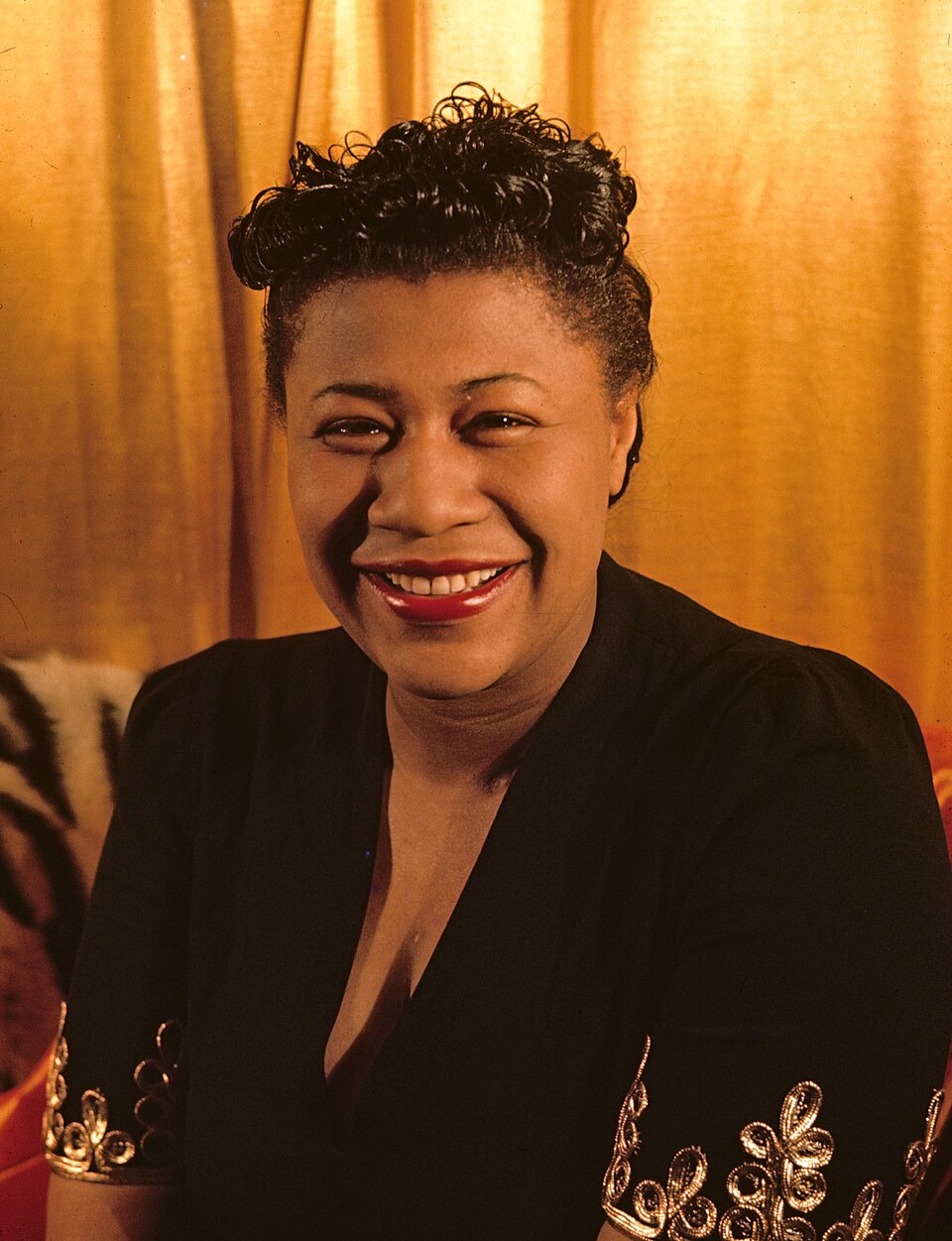
The First Lady of Song, whose purity of tone and boundless improvisational intelligence made her the defining voice in jazz for four decades.
Ella Fitzgerald possessed a voice of such clarity and precision that musicians compared it to a horn — capable of everything a brass or woodwind instrument could do and more, deployed in the service of an unfailing sense of swing. She won thirteen Grammy Awards, sold more than forty million records, and remained the standard against which jazz vocalists measured themselves across an entire career without a decline.
Harlem and the Amateur Night
Fitzgerald was born in Newport News, Virginia, in 1917 and raised in Yonkers, New York. Her early adolescence was turbulent — her mother died when she was fifteen, and she spent time in a reform school before ending up on the streets of Harlem. In 1934, on a dare, she entered the Amateur Night at the Apollo Theater intending to dance; she changed her mind and sang instead. She won first prize.
The bandleader Chick Webb heard about the contest, auditioned her, and offered her a position with his band. She was seventeen. Within two years she was the band's featured vocalist and one of the most recognised voices on 52nd Street.
Songbooks and the jazz canon
Webb died in 1939; Fitzgerald briefly led the band under her own name before embarking on a solo career. Her partnership with producer Norman Granz — who became her manager and founded Verve Records partly to record her — produced the work for which she is most remembered: the Songbook series.
Between 1956 and 1964 Fitzgerald recorded eight albums devoted to the work of specific American popular composers: Cole Porter, Rodgers and Hart, Duke Ellington, Irving Berlin, George and Ira Gershwin, Harold Arlen, Jerome Kern, and Johnny Mercer. The series was a critical and commercial success and effectively canonised the American Popular Songbook as a body of serious musical material.
It isn't where you came from; it's where you're going that counts.
Scat singing and improvisation
Fitzgerald's scat singing — wordless vocal improvisation using syllables — was among the most technically accomplished in jazz. Her 1960 live recording at the Zardi's Jazzland club in Hollywood demonstrated the range: she could sustain a phrase, vary its rhythm, and take it to a cadence with the logic of an instrumentalist rather than the emotive imprecision often tolerated in singers.
Her pitch was described by colleagues as virtually perfect — she could reproduce a chord tone or a passing note without noticeable deviation — and her intonation remained stable across a career that extended into the 1990s.
Legacy
Fitzgerald won thirteen Grammy Awards and received the Presidential Medal of Freedom in 1992. She was the subject of a Congressional Gold Medal awarded posthumously in 2024. Her influence on jazz vocalism has been foundational: the precision of her diction, her command of rhythm, and her ease across tempos from ballad to bebop set a standard that remains the reference point.