Erik Satie
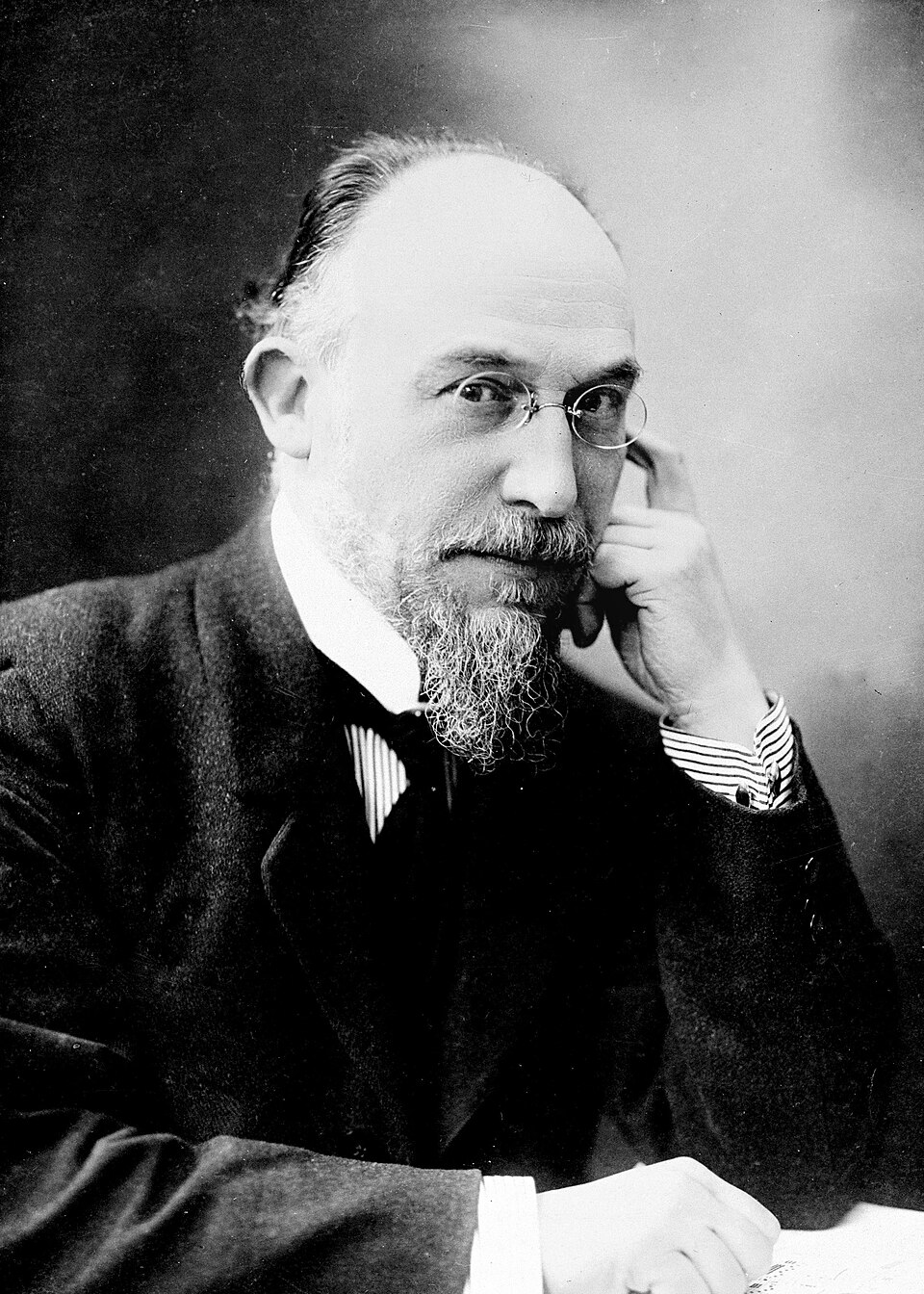
The French eccentric who stripped music down to its quietest essentials and, in doing so, invented the twentieth century's idea of ambient sound.
Erik Satie composed pieces so quiet and so stripped of development that contemporary audiences did not know what to do with them — and so did the twentieth century the favour of inventing minimalism, ambient music, and the idea that silence could be a compositional material, all before 1920.
Origins and the Conservatoire
Eric Alfred Leslie Satie was born in Honfleur, Normandy, in 1866, the son of a French father and a British mother. His mother died when he was six; he was sent to live with paternal grandparents in Honfleur before returning to Paris. He entered the Paris Conservatoire in 1879 but performed poorly — his professors described him as gifted but idle — and he did not graduate. He later re-enrolled in his forties to study counterpoint and fugue under Albert Roussel at the Schola Cantorum, a gesture of self-correction that surprised those who assumed he had transcended formal training.
Montmartre and the early piano works
In the 1880s Satie found work playing piano in the café-cabarets of Montmartre, an environment that shaped his taste for terse, repetitive, non-developing music. Between 1887 and 1895 he composed the works that would eventually make his name: three Gymnopédies (1888), three Gnossiennes (1890–1893), and a body of shorter piano pieces that stripped out the harmonic progression and developmental rhetoric of German Romanticism in favour of static, hovering chords.
The Gymnopédies were slow, modal, unresolved. They made no argument and stated no thesis. Claude Debussy, who orchestrated two of them in 1896, recognised something genuinely new in the approach.
He was briefly attached to a Rosicrucian sect in the 1890s, composing music for their rituals — an episode that fed his taste for strange, archaic-sounding harmonies.
We want to establish a music which would be like furniture — a music that is part of the surrounding noises and takes them into account.
Later work and musique d'ameublement
From the 1910s Satie became associated with the Parisian avant-garde — with Jean Cocteau, with the group later called Les Six, and with Erik Satie's performance of absurdity as a public posture. His scores became littered with ironic performance directions ("like a nightingale with a toothache") and typographical jokes that functioned as art objects independent of performance.
His 1917 ballet Parade, with a scenario by Cocteau, sets by Picasso, and choreography by Massine, brought the Ballets Russes scandal of that season. The music incorporated typewriter and foghorn sounds alongside the orchestra.
Most prophetically, he coined the concept of musique d'ameublement — "furniture music" — music designed to be ignored, to fill a room as wallpaper fills a wall. Performed in 1920 and reported to have been listened to rather than ignored by the audience (Satie circulated telling people not to listen), it is the direct ancestor of ambient music and Muzak.