Francis Kéré
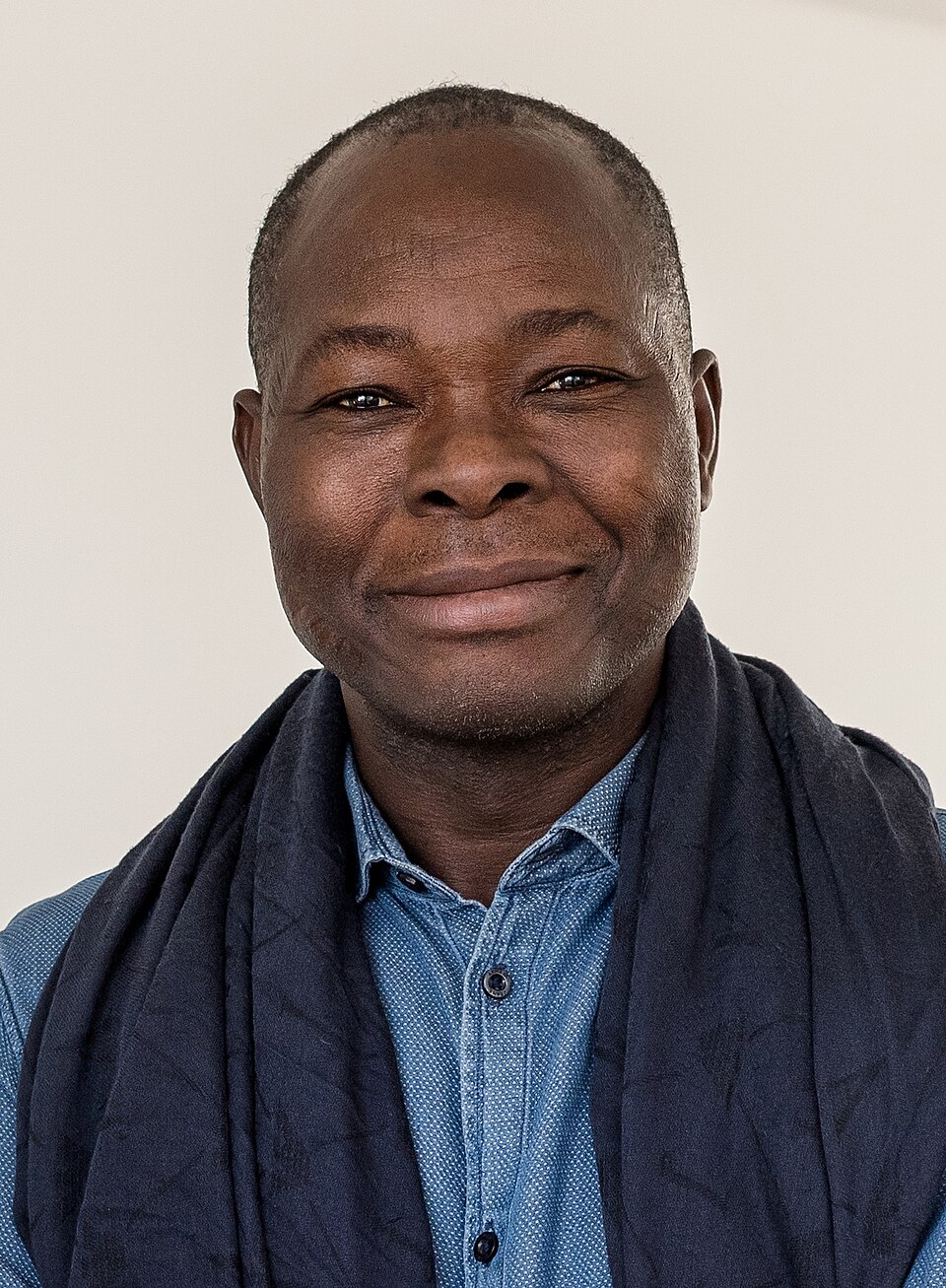
The architect from a village with no electricity who built his school by hand — then remade the terms on which African practice is recognised worldwide.
Diébédo Francis Kéré grew up in Gando, a village in southern Burkina Faso without electricity or running water. He left for Germany on a scholarship, trained as a structural engineer, then an architect, and built his first project — a primary school for his home village — by organising the community to make and lay every compressed-clay brick themselves. That building won the Aga Khan Award for Architecture in 2004. In 2022, the Pritzker Architecture Prize named him its laureate, the first native African to receive the honour.
Formation
Kéré arrived in Berlin in 1985 on a development scholarship from Burkina Faso's government. He studied carpentry before enrolling at the Technische Universität Berlin, where he trained in architecture and structural engineering. Parallel to his studies, he established the Kéré Foundation — a fundraising and community-development vehicle that would finance the Gando school and subsequent projects back home.
The foundation model was not incidental to the architecture: it embedded community ownership and local labour into the construction process from the outset, making participation a structural condition rather than an afterthought.
Method and material
Kéré's practice is built on a specific material logic adapted to the climate and economy of West Africa. His primary materials are compressed clay brick — durable, locally sourceable, thermally massive — and corrugated steel, used for wide, raised roof canopies that draw hot air upward and away from the inhabited space below. The gap between heavy wall and light roof is the project's cooling system: no mechanical plant required.
This passive cooling strategy, developed for the Gando school, has been refined across subsequent commissions. It allows buildings to remain habitable through temperatures that would defeat air-conditioned structures dependent on unreliable grid electricity. The approach is simultaneously climatic pragmatism and an argument about what sustainable architecture actually means in contexts where energy is scarce.
Community labour is a consistent feature. Kéré's teams train local workers on site — typically people with no prior construction experience — which both holds costs down and transfers skills that outlast the building itself.
Practice and recognition
In 2005, Kéré founded Kéré Architecture in Berlin. The office has since completed projects across Burkina Faso, Mali, Mozambique, Sudan, and Germany, as well as major temporary and institutional commissions in Europe and North America.
His 2017 Serpentine Pavilion in London — an indigo-blue canopy structure evoking the communal tree beneath which village life is conducted in the Sahel — brought his spatial thinking to a broad international audience. The National Assembly of Burkina Faso in Ouagadougou, an ongoing commission, extends his public-architecture ambitions to national civic scale.
The 2022 Pritzker Prize citation noted his ability to reconcile scarcity with dignity, local tradition with structural innovation, and individual authorship with collective process. He was the forty-ninth laureate and the first born on the African continent.
He has consistently crafted buildings that are both beautiful and functional, humble and innovative — solving the challenges of extreme heat, scarce resources and lack of skilled labour with simple and sustainable means.