Frank Gehry
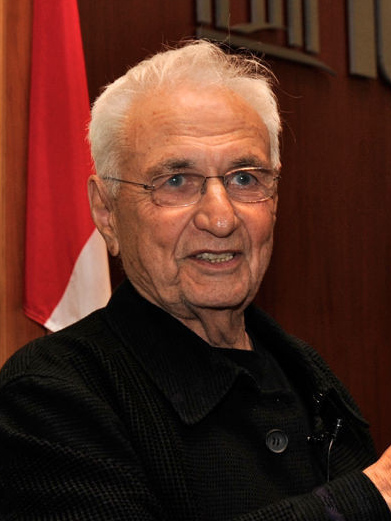
The architect whose corrugated metal, chain-link, and titanium-clad forms redrew what a building could be and, with one museum in Bilbao, helped revive an entire regional economy.
Frank Gehry spent the first half of his career as a competent but unremarkable Californian architect before a remodelling of his own Santa Monica home in 1977 announced a wholly different sensibility — one that treated the building process itself as subject matter, exposing raw materials and unfinished edges as an aesthetic declaration. The second half of his career produced a sequence of sculptural monuments that made him the most famous architect in the world and generated a vocabulary others have spent decades struggling to assimilate.
Formation and the Santa Monica house
Born Frank Goldberg in Toronto in 1929, Gehry emigrated to Los Angeles as a teenager. He studied architecture at the University of Southern California and then briefly at Harvard's Graduate School of Design, before building a practice in Los Angeles through the 1960s and early 1970s on commercial and institutional work. The transformation came with the renovation of his own house in Santa Monica (1977–78): he wrapped an ordinary Dutch Colonial in chain-link fencing, exposed plywood, and corrugated metal, leaving the original house legible inside the new envelope. The building was scandalous in its neighbourhood and revelatory in the profession.
Through the 1980s Gehry developed the language further, working in fish forms, exploded geometries, and clashing materials. His friendship with artists — Claes Oldenburg, Jasper Johns, Richard Serra — drew him toward contemporary art's formal freedom; his use of aerospace digital modelling software, first applied systematically to the Fish Sculpture for the Barcelona Olympics (1992), gave him the tools to realise what his sketches proposed.
Bilbao and the cultural building as urban catalyst
The Guggenheim Museum Bilbao (1997) became an instant landmark — not only for its curving titanium cladding and vertiginous interior spaces, but for what it did to the city around it. Bilbao, a declining industrial port, saw tourism surge dramatically in the years following the museum's opening.1 The phrase "the Bilbao effect" entered planning discourse to describe the use of a signature cultural building as a tool of urban regeneration — an idea, influential and subsequently much debated, that Gehry's building embodied more powerfully than any other.
The museum's atrium — a 50-metre-high canyon of curving steel — is among the most extraordinary interior volumes built in the 20th century. The galleries themselves, necessarily orthogonal, are tucked behind the sculptural skin; Gehry's spatial drama occurs primarily in the transitional and circulation spaces.
Method and material
Gehry works from hand sketches — crumpled paper and rapid charcoal marks — that are then interpreted by collaborators using CATIA software originally developed for aircraft design. The digital models allow double-curved surfaces to be resolved into constructable panels. His office, Gehry Partners, has developed considerable expertise in managing the fabrication complexity that his forms require.
| Building | Location | Completed |
|---|---|---|
| Guggenheim Museum Bilbao | Bilbao, Spain | 1997 |
| Walt Disney Concert Hall | Los Angeles | 2003 |
| Louis Vuitton Foundation | Paris | 2014 |
| Jay Pritzker Pavilion | Chicago | 2004 |
The Walt Disney Concert Hall in Los Angeles (2003) is the complement to Bilbao: where the Guggenheim is a museum wrapped in spectacle, Disney Hall is a concert hall of genuine acoustic excellence (designed with acoustician Yasuhisa Toyota) wrapped in stainless steel. The tension between performance and image is resolved more successfully here than in many of Gehry's cultural buildings.
Legacy
The Pritzker Prize, awarded in 1989, recognised Gehry before Bilbao, which suggests that the profession understood his importance before the public did. His influence is felt most in the licence his work gave to formal experiment — a generation of architects used his example to justify sculptural buildings that do not always share his compositional discipline. The risk is that "the Gehry effect" produces gesture without rigour; at his best, Gehry's buildings are both striking and precise.
Architecture should speak of its time and place, but yearn for timelessness.
Footnotes
- The scale of the economic impact became the subject of substantial academic study; the Basque government reported that the museum generated significant tax revenues within its first years of operation, repaying construction costs ahead of schedule. ↩