Frédéric Chopin
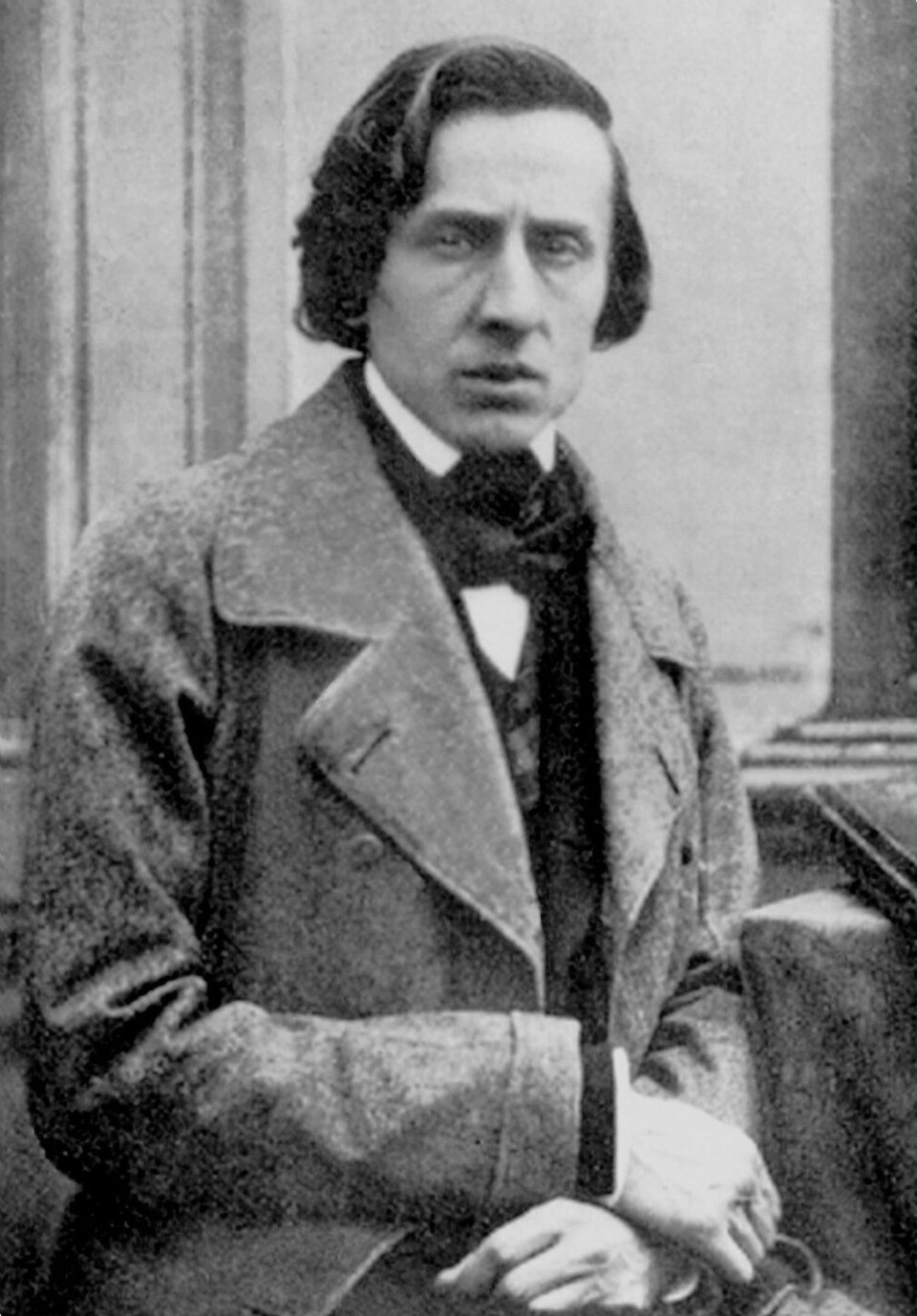
The Polish-French composer who made the solo piano the vessel for the most concentrated expression in Romantic music, producing forms — the nocturne, the ballade, the étude — that remain central to the repertoire.
Frédéric Chopin composed almost exclusively for solo piano, and in doing so elevated the instrument to a vehicle for the innermost experience. His output — nocturnes, études, preludes, mazurkas, polonaises, ballades — was never large in scale and always exacting in craft. He performed rarely in public, preferring the intimacy of Parisian salons, and died at thirty-nine with a catalogue that has not left the repertoire since.
Origins and formation
Frédéric François Chopin was born on 22 February 1810 in Żelazowa Wola, in the Duchy of Warsaw, to Nicolas Chopin, a French émigré who had settled in Poland, and Justyna Krzyżanowska. The family moved to Warsaw shortly after his birth, and he showed exceptional musical ability as a child. He studied at the Warsaw Conservatory under Józef Elsner, who recognised that his pupil's gifts would not be served by the standard curriculum and left him largely free to develop his own voice.
Chopin gave his first public concert in Warsaw at eight years old. By his early twenties he had composed works — including the two piano concertos and several sets of études — that already bore the harmonic complexity and melodic originality that would define his mature style.
Paris and the salon world
In 1830, Chopin left Warsaw for a concert tour that was meant to establish his European reputation. The November Uprising in Poland cut off his return, and he settled in Paris in 1831. He never saw Poland again. In Paris he moved quickly into the highest cultural circles — he counted Liszt, Berlioz, Delacroix, and Heinrich Heine among his acquaintances — but he chose to earn his living primarily through teaching aristocratic pupils rather than through public performance.
His preference was for the salon: small rooms, candlelight, audiences of fifty at most. In these conditions he could shape a phrase at the pianissimo level he regarded as essential and which the large concert hall would have swallowed. He gave perhaps thirty public recitals in his lifetime, a figure strikingly low for a composer of his standing.
George Sand and the creative years
In 1837 Chopin met the novelist George Sand (Amantine Lucile Aurore Dupin). Their relationship lasted a decade and was among the most productive of his life. He spent summers at her estate at Nohant in the Berry region of France, where the stability of the routine and the distance from Paris allowed sustained composition. Many of the mature nocturnes, the Ballade No. 3, the Polonaise-Fantaisie, and the Piano Sonata No. 3 were written or completed at Nohant.
The relationship deteriorated through 1846 and 1847, partly over a dispute involving Sand's children, and they separated acrimoniously. Chopin's health, already compromised by tuberculosis, declined sharply afterward.
Final years and death
Chopin undertook a tour of Britain and Scotland in 1848, performing in London, Manchester, Edinburgh, and Glasgow under conditions of considerable physical strain. He returned to Paris in November 1848, too ill to teach or compose. He died on 17 October 1849 at his apartment on the Place Vendôme. His funeral at the Madeleine drew a congregation of three thousand; Mozart's Requiem was performed at his request. He was buried at Père Lachaise cemetery, though his heart — at his instruction — was removed and taken to Warsaw, where it remains interred at the Church of the Holy Cross.
His poetic genius was based on a professional technique that was without equal in his generation.