George Frideric Handel
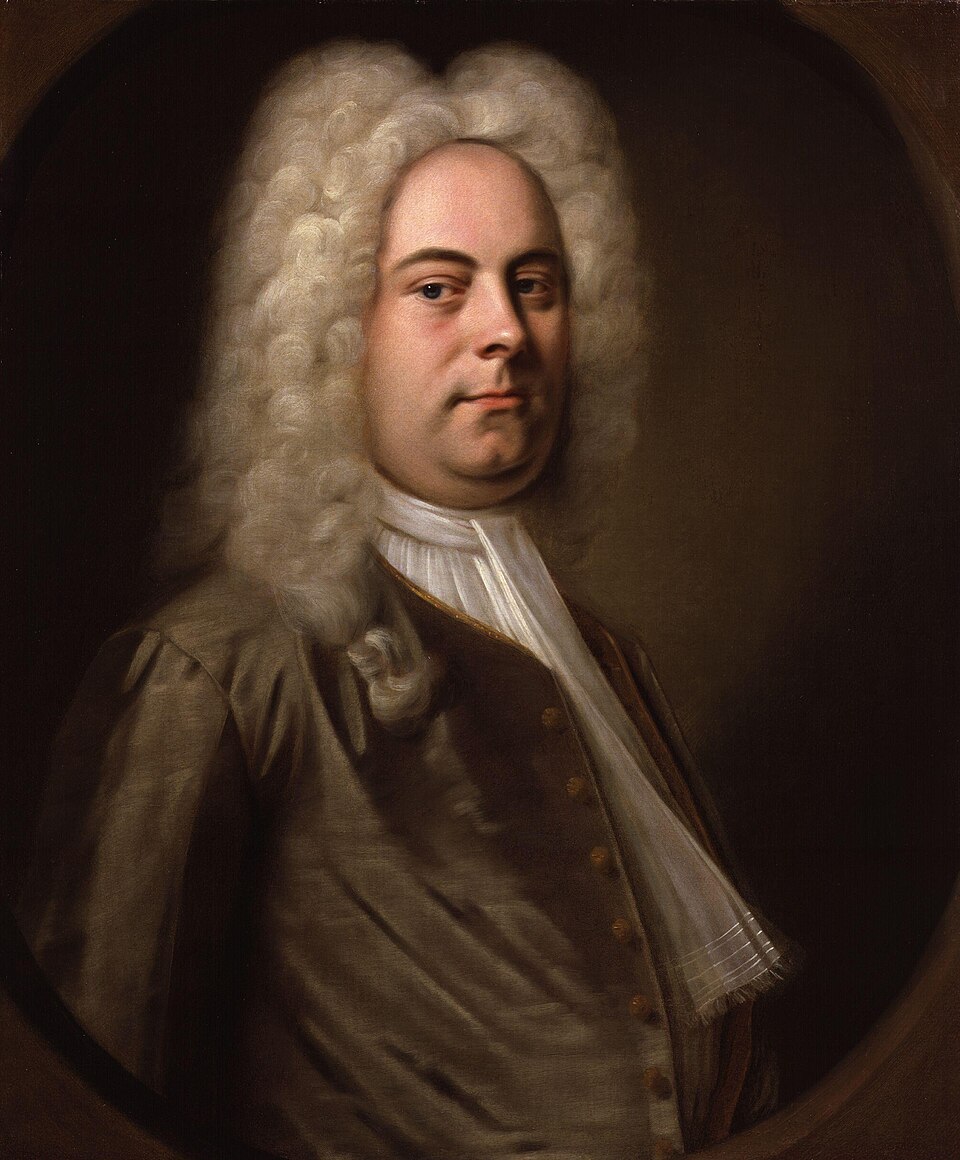
The German-born composer who moved to London, became British, and wrote the most performed oratorio in the Western canon — a body of work so embedded in English cultural life that his death was mourned as a national event.
George Frideric Handel arrived in London in 1712 as a German composer on a temporary visit and never left. In the following four decades he transformed English musical culture, invented a genre — the English oratorio — that outlasted the Baroque opera he had come to write, and produced in the Messiah a work performed continuously from its premiere to the present day. He was buried in Westminster Abbey with state honours, having become more thoroughly English, in the public estimation, than many who were born there.
Halle, Hamburg, and Italy
Handel was born in Halle on 23 February 1685, the same year as Johann Sebastian Bach and Domenico Scarlatti — a fact that marks 1685 as one of the more improbable years in European music history. His father, a barber-surgeon, opposed a musical career; Handel is said to have practised secretly as a child. He studied under Friedrich Wilhelm Zachow, the organist at the Marktkirche in Halle, who gave him a thorough training in counterpoint, harmony, and the organ.
In 1703 Handel moved to Hamburg, then Germany's most active operatic city, where he played violin and harpsichord in the opera orchestra and produced his first operas. In 1706 he went to Italy — Florence, Rome, Naples, and Venice — where he absorbed Italian operatic and sacred music at its source, met Arcangelo Corelli, and produced works that brought him to the attention of the Italian aristocracy. His oratorio La Resurrezione was performed in Rome in 1708 with lavish forces; his opera Agrippina, staged in Venice in 1709, ran for over twenty performances.
London and the Royal Academy of Music
In 1710 Handel was appointed Kapellmeister to the Elector of Hanover. He obtained immediate leave to travel, went to London, produced an opera there, and returned to Hanover. In 1712 he returned to London on further leave and simply stayed — a professional choice that proved prescient when, in 1714, the Elector of Hanover became King George I of Great Britain, transforming Handel's awkward position into a natural one.
In 1719 Handel helped found the Royal Academy of Music — not a school but an opera company — with the aim of establishing Italian opera seria in London on a permanent institutional basis. He served as music director and composed dozens of operas for it over the following decade. The venture was commercially precarious: the company folded in 1728, revived, and collapsed again. But the operas produced in that period — Giulio Cesare (1724), Rodelinda (1725), Orlando (1733) — are among the finest in the genre.
I should be sorry if I only entertained them. I wished to make them better.
Water Music and Fireworks Music
Handel's relationship with the monarchy was close and productive. The Water Music (1717), a suite of orchestral pieces performed on a barge on the Thames for George I, became one of the most celebrated public musical events of the early eighteenth century. The Music for the Royal Fireworks (1749), composed for a celebratory display in Green Park marking the Peace of Aix-la-Chapelle, was rehearsed publicly in Vauxhall Gardens before an audience reportedly exceeding twelve thousand people.
In 1727 Handel became a British subject by act of naturalisation, and composed the Coronation Anthems for the coronation of George II, including Zadok the Priest — performed at every British coronation since.
The oratorio and the Messiah
As Italian opera lost favour with London audiences in the 1730s, Handel pivoted to a form he had explored occasionally but not systematically: the English oratorio, a large-scale dramatic work for soloists, chorus, and orchestra on a biblical text, performed in concert rather than staged. The shift was pragmatic but the results were decisive.
Messiah was composed in approximately three weeks in August and September 1741 and premiered in Dublin on 13 April 1742 — chosen for its Irish premiere partly because London was associated with his operatic difficulties. The response was immediate and sustained. Messiah entered the London repertoire the following year and has not left it.
Handel went blind in 1751 but continued to perform and oversee performances. He died on 14 April 1759 and was buried in Westminster Abbey, with a monument by Roubiliac. He left his estate to a range of beneficiaries including the musicians' charity the Fund for the Support of Decayed Musicians.