Gioachino Rossini
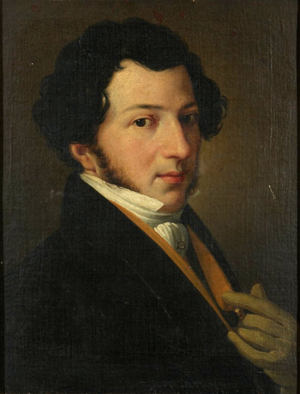
The prodigious Italian who set new standards for both comic and serious opera before retiring from public composition at thirty-seven, at the height of his fame.
Gioachino Rossini wrote thirty-nine operas before he turned thirty-eight and then stopped — not from failure but from the opposite. At the peak of his European fame, after the triumphant premiere of Guillaume Tell in Paris, he simply withdrew from large-scale composition. The reasons have been debated ever since; the fact is not. He spent his remaining four decades as a celebrated host, gourmet, and occasional composer of small-scale pieces he called his Péchés de vieillesse.
Early career
Rossini was born in Pesaro on 29 February 1792 to parents who were both musicians — his father a horn player, his mother a singer. He was composing operas by his late teens, and his first major success came in 1813 when he was twenty-one: Tancredi and L'italiana in Algeri both premiered that year. L'italiana established his voice in comic opera — fast-moving, irresistible, with the accelerating ensemble finales that became his signature.
By 1816 he had produced Il barbiere di Siviglia (The Barber of Seville), adapted from Beaumarchais. Its premiere was disastrous — the audience hostile, stage mishaps numerous — but subsequent performances confirmed it as a masterpiece of comic opera. It remains so.
Style and innovation
Rossini's comic operas are distinguished by the crescendo that now bears his name: a passage that repeats a phrase while adding instruments and raising volume in graduated steps until the whole orchestra is at full force. His contemporaries found it irresistible to the point of cliché; later composers — Beethoven among them — were less tolerant of the trick. His serious operas, including Semiramide (1823), demanded exceptional coloratura singing and redefined what the voice could be asked to do.
His move to Paris in the 1820s introduced a grander scale. Guillaume Tell (1829), his final opera, runs nearly four hours and contains music of a kind he had not written before — notably the overture, whose storm and pastoral sequences entered the popular consciousness far beyond the opera house.
Give me a laundry list and I will set it to music.
Retirement and later years
Rossini retired from opera after Guillaume Tell without public explanation. He suffered episodes of what appears to have been depression, complicated by poor health, and spent years in virtual seclusion. He eventually settled in Paris, where his Saturday evening gatherings became one of the city's most coveted social events. The small piano pieces and songs he composed in his later years — collected as Péchés de vieillesse (Sins of Old Age) — show his wit undiminished: they are named with elaborate comic titles and aimed at private amusement rather than the opera house.
Legacy
Rossini's operas are performed in every major house; Il barbiere di Siviglia in particular has never left the repertoire. His influence on the technique of comic opera — the ensemble finale, the accelerating crescendo, the precise comic timing of the accompanied recitative — shaped Donizetti, Bellini, and the young Verdi.