Giuseppe Verdi
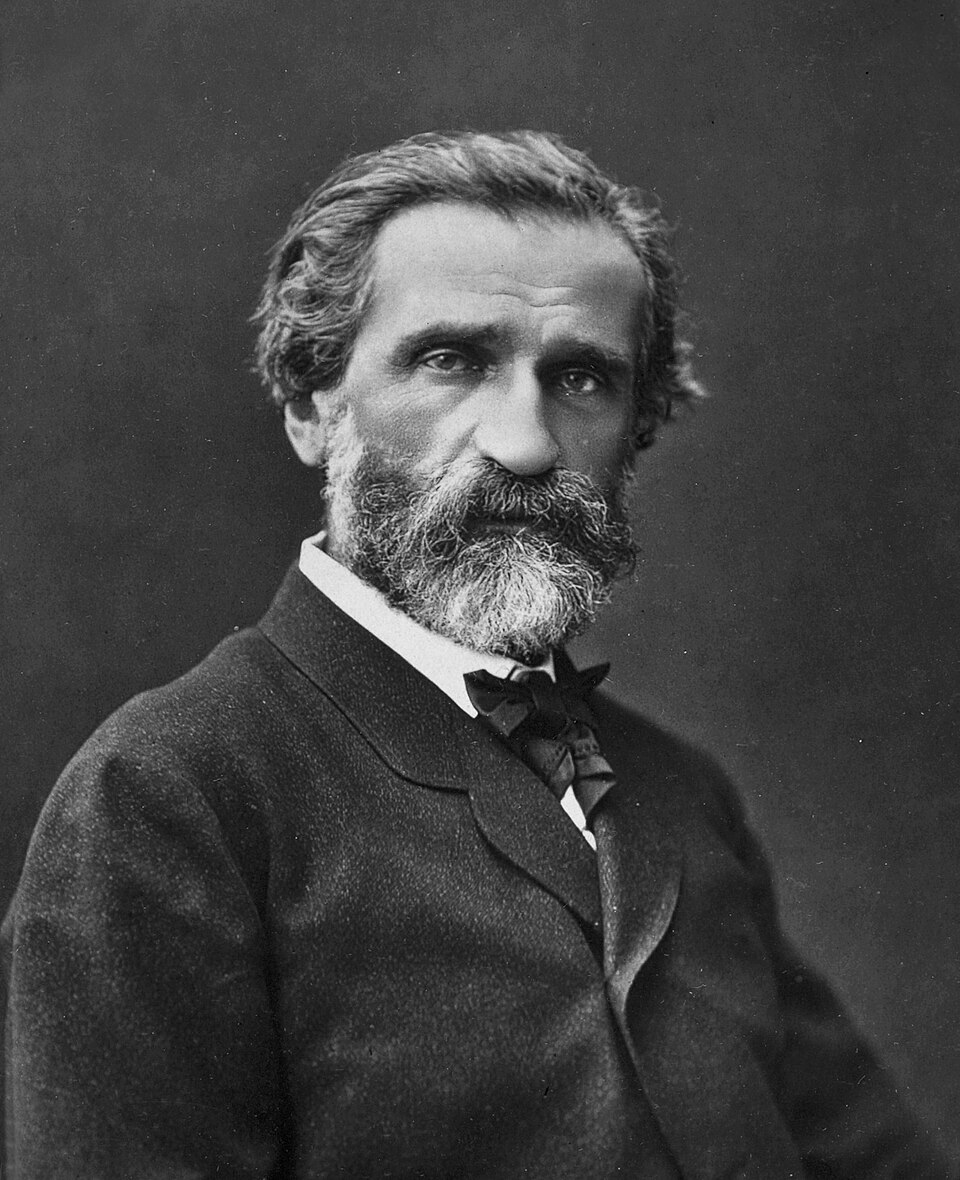
The Italian opera composer who made human drama the measure of every musical choice, from the political urgency of his middle works to the Shakespearean precision of his last.
Giuseppe Verdi dominated Italian opera for half a century, and then, in his late seventies, wrote two Shakespearean operas — Otello and Falstaff — that exceeded everything that had come before. His career traced an arc from the muscular patriotic drama of his early works through the psychological refinement of the middle trilogy to a final decade of concentrated mastery, proving that artistic development need not stop at any age.
Origins and early life
Verdi was born in 1813 in Le Roncole, a village near Busseto in what was then the Duchy of Parma. His father kept a tavern; the family was of modest means. His musical education was supported by Antonio Barezzi, a local merchant and music lover who became his patron, father-in-law, and lifelong friend. Verdi applied to the Milan Conservatory and was rejected — a slight he did not forget — and instead studied privately in Milan with Vincenzo Lavigna.
His early career was marked by personal tragedy: within three years, his two children and his first wife died. Out of that grief came Nabucco (1842), his third opera, which became an immediate sensation — the chorus "Va, pensiero," a lament of Hebrew slaves in Babylonian captivity, was heard by the Milan audience as a commentary on Italian subjugation and encored on the night.
The middle period
The 1850s brought what critics call the middle trilogy: Rigoletto (1851), Il trovatore (1853), and La traviata (1853). Each is a study in an outsider pressed by society toward destruction. Rigoletto — adapted from Victor Hugo — is built on a curse; La traviata — adapted from Dumas fils — places a consumptive courtesan at its centre. Both were controversial on moral grounds and both became the most performed operas in the repertoire. Verdi's gift was to make the dramatic situation determine the musical form: recitative, aria, and ensemble are not separate genres he moves between but a continuous expressive fabric.
Let us copy nature faithfully, but not disdain to look for it in beautiful and noble forms.
Late mastery
After Aida (1871) and the Requiem (1874), Verdi fell largely silent for over a decade. He returned with Otello in 1887, collaborating with the librettist Arrigo Boito to produce the most closely integrated Italian opera yet written — every bar of music grows from Shakespeare's characters. Four years later, at seventy-nine, he wrote Falstaff, his only comic opera since Un giorno di regno and a work that achieves the rarest thing: it is simultaneously the summation of an entire operatic tradition and a departure from it, ending with a fugue — all the world's a jest — that closes the book on the nineteenth century in music.
Legacy
Verdi's operas form the backbone of the international repertoire; no composer's works are performed in opera houses more often. His influence on operatic dramaturgy — the insistence that music must serve character and dramatic situation — shaped everyone who followed, including Puccini. He used his considerable fortune to fund a home for retired musicians in Milan, the Casa di Riposo per Musicisti, which continues to operate.