Gordon Parks
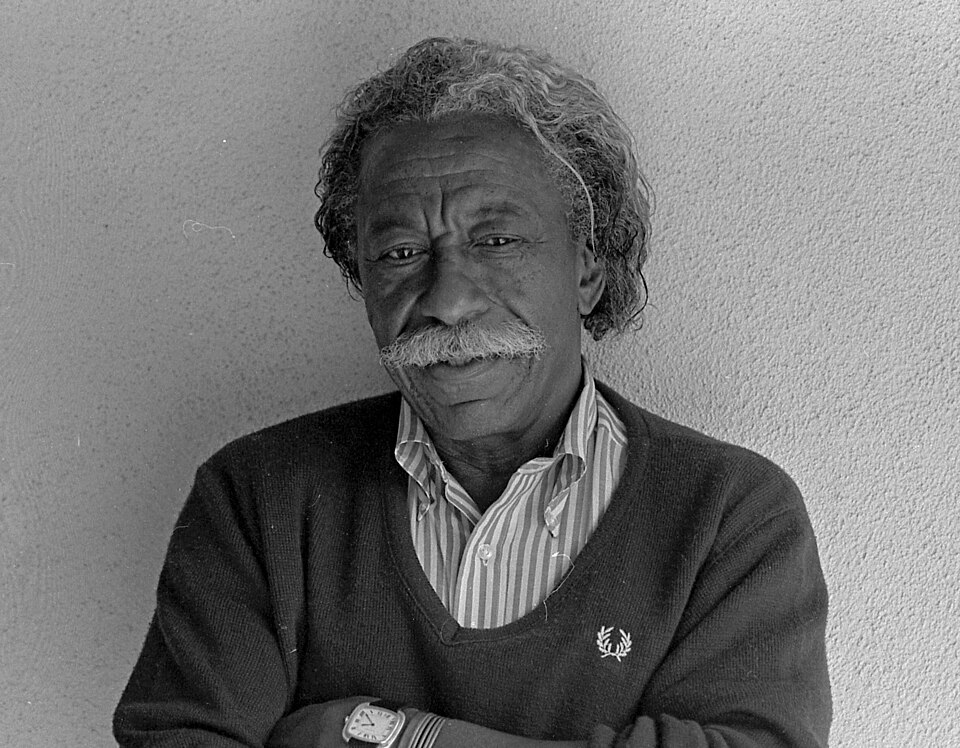
A self-taught photographer who made poverty and racism visible on the pages of Life magazine — and then became the first Black director of a major Hollywood studio film.
Gordon Parks arrived in photography without formal training and no camera of his own, yet went on to define documentary photojournalism in America for three decades. His eye moved between the suffering of the poor and the glamour of fashion — proof, he said, that the camera was a weapon against poverty, racism, and degradation.
Forged in Hardship
Parks was the youngest of fifteen children in Fort Scott, Kansas. His mother died when he was sixteen; he was passed between relatives and eventually made his way north, working as a waiter, piano player, and semi-professional basketball player before buying a secondhand camera in a Seattle pawn shop in 1937. He taught himself photography from books and from studying the work of Farm Security Administration photographers — particularly Dorothea Lange and Russell Lee — whose images of Depression-era poverty showed him what the medium could do.
A Julius Rosenwald Fellowship in 1941 brought Parks to the Farm Security Administration in Washington, where he worked under Roy Stryker. His portrait of government charwoman Ella Watson — posed against an American flag with mop and broom — became one of the era's most quietly devastating images of institutional racism.1
Life Magazine and the Documentary Essay
Parks joined Life in 1948, becoming the magazine's first Black staff photographer. Over the following two decades he produced extended photo essays on subjects including the Black Muslim movement, the civil rights struggle, the street gang leader Red Jackson, and the Brazilian child Flávio da Silva, whose story in a Rio favela generated a worldwide public response. Parks could also turn to fashion and celebrity portraiture — Gloria Vanderbilt, Muhammad Ali — with equal facility, an unusual range that reflected both his ambition and Life's.
His 1961 essay on the family of Flavio da Silva prompted Life readers to raise money to move the family out of the favela; the magazine flew the child to the United States for medical treatment. The campaign illustrated Parks's belief that photographs could produce direct social change.
Film and Autobiography
Parks moved into film in the late 1960s. The Learning Tree (1969), adapted from his own autobiographical novel of the same name, was the first Hollywood studio film directed by a Black American. Shaft (1971) followed — a commercial thriller that helped found the blaxploitation genre and whose Isaac Hayes score won the Academy Award for Best Original Song. Parks directed its sequel, Shaft's Big Score!, in 1972.
He also wrote poetry, composed music, and published multiple volumes of autobiography and fiction, making him one of the most complete creative figures of his era.
The camera is not merely a reflecting pool and the photographs are not exactly the mirror image of reality.
Footnotes
- Parks later said he had been trying to make his own version of the American Gothic — substituting a Black woman's invisible labour for the white farmer's land. ↩