Gottfried Wilhelm Leibniz
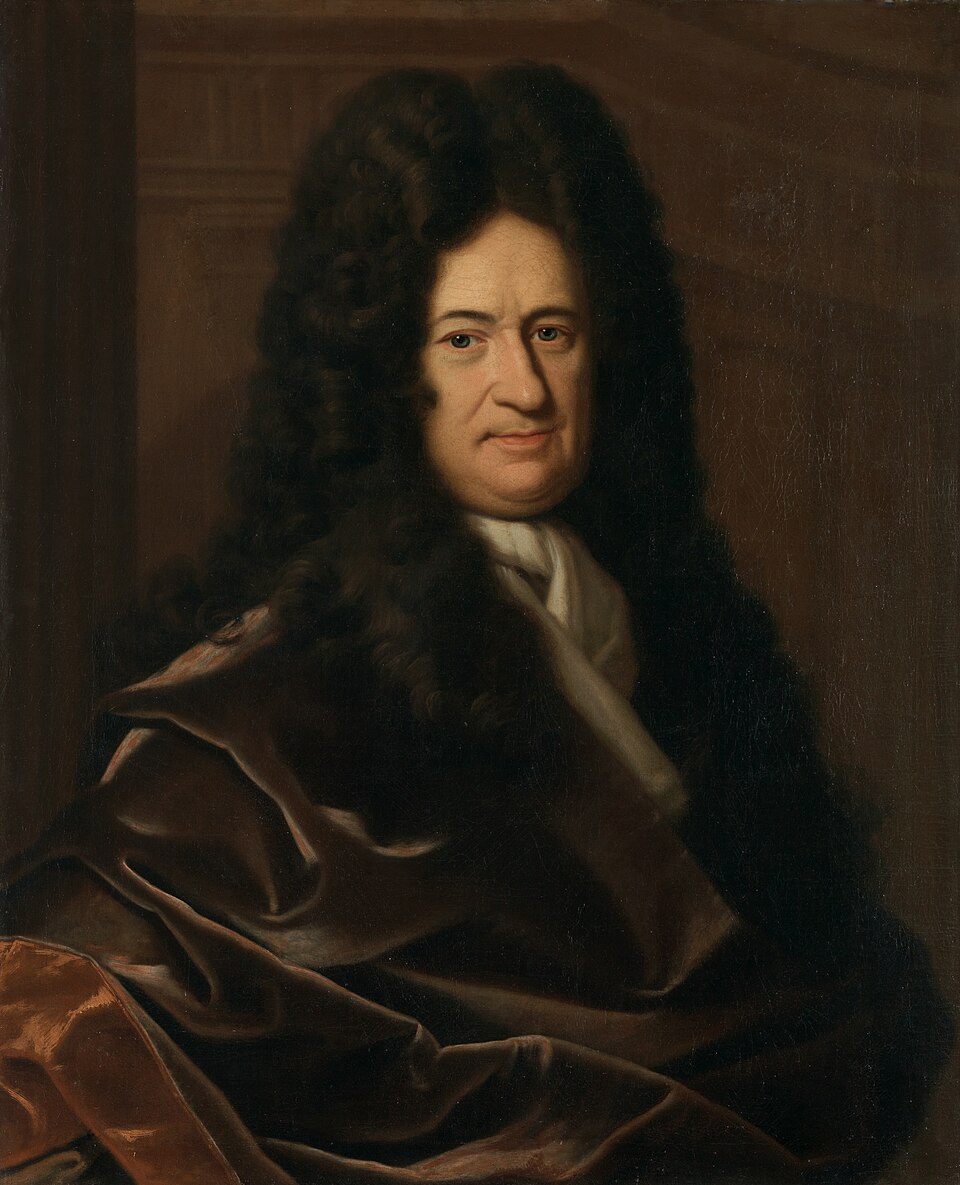
The last person credited with mastering every branch of knowledge in his time — co-inventor of calculus, architect of binary arithmetic, and philosopher of an optimistic universe.
Gottfried Wilhelm Leibniz worked simultaneously in mathematics, philosophy, theology, jurisprudence, history, linguistics, and diplomacy, leaving a deep mark on each. He developed calculus independently of Newton — and the notation he introduced is the notation the world still uses. He designed a calculating machine, proposed the logical basis of binary arithmetic, and wrote a philosophy in which this was the best of all possible worlds. He died, largely forgotten, without a single mourner at his funeral.
Early life and formation
Leibniz was born on 21 June 1646 in Leipzig, the son of a professor of moral philosophy who died when the boy was six. He was largely self-taught, gaining access to his father's library early, and enrolled at the University of Leipzig at fourteen. He studied law, philosophy, and mathematics, completing a doctorate in law at Altdorf in 1667 after Leipzig refused him a degree — allegedly on grounds of youth.
Rather than accepting an academic position, he entered the service of Johann Christian von Boineburg, a prominent diplomat, and subsequently worked for the Archbishop-Elector of Mainz. Leibniz spent much of his twenties angling for patronage and composing ambitious memoranda — on legal reform, on a proposed French invasion of Egypt intended to distract Louis XIV from European expansion, on the reunification of the Catholic and Protestant churches. Most of these schemes came to nothing, but they placed him at the centre of European intellectual and diplomatic networks.
Calculus and the controversy with Newton
During a stay in Paris from 1672 to 1676, Leibniz immersed himself in mathematics, meeting Christiaan Huygens and encountering the unpublished work of Blaise Pascal. By 1675 he had developed the fundamental theorem of calculus — the relationship between differentiation and integration — and the notation he devised then (the integral sign ∫ and the differential d) passed directly into mathematical usage. Isaac Newton had reached similar conclusions a decade earlier, but had not published them; the result was one of the most acrimonious priority disputes in the history of science, poisoning relations between British and Continental mathematics for a generation. Modern scholarship attributes independent and parallel invention to both men.
Leibniz also developed binary arithmetic — the representation of all numbers using only 0 and 1 — which he connected to metaphysical ideas about creation from nothing. It became the mathematical foundation of digital computing three centuries later.
Monadology and philosophy
Leibniz's philosophy is contained in a series of works and letters rather than a single systematic treatise. Its central concept is the monad: the ultimate, indivisible, non-material unit of reality. Monads do not interact causally; each one unfolds its entire history from within, in a pre-established harmony ordained by God such that all monads mirror the same universe from different perspectives. The physical world of extended matter is, on this account, a well-founded appearance underpinning which lies an infinite community of perceiving, striving monads.
From this framework Leibniz developed a theodicy — an account of why a good and omnipotent God permits evil. The Theodicy (1710), his only book-length philosophical work published during his lifetime, argues that this world, though imperfect, is the best of all possible worlds: God chose among infinite alternatives and selected the one with the greatest ratio of good to evil. The argument was famously satirised by Voltaire in Candide (1759), and the caricature has outlasted the original.
The Monadology (1714), a short text of ninety numbered paragraphs composed near the end of his life, is the most concise statement of his mature metaphysics.
Hannover and later career
From 1676 until his death Leibniz served the House of Hannover as librarian, historian, and general intellectual factotum. He was commissioned to write a history of the Welf dynasty, a task he pursued so energetically — insisting on archival rigour and making research trips across Central Europe — that he never finished it. When the Elector of Hannover became King George I of Britain in 1714, the court moved to London, but Leibniz was left behind, partly because the calculus dispute had made him unwelcome in Britain. He died in Hannover on 14 November 1716, attended only by his secretary. The Royal Academy of Sciences in Berlin, which he had helped found, made no official acknowledgement of his death.
Music is the pleasure the human mind experiences from counting without being aware that it is counting.