Gustav Mahler
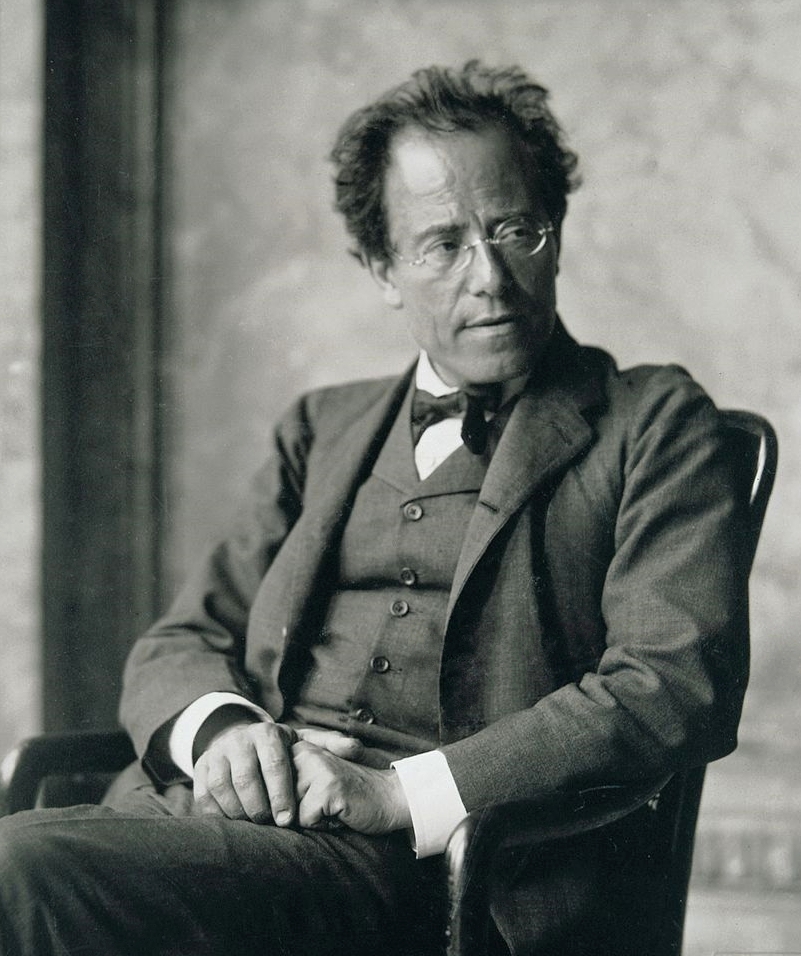
The composer who pushed the symphony to its outer limit — vast in duration, plural in voice, and haunted by a confrontation with mortality that audiences heard more clearly after his death than in his lifetime.
Gustav Mahler straddled the nineteenth and twentieth centuries in music as no one else did — his symphonies inherit the full weight of the German Romantic tradition from Beethoven and Brahms and then strain it to the point of fracture, anticipating the atonalism of Schoenberg while remaining tethered to key. He was among the great conductors of his age, but it was his compositions, largely ignored or banned for decades, that eventually secured his place in the permanent repertoire.
Bohemia and formation
Mahler was born in Kaliště, Bohemia, in 1860, the second of fourteen children in a Jewish family. The family moved to Iglau (now Jihlava in the Czech Republic), where he grew up surrounded by military band music and folk song — two sounds that reappear throughout his work. He studied at the Vienna Conservatory and privately with Anton Bruckner, though his composing debts are more complex than a single teacher can account for. Beethoven and Wagner were his primary models.
The conductor
For most of his working life, Mahler composed only in summer, reserving his winters for conducting. He held positions in Kassel, Prague, Leipzig, Budapest, and Hamburg before reaching his most significant appointment: director of the Vienna Court Opera in 1897 — the most prestigious conducting post in German-speaking Europe. His decade there was legendary for its musical standards and for the conflicts his autocratic methods generated. He resigned in 1907 and concluded his career as conductor of the Metropolitan Opera and then the New York Philharmonic.
The symphonies
Mahler completed nine symphonies and left a tenth unfinished. They vary enormously in scale and character — from the relatively compact Fourth to the enormous Eighth (scored for very large forces, dubbed the "Symphony of a Thousand" by a promoter) — but share certain preoccupations: the quotation of folk melody and march rhythm alongside high-Romantic orchestral writing; movements of exceptional length; and a recurring concern with death, transcendence, and what might follow. Several symphonies incorporate voice: the Second, Third, Fourth, and Eighth all use vocal soloists or chorus.
The song-cycle Das Lied von der Erde (1909), setting Chinese poetry in German translation, is sometimes counted as a tenth symphony. It ends with an Abschied (Farewell) of extraordinary length and emotional concentration.
Tradition is not the worship of ashes, but the preservation of fire.
Reception and rediscovery
In his lifetime Mahler's music received mixed responses. Audiences respected him as a conductor far more than as a composer. After his death in 1911 his symphonies fell in and out of favour; the Nazi period brought a ban on his work in Germany and Austria. The rediscovery came after 1945, driven in part by conductors including Bruno Walter and Leonard Bernstein, whose recordings brought Mahler to new audiences. By the late twentieth century his symphonies were among the most frequently performed in the orchestral repertoire.