Igor Stravinsky
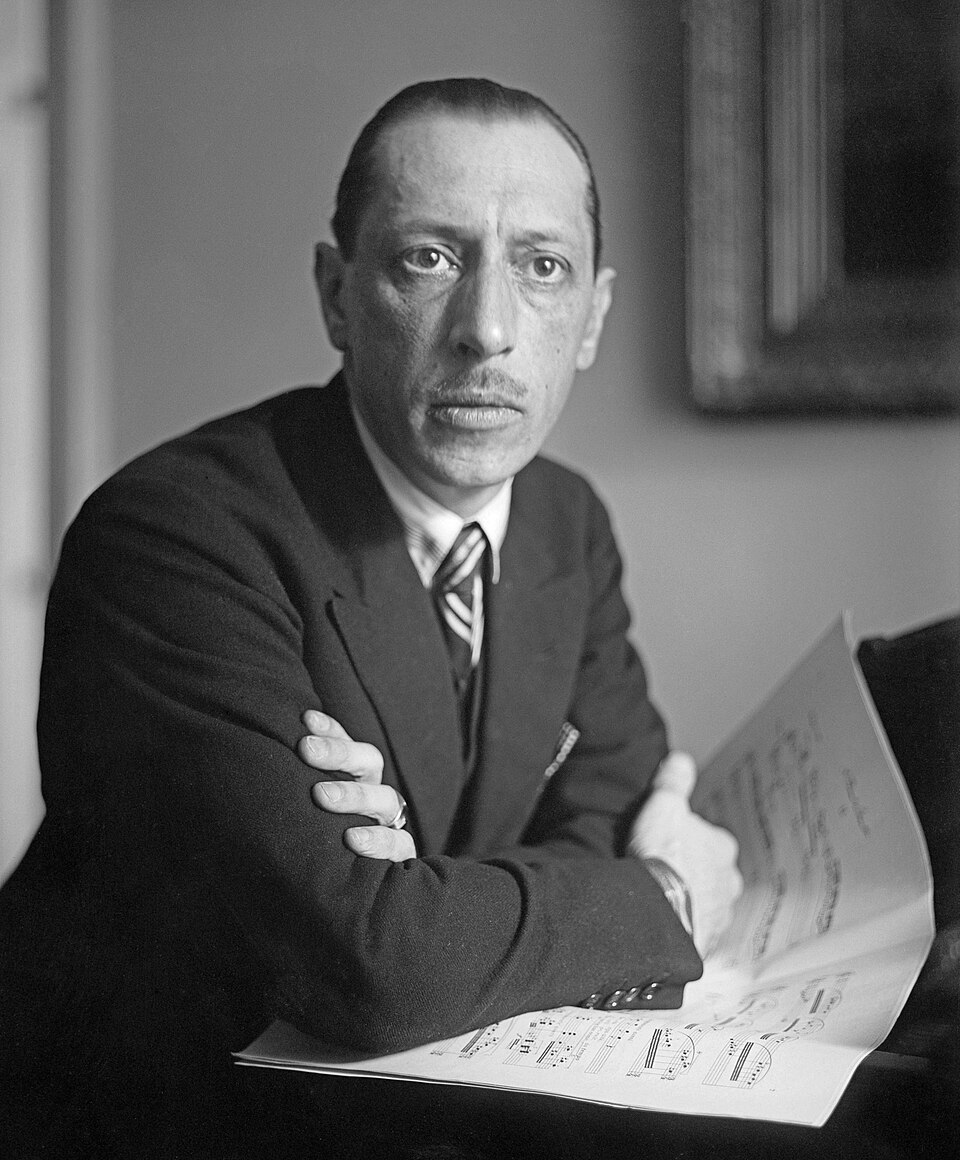
The composer whose three pre-war ballets remade Western music's sense of rhythm and possibility.
Igor Stravinsky is among the most consequential composers of the twentieth century, a figure who did not settle into a single style but instead remade himself — and Western music — across three distinct creative phases spanning more than six decades. His work raised the question of what music could do with rhythm, dissonance, and borrowed tradition, and never stopped provoking answers.
Origins and training
Stravinsky was born in 1882 near St. Petersburg into a musical household; his father was a bass singer at the Imperial Opera. He studied law but pursued music privately, becoming a pupil of Nikolai Rimsky-Korsakov between 1905 and 1908. The relationship was formative: Rimsky-Korsakov's mastery of orchestral colour left visible traces on Stravinsky's early work. His first significant pieces — a symphony, a song cycle — circulated quietly before Sergei Diaghilev, impresario of the Ballets Russes, heard something in the young composer worth betting on.
The three ballets
Diaghilev commissioned three ballets in quick succession that made Stravinsky's international reputation. The Firebird (1910) dazzled Paris with its Rimsky-Korsakov-inflected orchestration. Petrushka (1911) introduced a harder, more ironic voice, the puppet's grief expressed through colliding tonalities. The Rite of Spring (1913) remains the defining rupture: its irregular, pounding rhythms and primitivist subject matter provoked uproar at the Théâtre des Champs-Élysées premiere1 and have never ceased to fascinate analysts. The three works together changed how composers thought about pulse, accent, and the orchestra as a percussive instrument.
Neoclassicism and serial work
After World War I Stravinsky moved toward spare, ironic neoclassicism — the Symphony of Psalms (1930), the opera-oratorio Oedipus Rex (1927), Pulcinella (1920) — reworking old forms and styles with cool detachment. He settled in France, then moved to the United States in 1939. Late in life, following the death of his close associate Ernest Ansermet and under the influence of conductor Robert Craft, he absorbed twelve-tone serialism. Works such as Agon (1957) and Threni (1958) showed a third reinvention, confounding those who thought they had placed him.
| Phase | Approximate period | Representative work |
|---|---|---|
| Russian / Primitivist | 1910–1920 | The Rite of Spring |
| Neoclassical | 1920–1951 | Symphony of Psalms |
| Serial | 1952–1966 | Agon |
Legacy
Stravinsky's influence on subsequent composers — from Aaron Copland to Elliott Carter to Arvo Pärt — is pervasive enough to be almost invisible, absorbed into the fabric of what concert music considers natural. His recordings as conductor of his own works remain a primary source. He died in New York in 1971 and was buried in Venice, near Diaghilev.
The Rite of Spring has no story. It has a subject — the ancient Slavic rite of sacrificing a young girl to propitiate the god of spring.
Footnotes
- Accounts of the premiere riot differ in detail, but the disruption was real; police were called. ↩