Jean Sibelius
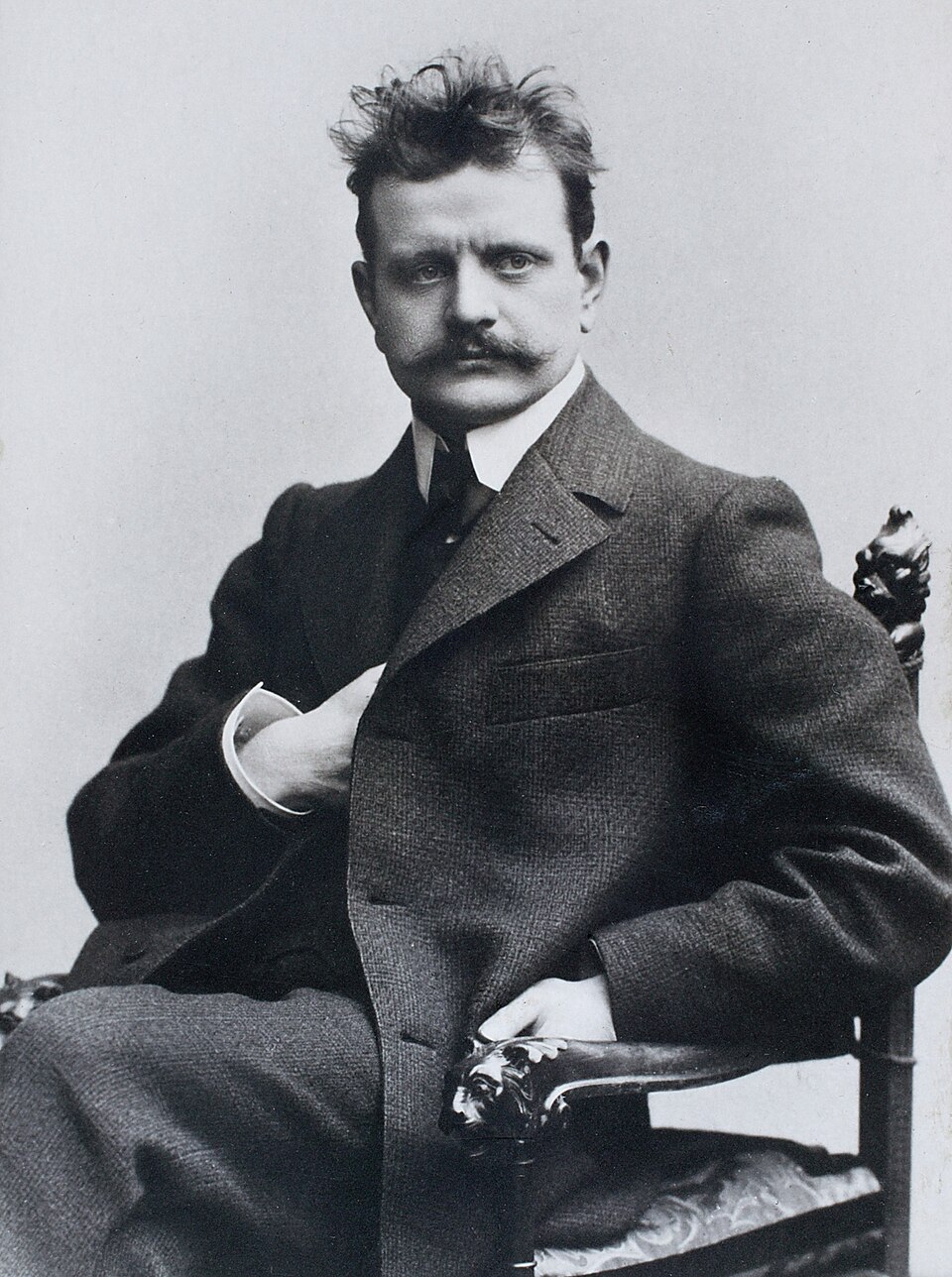
Finland's defining voice — a composer whose seven symphonies and tone poems forged a national musical identity out of Nordic landscape and mythological deep time.
Jean Sibelius is the composer in whom Finnish national consciousness found its most powerful musical expression: he transformed the landscapes, legends, and political resistance of a small northern country into seven symphonies and a series of tone poems that entered the international repertoire and stayed. His long silence — nearly thirty years without a new work — has given his output an enigmatic completeness, as though he calculated the exact moment to stop.
Origins and formation
Born in Hämeenlinna in 1865, Sibelius grew up in a Swedish-speaking Finnish family. His father, a doctor, died of typhus when Jean was two; he was raised by his mother and grandmother in a household where music was central. He began violin lessons at nine and became an accomplished enough player to harbour ambitions of a performing career, though he eventually recognised that composition was his true calling.
He studied in Helsinki, then in Berlin (1889–90) under Albert Becker, and in Vienna (1890–91) under Robert Fuchs and Karl Goldmark. The encounter with the German symphonic tradition gave him technical grounding; the pull of Finland and its mythology drew him home. Kullervo (1892), a choral symphony based on the Kalevala, the Finnish national epic, announced his intention to create a distinctively Finnish art music.
National identity and the tone poems
The 1890s were a period of increasing Russian attempts to suppress Finnish autonomy — the so-called Russification policy. Sibelius's music became, sometimes explicitly, an act of cultural resistance. Finlandia (1899), originally composed for a press celebration rally that concealed its political nature from Russian censors, became an unofficial national anthem — its central hymn melody still widely recognised.
The Lemminkäinen Suite (1895, revised 1897 and 1900) drew on Kalevala legends with an orchestral vividness that established his reputation beyond Finland. The Swan of Tuonela, for cor anglais and strings, became one of the most haunting pieces in the orchestral catalogue.
While other composers were making cocktails for their public, I was offering pure cold water.
The seven symphonies
Sibelius's seven symphonies, composed between 1899 and 1924, trace an arc from the lush post-Romanticism of the First to the compressed, single-movement severity of the Seventh. The Second Symphony (1902) with its spacious finale became his most popular. The Fourth (1911) marked a radical turn toward austerity and harmonic ambiguity that alienated some listeners but secured his reputation as a serious modernist. The Fifth (1915, revised 1916 and 1919), Sixth (1923), and Seventh (1924) are each formally distinctive — the Seventh compresses four traditional movements into a single continuous span of approximately twenty minutes.
He also composed the Violin Concerto (1904, revised 1905), which became a major work of the solo repertoire.
The silence
After the tone poem Tapiola (1926), Sibelius published virtually nothing for the remaining thirty-one years of his life. He worked on an eighth symphony — sketches survive — but destroyed or suppressed it. The silence was not announced; he simply stopped. He lived at his home Ainola, outside Helsinki, until his death in 1957 at ninety-one. The reasons for the silence have been extensively debated and remain unclear.