Jimi Hendrix
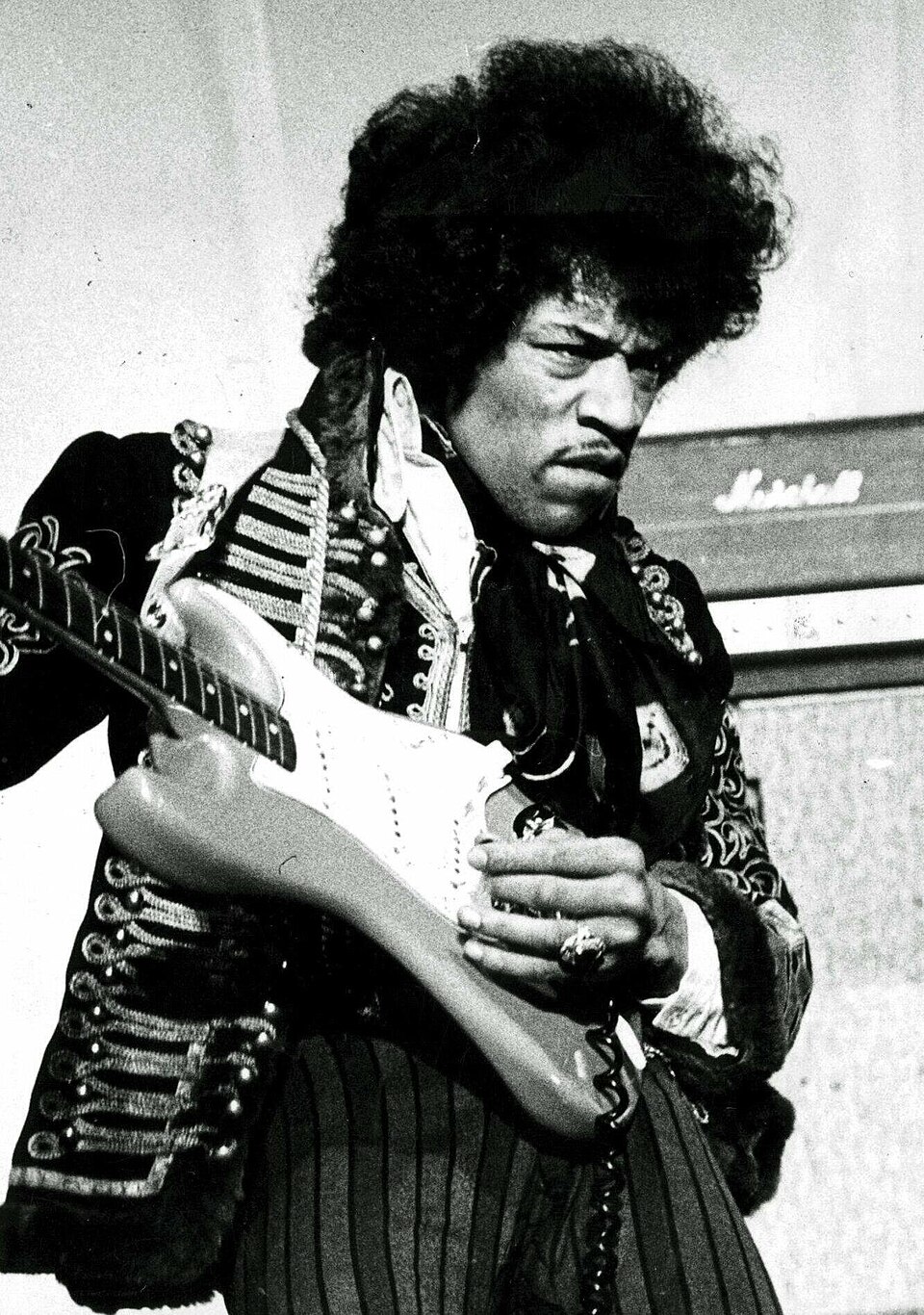
The Seattle guitarist who in fewer than five years permanently expanded what the electric guitar could say, building a language of feedback, distortion, and melodic invention that all subsequent rock music inhabits.
Jimi Hendrix arrived in London in 1966 and within a year had made every other electric guitarist reconsider what the instrument was for. By his death at twenty-seven, he had recorded three studio albums that remain among the most densely inventive in the history of popular music, and given the guitar a vocabulary of pure sound — feedback as melody, distortion as texture — that has defined rock playing ever since.
Formation
James Marshall Hendrix was born in Seattle, Washington, on 27 November 1942. His childhood was unstable — his parents separated, his mother died when he was fifteen — and he was largely raised by his father, Al, in difficult circumstances. He taught himself guitar as a teenager, absorbing electric blues from records by Muddy Waters, B.B. King, and Robert Johnson. After a brief period in the US Army (he was discharged in 1962), he worked as a touring musician, backing Little Richard, the Isley Brothers, and other R&B artists on the so-called "chitlin' circuit" — an education in stagecraft and in the American Black musical tradition that formed his entire approach.
London and the Experience
In 1966, bassist and manager Chas Chandler brought Hendrix to London and formed the Jimi Hendrix Experience with Noel Redding on bass and Mitch Mitchell on drums. The first single, "Hey Joe," appeared in December 1966; the debut album, Are You Experienced, followed in May 1967. The speed of his impact on London's music community was extraordinary — Eric Clapton, Pete Townshend, and Jeff Beck were all publicly humbled by what they heard at early club performances.
Are You Experienced announced a synthesis that had no precedent: electric blues extended through feedback and studio manipulation, rhythm and lead guitar integrated into a single sound, the voice embedded in the texture as another instrument. It was not progressive rock or psychedelia, though it influenced both; it was something genuinely new.
Music doesn't lie. If there is something to be changed in this world, then it can only happen through music.
Woodstock and the apex
The three-album run of Are You Experienced (1967), Axis: Bold as Love (1967), and Electric Ladyland (1968) constitutes one of the most concentrated periods of creative output in rock history. Electric Ladyland, a double album, demonstrated his command of the studio as an instrument: backwards guitar, phasing, layered tracks, and stereo space used as compositional material.
His performance of "The Star-Spangled Banner" at Woodstock in August 1969 — a solo guitar interpretation that incorporated sirens, bombs, and feedback — remains the most discussed single performance in rock history, and one of the most politically legible acts in popular music.
Legacy
Hendrix died in London on 18 September 1970, aged twenty-seven. The cause was asphyxiation following barbiturate intoxication. He was inducted into the Rock and Roll Hall of Fame in 1992 as part of the Jimi Hendrix Experience. The Rock and Roll Hall of Fame describes him as "arguably the greatest instrumentalist in the history of rock music."
His technical innovations — the use of feedback as melodic material, the wah-wah pedal as expressive device, the left-handed playing of a right-handed guitar strung in reverse — have been absorbed so thoroughly into the vocabulary of electric guitar playing that they are now taught as standard technique. No guitarist working after 1967 has been unaffected.