Johannes Brahms
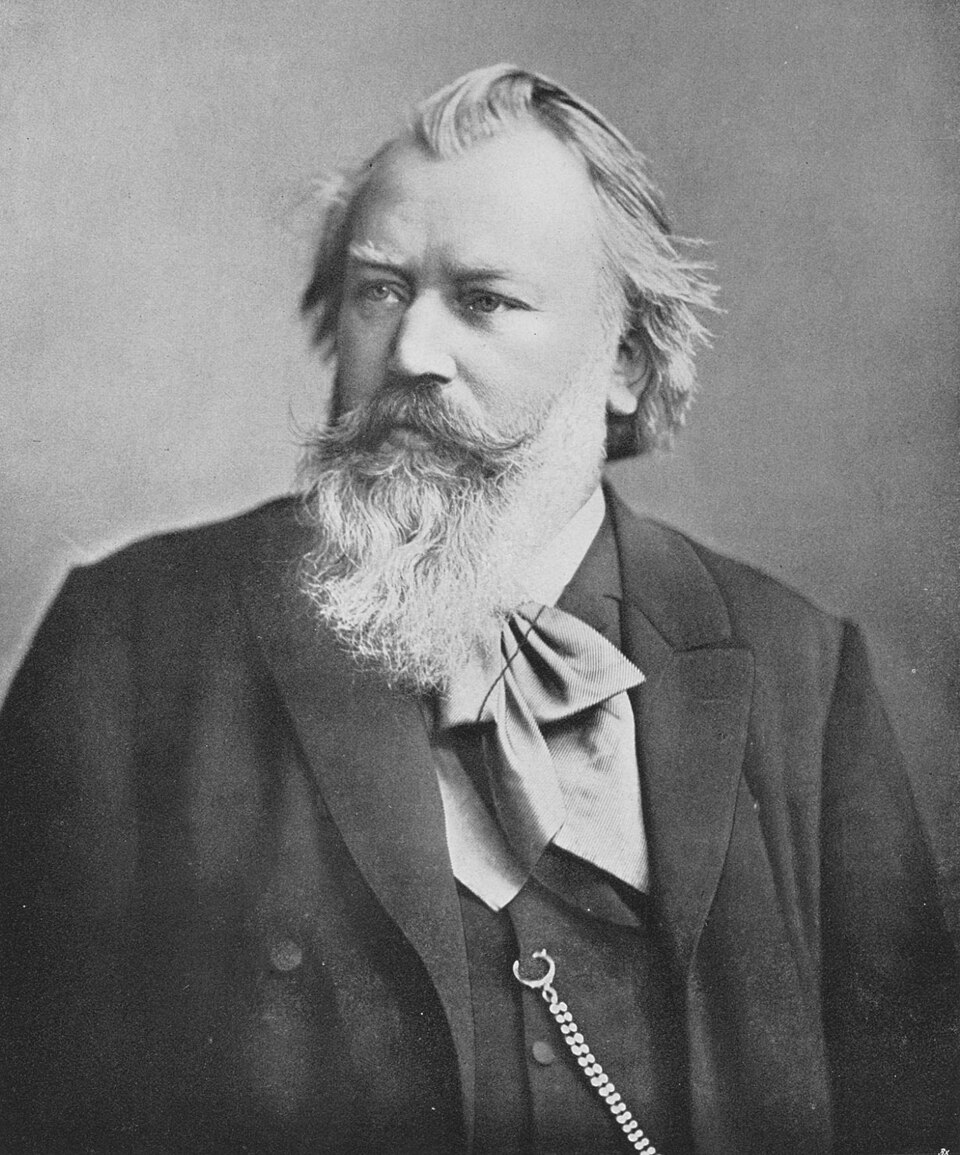
The last great architect of classical form in the Romantic era, who built four symphonies and a Requiem from counterpoint, rhythmic daring, and emotional weight.
Johannes Brahms composed as if form and feeling were not opposites but the same force. In an age when Wagner dismantled classical architecture and Liszt chased the infinite, Brahms returned again and again to sonata, variation, and fugue — not from timidity but from conviction that the old containers could still hold something vast.
Hamburg and a long apprenticeship
Brahms was born in Hamburg on 7 May 1833 into a modest household; his father played double bass in taverns and theatre orchestras. He received piano lessons from Friedrich Cossel and later Otto Friedrich Willibald Cossel, and earned money playing in Hamburg's rougher venues as a teenager — an experience he seldom dwelt on. The decisive turn came in 1853 when he accompanied the Hungarian violinist Eduard Reményi on a tour and was introduced to Robert Schumann. Schumann's famous Neue Zeitschrift article hailing Brahms as a coming master arrived almost before the young composer had published anything, a pressure that shaped the next two decades of work.
He moved to Vienna in 1863, and the city became his permanent home. Brahms absorbed Vienna's musical past — Haydn, Mozart, Beethoven, Schubert — as living obligations rather than museum pieces.
Four symphonies and the architecture of resistance
Brahms completed his First Symphony in 1876 after more than twenty years of revision and doubt. Conductors called it "Beethoven's Tenth" — a label he resisted — but the comparison contained the point: Brahms worked in a tradition he regarded as still alive. The Second, Third, and Fourth symphonies followed over the next decade. Each is structurally different; the Fourth ends with a passacaglia, thirty variations over a repeating bass line, a form borrowed from the Baroque.
His two piano concertos — the First (1859) and Second (1881) — are among the most demanding in the repertoire. The Violin Concerto (1878), written for Joseph Joachim, and the Double Concerto for violin and cello (1887) complete the concerto canon.
It is not hard to compose, but it is wonderfully hard to let the superfluous notes fall under the table.
The German Requiem and the chamber music
The Ein deutsches Requiem (1869) stands apart. Setting texts chosen by Brahms himself from Luther's German Bible — not the Latin Mass for the Dead — it addresses the living mourning their dead rather than the dead awaiting judgment. Seven movements, a large chorus and orchestra, two soloists, and a controlled solemnity that never breaks into rhetoric.
His chamber music is the other body of work that defines him: three string quartets, a piano quintet, two string quintets, three piano trios, two string sextets. The late clarinet sonatas and trio (1894) — written for Richard Mühlfeld — show a late style of increasing harmonic compression and restraint.