John Coltrane
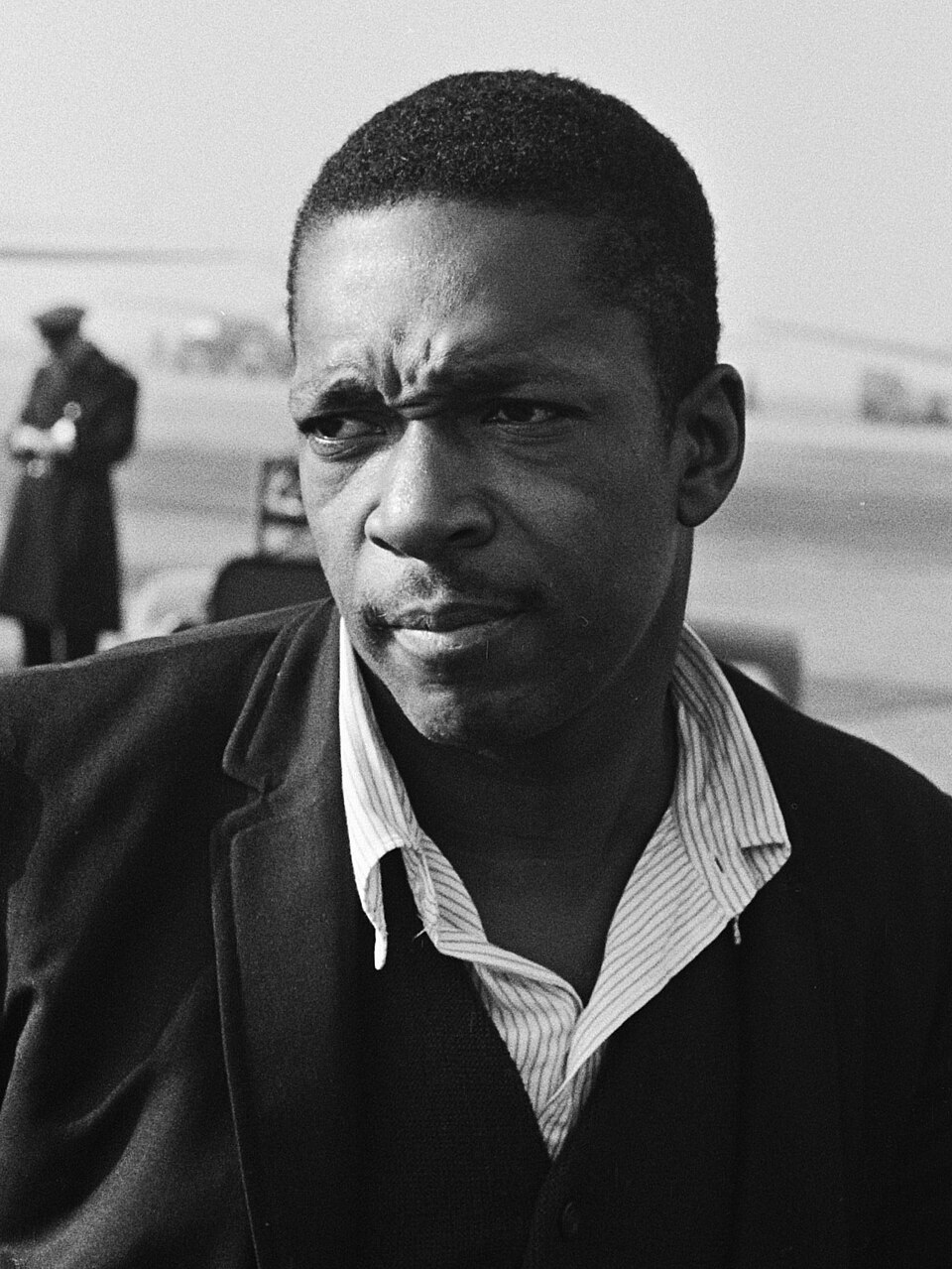
A tenor and soprano saxophonist who compressed jazz's entire harmonic vocabulary, then detonated it, leaving a music permanently altered in his wake.
John Coltrane arrived in jazz as a bebop sideman and left it as its most consequential revolutionary — a musician who in little more than a decade moved from meticulous harmonic excavation to spiritual ecstasy to the outer reaches of free improvisation. He died at forty, and jazz has been measuring itself against the distance he covered ever since.
North Carolina to Philadelphia
Born in Hamlet, North Carolina on 23 September 1926, Coltrane grew up in High Point and moved to Philadelphia after the Second World War, where he studied at the Ornstein School of Music and the Granoff Studios. His early professional work in rhythm-and-blues bands — including a stint with Eddie Vinson — gave him a working-man's grounding before jazz claimed him fully. A period of heroin and alcohol dependence in the early 1950s interrupted his development; he would later describe his 1957 spiritual awakening and recovery as the turning point that unlocked both his discipline and his ambition.
Miles Davis and harmonic density
Joining Miles Davis's first great quintet in 1955, Coltrane found himself opposite a musician who demanded economy. The contrast was productive: Coltrane brought density — what critic Ira Gitler famously called "sheets of sound" — to Davis's cool precision. The collaboration produced landmark recordings including Kind of Blue (1959), on which Coltrane's playing on modal structures pointed directly toward his own next phase.1 In parallel, his work with pianist Thelonious Monk in 1957 further sharpened his harmonic thinking.
Giant Steps and the Classic Quartet
Giant Steps (1960) announced full independence. The album introduced what theorists now call "Coltrane changes" — a harmonic substitution system cycling through three tonal centres a major third apart — and set a technical challenge that subsequent jazz musicians spent years learning to answer. With the Classic Quartet (pianist McCoy Tyner, bassist Jimmy Garrison, drummer Elvin Jones), Coltrane produced the body of work for which he is most celebrated: My Favorite Things (1961), Ballads (1963), and the towering A Love Supreme (1965), a four-part suite conceived as an offering of gratitude and a spiritual testament.
The late period
After A Love Supreme, Coltrane moved into increasingly free territory, incorporating ideas from Ornette Coleman's circle and non-Western music. Albums such as Ascension (1966) and Interstellar Space (recorded 1967) tested the patience of listeners who had embraced the Classic Quartet work; they have since been reassessed as genuinely exploratory rather than merely difficult. He died from liver cancer in July 1967, leaving recordings that document a musician still in motion.
My music is the spiritual expression of what I am — my faith, my knowledge, my being.
Footnotes
- Coltrane was not in Davis's band continuously; he was fired in 1956 owing to his addiction and rehired in 1958 after his recovery. ↩