Joni Mitchell
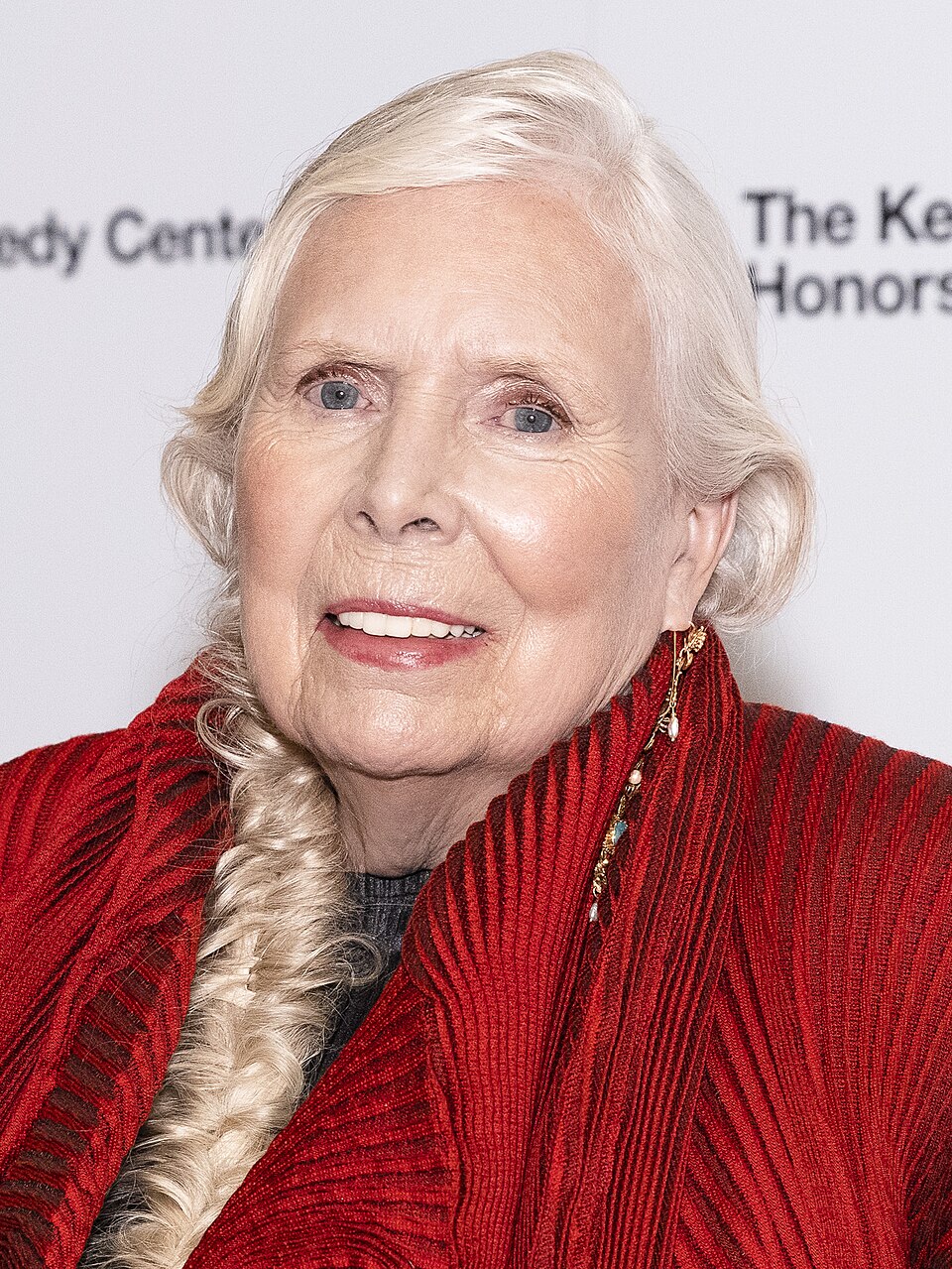
A Canadian singer-songwriter who brought the confessional interior of poetry to popular music, rewriting what a song could say and how it could be structured.
Joni Mitchell arrived in the late 1960s as a folksinger and left, by the mid-1970s, as something harder to categorise — a composer whose open guitar tunings, jazz harmonics, and plainspoken autobiography had permanently shifted the landscape of popular song. Her influence on subsequent generations of songwriters is so pervasive as to be nearly atmospheric.
Prairie origins and the folk circuit
Born Roberta Joan Anderson in Fort Macleod, Alberta on 7 November 1943, Mitchell grew up in Saskatchewan, contracting polio at age nine — an illness that sharpened her self-reliance. She studied art at the Alberta College of Art in Calgary before the Toronto folk scene drew her southward in the early 1960s. A daughter given up for adoption in 1965, later reunited with Mitchell, became the subject of songs she did not name publicly for years.1 Her early repertoire circulated among other performers before her own recordings; Judy Collins recorded "Both Sides Now" in 1967, giving Mitchell her first public foothold.
Breakthrough and the defining album
Mitchell's first albums were warmly received, but Blue (1971) is the work that secured her place in the canon. Recorded with minimal accompaniment — dulcimer, guitar, piano — the album's ten tracks achieve an intimacy unusual in commercial recording. Songs like "A Case of You," "River," and "The Last Time I Saw Richard" proceed from emotional precision rather than rhetorical effect. Critics and peers have consistently returned to Blue as a benchmark; it placed near the top of Rolling Stone's 2020 list of the 500 greatest albums of all time.
Jazz period and compositional expansion
Court and Spark (1974) pushed Mitchell into jazz-rock territory with arrangements by Tom Scott's L.A. Express, producing her highest-charting album. The Hissing of Summer Lawns (1975) and Hejira (1976) took larger formal risks: the latter is distinguished by the fretless bass work of Jaco Pastorius, which gave Mitchell's open-tuned guitar an elastic, conversational partner. Mingus (1979), a collaboration with bassist and composer Charles Mingus in the final year of his life, remains among the more formally ambitious projects in her catalogue.
Later decades and recognition
Mitchell's output slowed considerably after 1980, though she continued recording into the 2000s. A serious brain aneurysm in 2015 led to a long recuperation; her return to live performance at the 2022 Newport Folk Festival, and a subsequent appearance at the Grammys in 2024, were received with unusual public emotion. She holds eleven Grammy Awards, including a Lifetime Achievement Award in 2002.
I am on the black keys.
Footnotes
- The daughter, Kilauren Gibb, was reunited with Mitchell in 1997, a reunion Mitchell subsequently discussed in interviews. ↩