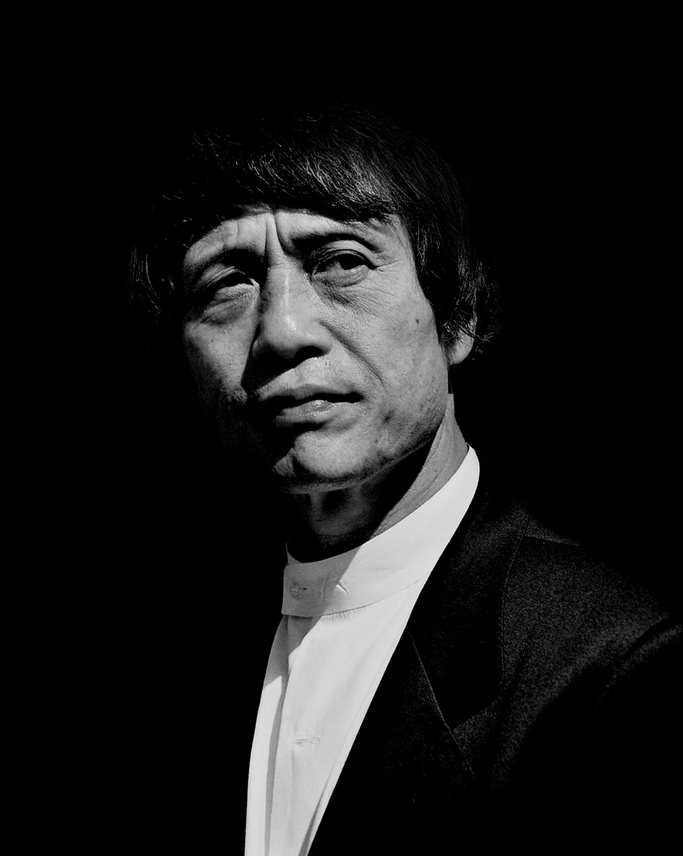
Kenzō Tange
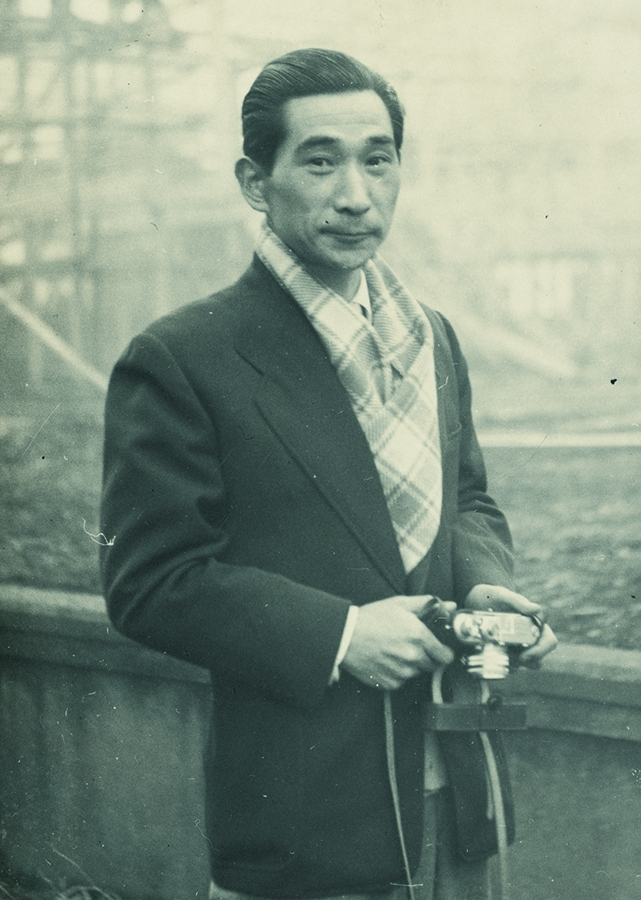
The architect who rebuilt Japan's cities after the war while opening Japanese modernism to the world.
Kenzō Tange was the central figure in twentieth-century Japanese architecture: a designer who synthesised traditional Japanese spatial principles with the structural ambition of Le Corbusier, and whose city plans shaped postwar reconstruction from Hiroshima to Tokyo. He was the first Japanese architect to win the Pritzker Prize.
Formation and Wartime Work
Tange was born in Sakai and grew up partly in China and southern Japan, encountering a range of architectural cultures in early life. He studied architecture at the University of Tokyo, graduating in 1938, and completed his doctorate there in 1959. As a student he was profoundly affected by Le Corbusier's published work — the Unité and the Chandigarh plans — and by Japanese classical architecture, particularly the shrine complexes of Ise and Nikkō.
His earliest major recognition came from a prize-winning design for a Greater East Asia Co-Prosperity Sphere Monument in 1942. The design merged Japanese roof forms with modernist massing — a synthesis he would refine throughout his career.
Hiroshima and International Emergence
The Hiroshima Peace Memorial Park (1955), designed with colleague Arata Isozaki among others, established Tange's international reputation. The memorial hall's pilotis frame the atomic bomb dome precisely, creating one of the most powerful acts of architectural memory in the postwar world. Its combination of Corbusian structure with a roof form recalling traditional Japanese raised-floor granaries demonstrated that modernism and Japanese tradition could reinforce rather than cancel each other.
His engagement with the Congrès Internationaux d'Architecture Moderne (CIAM) in the 1950s connected him to the international avant-garde and brought Japanese architecture onto the world stage in a sustained way for the first time.
Urban Visions and Late Career
Tange produced speculative urban plans of extraordinary ambition. His Tokyo Bay Plan of 1960 proposed extending the city over the bay on a linear spine — a scheme never built but enormously influential on the Metabolist movement that several of his students (Kisho Kurokawa, Fumihiko Maki) would lead. His built urban work includes the Yoyogi National Gymnasium designed for the 1964 Tokyo Olympics — a pair of suspended-roof structures whose catenary steel cables produce sweeping organic forms that read as both structurally innovative and culturally Japanese.1
In later decades Tange worked internationally, producing major buildings in Europe, the Middle East, and North America, including the Fuji Television Building in Tokyo (1996) and urban plans for cities across the developing world.
| Period | Theme | Representative work |
|---|---|---|
| 1940s | Synthesis of tradition and modernism | Peace Memorial Park design |
| 1950s | Postwar reconstruction | Hiroshima Peace Memorial Park |
| 1960s | Urban megastructure | Tokyo Bay Plan; Yoyogi Gymnasium |
| 1970s–90s | International practice | Fiera Milano; Fuji Television Building |
Legacy
Tange was awarded the Pritzker Prize in 1987 and the RIBA Royal Gold Medal in 1965. His teaching at the University of Tokyo trained a generation of architects — Isozaki, Maki, Kurokawa — who shaped global architecture after him. He died in Tokyo on 22 March 2005.
Architecture cannot be simply a matter of pure technology — it must express the aspirations of a people.
Footnotes
- The Yoyogi gymnasium's suspended-roof system was the largest of its kind when completed and remains one of the structural achievements of postwar architecture. ↩