Kurt Gödel
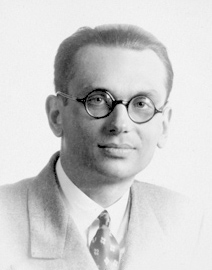
The logician whose incompleteness theorems proved that no formal system powerful enough to describe arithmetic can be both complete and consistent — a result that permanently altered the foundations of mathematics.
Kurt Gödel published his incompleteness theorems in 1931, aged twenty-four, and in doing so answered — negatively — a question that had preoccupied the greatest mathematicians of the previous three decades: whether arithmetic could be given a complete, consistent formal foundation. The answer was no, and the proof was carried out from within mathematics itself, using arithmetic to encode statements about arithmetic.
Formation in Vienna
Gödel was born in Brno, then part of the Austro-Hungarian Empire (now Czech Republic), in 1906. He studied mathematics and philosophy at the University of Vienna, where he was drawn into the orbit of the Vienna Circle — the group of logical positivists who believed that philosophy should be grounded in formal logic and empirical verification. Gödel shared their precision but not their confidence: from the beginning he was skeptical of the positivist claim that all meaningful statements were reducible to empirical or logical ones.
His doctoral dissertation, completed in 1929, proved the completeness of first-order predicate logic — demonstrating that every valid formula in the system was provable from the axioms. It was a positive result, establishing the formal system's power. The incompleteness theorems that followed in 1931 were its shadow side.
The incompleteness theorems
The first incompleteness theorem states that any consistent formal system capable of expressing basic arithmetic contains true statements that cannot be proved within the system. The second states that such a system cannot prove its own consistency. Together they showed that David Hilbert's programme — to put all of mathematics on a complete, decidable formal footing — was impossible in principle.
The proof's method was as striking as its conclusion. Gödel constructed a statement within arithmetic that effectively says "this statement is not provable in this system." If the system is consistent, the statement is true but unprovable. The encoding technique — assigning numbers to symbols and formulas — is now called Gödel numbering and became a tool for computability theory as well.
Either mathematics is too big for the human mind, or the human mind is more than a machine.
Princeton and later work
Gödel emigrated to the United States in 1940, settling at the Institute for Advanced Study in Princeton, where he became a close friend of Albert Einstein. Their daily walks were a feature of Princeton life through the 1940s and 1950s. Gödel's later work ranged from set theory — he proved the consistency of the Axiom of Choice and the Generalised Continuum Hypothesis with the standard axioms of set theory — to general relativity, where he found a solution to Einstein's field equations permitting closed timelike curves (Gödel universes), and to philosophy of mathematics, where he defended a Platonist position: that mathematical objects exist independently of the human mind and are discovered rather than invented.
His health deteriorated in the final years of his life. After his wife Adele's hospitalisation removed the person who ensured he ate, Gödel's refusal to accept food from untrusted sources became extreme. He died of starvation in January 1978, weighing 65 pounds.