Maurice Ravel
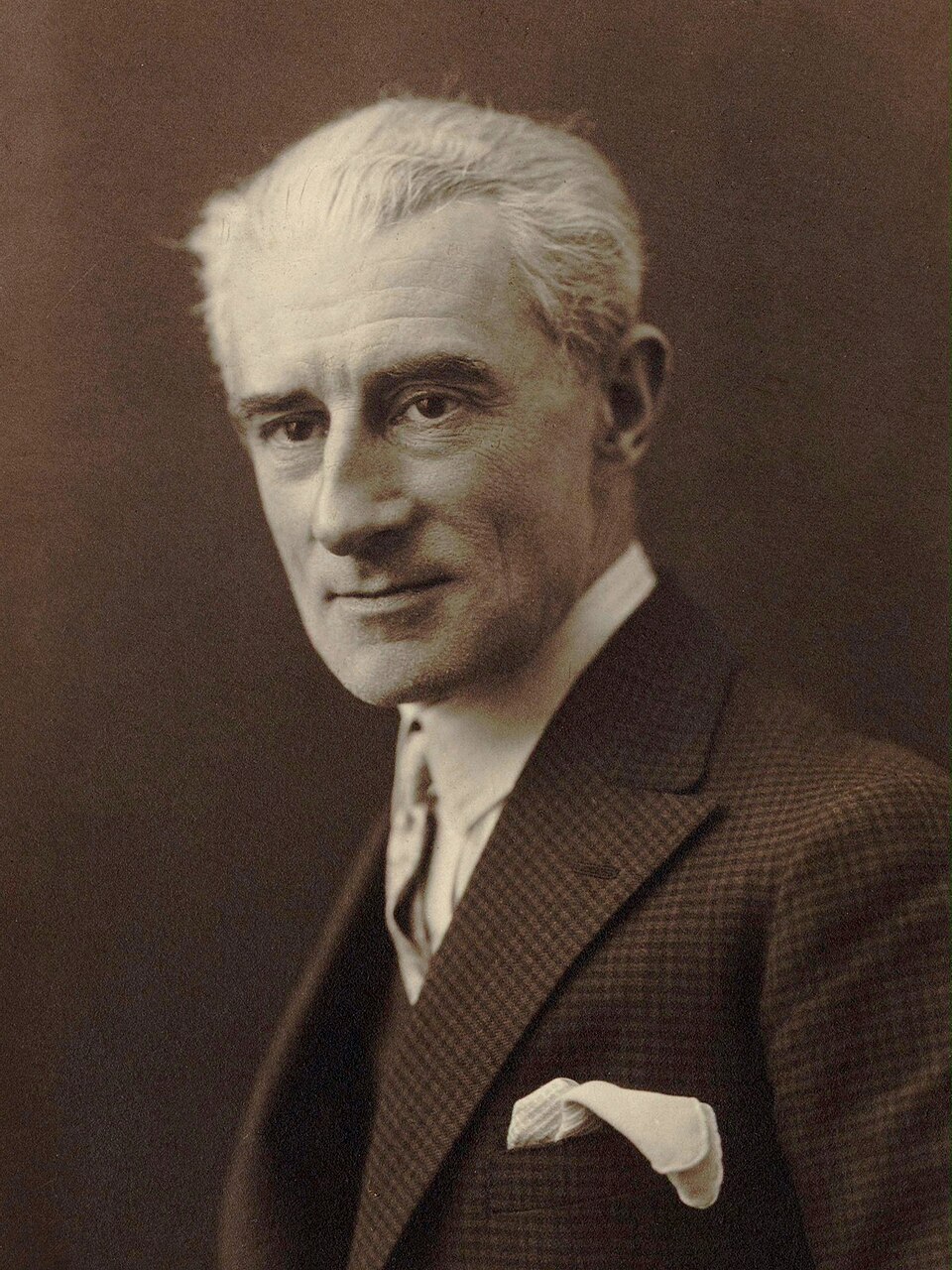
The craftsman of French music who proved that refinement and precision can be as radical as any manifesto — and that a single repeating melody, played long enough, becomes hypnotic.
Maurice Ravel was the most precise craftsman French music produced in the early twentieth century — a composer whose surface elegance concealed rigorous structural thought, and whose range extended from intimate piano miniatures to works for full orchestra that have never left the repertoire. He was often paired with Claude Debussy under the label Impressionism, a term both men rejected. Ravel's music is better understood as the opposite of vague: everything is placed exactly where he intended it.
Basque origins and the Conservatoire
Ravel was born in Ciboure, in the French Basque Country, on 7 March 1875, the son of a Swiss engineer and a Basque mother whose folk music made an early impression. The family moved to Paris within months of his birth, and Ravel entered the Paris Conservatoire in 1889, eventually studying composition under Gabriel Fauré. The Conservatoire years were long and contentious. Ravel sat for the Prix de Rome — France's premier composition prize — five times between 1900 and 1905, and was rejected each time. His final disqualification, on technical grounds, triggered a public scandal known as the Ravel Affair: critics and colleagues argued that the jury was protecting conservative taste at the expense of the most gifted student of his generation. The controversy led directly to the resignation of the Conservatoire's director.
Piano works and the pre-war decade
The Prix de Rome controversy did nothing to slow Ravel's output. Between 1901 and 1917 he produced a sequence of piano works that remain central to the repertoire: Jeux d'eau (1901), which anticipated much of what Debussy would later do with water imagery; Miroirs (1905), five pieces that each portray a kind of reflection; and Gaspard de la nuit (1908), based on prose poems by Aloysius Bertrand, which is regarded as one of the most technically demanding works in the piano literature. He also wrote the String Quartet in F major (1903), a tightly argued work that Debussy admired, and Daphnis et Chloé (1912), an extended ballet score commissioned by Sergei Diaghilev for the Ballets Russes and widely considered the summit of Ravel's orchestral writing. Le tombeau de Couperin (1917), an elegant homage to Baroque forms, was composed during the First World War — each of its six movements dedicated to a friend killed in the fighting.
I have no theories. I work with whatever I have — the material itself tells me what it needs.
Boléro and the concertos
In the 1920s Ravel emerged as France's most celebrated living composer. His 1922 orchestration of Mussorgsky's Pictures at an Exhibition became the version that most orchestras play. Then, in 1928, came Boléro: a single melody repeated eighteen times over an unvarying snare-drum ostinato, the orchestration gradually thickening until the texture becomes overwhelming. Ravel described it as an experiment in mechanical repetition without development, and was surprised by the work's instant and lasting popularity. He completed two piano concertos in 1931 — the Piano Concerto in G major, light and jazz-inflected, and the Piano Concerto for the Left Hand, commissioned by the pianist Paul Wittgenstein who had lost his right arm in the war: a darker, more troubled work that demonstrated the full range of Ravel's emotional register.
Final years and illness
Ravel never accepted the Legion of Honour when it was offered by the French government — a refusal consistent with his lifelong independence from official recognition. In the early 1930s he began showing signs of a progressive neurological illness, now believed to have been frontotemporal dementia or Pick's disease, which gradually destroyed his ability to compose, write, and eventually speak. He died on 28 December 1937 in Paris, following brain surgery. He was sixty-two.