Miles Davis
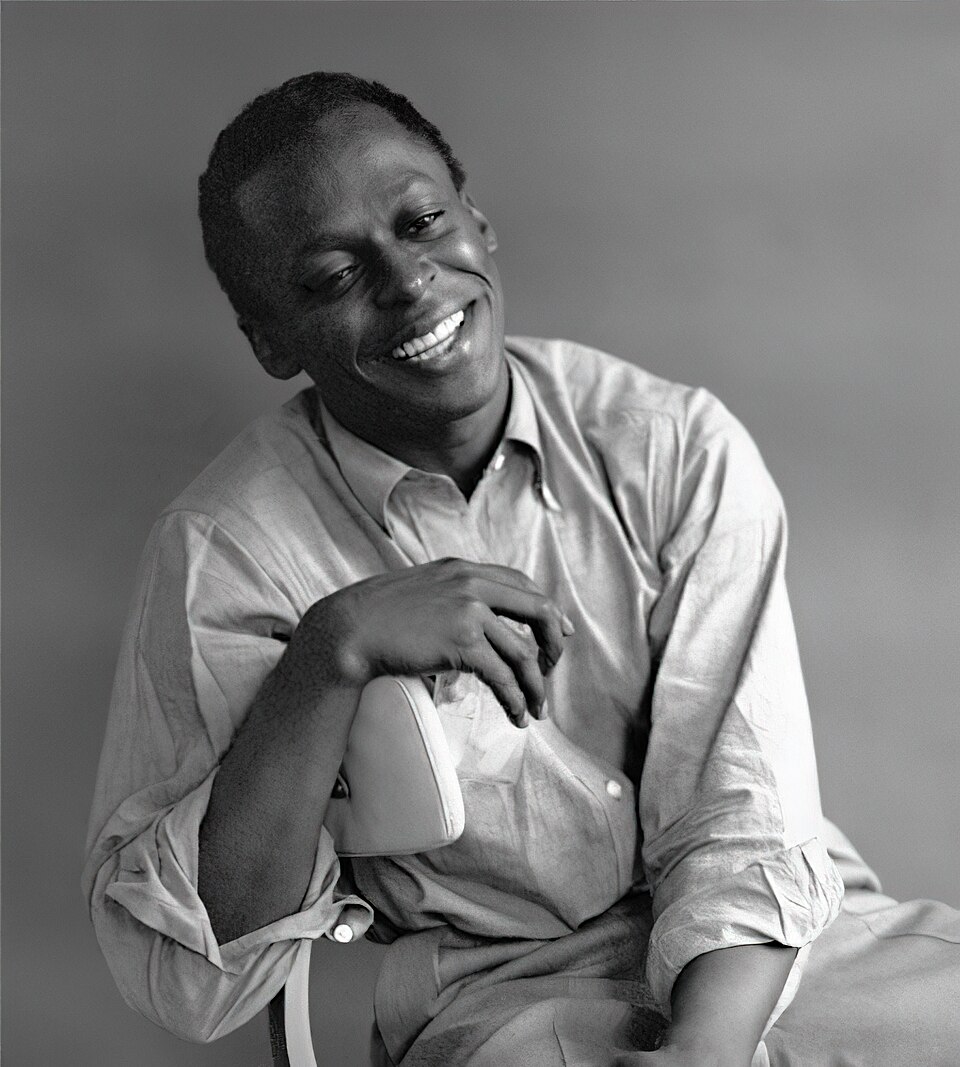
A trumpeter who remade jazz at least five times over, each reinvention arriving before audiences had finished absorbing the last.
Miles Davis did not belong to any single moment in jazz — he was the artist who kept moving the moment itself. From bebop apprentice to cool stylist to modal innovator to electric provocateur, his career was less a single arc than a sequence of sharp pivots, each one reorienting a genre.
Origins and bebop apprenticeship
Miles Dewey Davis III was born in 1926 in Alton, Illinois, and raised in East St. Louis in a middle-class household — his father was a dentist. He received his first trumpet at thirteen. In 1944 he moved to New York ostensibly to study at the Juilliard School, but quickly found himself in the orbit of Charlie Parker and Dizzy Gillespie on 52nd Street. He joined Parker's quintet, learning bebop from the inside at the highest level. His tone even then was distinctive — not the bright, projecting sound of Gillespie, but something more interior and restrained.
Cool jazz and the Miles Davis Nonet
By 1949 Davis had grown restless with bebop's density. The sessions he organised with arranger Gil Evans and baritone saxophonist Gerry Mulligan produced a quieter, more orchestrally conceived music. Released as Birth of the Cool (Capitol, 1957, from 1949–50 recordings), these sides named an aesthetic that would define a generation of West Coast players.
His signing to Columbia in 1955 and the formation of the First Great Quintet — with John Coltrane, Red Garland, Paul Chambers, and Philly Joe Jones — marked a commercial and artistic ascent. The late-1950s Columbia recordings with arranger Gil Evans (Miles Ahead, Porgy and Bess, Sketches of Spain) demonstrated that jazz and the symphony orchestra could meet on equal terms.
Modal jazz and Kind of Blue
In 1959, Davis recorded Kind of Blue in two sessions with a sextet that included Coltrane, Cannonball Adderley, Bill Evans, and Jimmy Cobb. The album replaced chord-sequence improvisation with modal scales, opening up a spaciousness that had no precedent in recorded jazz. It became — and remains — the best-selling jazz album ever made.1 Davis offered no grand theoretical statement; the musicians had minimal rehearsal time and some learned the pieces on the day of recording, which gives the album its quality of discovery.
| Period | Sound | Key release |
|---|---|---|
| 1949–50 | Cool, orchestral | Birth of the Cool |
| 1955–60 | Hard bop / modal | Kind of Blue |
| 1964–68 | Post-bop, Second Quintet | E.S.P., Miles Smiles |
| 1969–75 | Electric fusion | Bitches Brew |
Electric turn and later years
In a Silent Way (1969) and Bitches Brew (1970) applied studio layering and electric instruments to jazz improvisation, alienating some listeners and galvanising a new generation of rock-influenced musicians. The groups Davis assembled in this period — featuring Chick Corea, Herbie Hancock, John McLaughlin, and others — became seedbeds for the fusion movement of the 1970s.
After a five-year hiatus (1975–1980) caused by ill health, Davis returned with a more pop-inflected approach, working with producers including Marcus Miller. He died in Santa Monica in September 1991.
Do not fear mistakes — there are none.
Footnotes
- Kind of Blue has sold over five million copies in the United States alone, certified 5× Platinum by the RIAA. ↩