Nikolai Rimsky-Korsakov
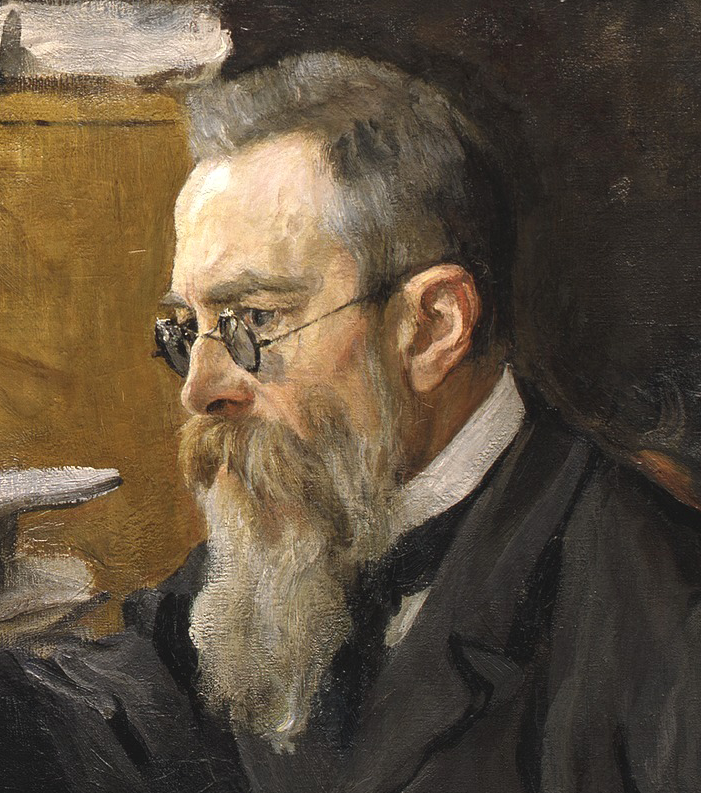
The Russian master of orchestral colour who made the symphony orchestra shimmer with fairy-tale light and Eastern promise.
Nikolai Rimsky-Korsakov was the supreme orchestral colourist of nineteenth-century Russia — a composer who could paint a sea-swell or a hummingbird's wing in brass and woodwind with an exactness that no contemporary could match. His fifteen operas and a handful of concert works made the sounds of Russian folklore and Eastern legend available to every orchestra in the world.
The naval officer who turned composer
Rimsky-Korsakov was born in 1844 in Tikhvin, a provincial town southeast of St Petersburg, into a family with a naval tradition. He entered the Naval College at twelve, began piano lessons, and encountered the music of Glinka — the revelation that Russian subjects could be treated with full symphonic seriousness. A chance introduction to Mily Balakirev, leader of the nationalist circle that would become known as The Five, redirected his ambitions permanently. His First Symphony was sketched during a three-year naval voyage and completed with Balakirev's guidance; it was performed in 1865, making Rimsky-Korsakov the first member of The Five to have a symphony performed publicly.
He remained a naval officer until 1873, composing in his spare time. The appointment as professor of composition and instrumentation at the St Petersburg Conservatory that year — a position he accepted despite knowing, by his own account, less theory than his students — forced a rigorous self-education that produced his lifelong reputation as the greatest teacher of orchestration in Russia.
Orchestral mastery
The works of the 1880s established his international reputation. Capriccio Espagnol (1887) displayed his capacity to translate the idioms of another culture into purely orchestral terms. Scheherazade (1888), a four-movement symphonic suite drawn from One Thousand and One Nights, became his most enduring concert work: a continuous narrative told through the contrast between a stern brass theme representing the Sultan and a sinuous solo violin representing Scheherazade herself. The Russian Easter Festival Overture (1888) wove Orthodox plainchant into a blazing ceremonial piece.
The art of orchestration is not a mechanical one, but a true art demanding a vast knowledge of the nature of sounds and a perfect mastery of tone colour.
The operatic world
Opera was Rimsky-Korsakov's primary concern. Of his fifteen operas, most draw on Russian fairy-tale and folk subject matter: The Snow Maiden (1882), Sadko (1898), The Tale of Tsar Saltan (1900), and The Golden Cockerel (1909), the last completed shortly before his death and staged posthumously. These works refined his approach to musical characterisation — the supernatural is rendered in chromatic harmonies and whole-tone scales while the human world uses diatonic writing, a system he used consistently enough to be called a harmonic signature.
He was also the era's most important editor and reviser of Russian music: he completed Mussorgsky's Boris Godunov and Khovanshchina, and orchestrated Borodin's Prince Igor — work that ensured those masterpieces reached the stage but also controversially reshaped the originals.
Teaching and legacy
As a teacher at the St Petersburg Conservatory for nearly four decades, Rimsky-Korsakov trained most of the leading Russian composers of the next generation, including Glazunov, Lyadov, and Igor Stravinsky, who studied privately with him from 1904 to 1908. His treatise Principles of Orchestration, compiled from his scores and published posthumously, remained a standard text throughout the twentieth century. The sensuous orchestral palette of Stravinsky's early ballets — The Firebird, Petrushka — is the direct descendant of his methods.