Otto Wagner
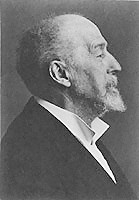
The Viennese architect who led the Secession's assault on historicism and designed a Vienna Metro system whose stations remain among the finest examples of rational ornament in European architecture.
Otto Wagner spent the first half of his career building handsome historicist apartment houses in Vienna and the second half dismantling everything he had done. His 1895 treatise Moderne Architektur argued that the only valid style was one derived from construction, materials, and purpose — not from historical precedent — and his own practice evolved accordingly, from the ornamental Art Nouveau of the Vienna Metro stations to the severe geometric clarity of the Postal Savings Bank, a building that pointed directly toward Modernism.
Formation and the classical inheritance
Wagner was born in 1841 in Penzing, then a suburb of Vienna. He studied at the Vienna Polytechnic, the Berlin Bauakademie, and the Vienna Academy, absorbing the eclectic historicist training of mid-century European architecture. His early practice produced large apartment buildings in the Ringstrasse manner — historicist, ornamented, respectable.
He was appointed professor at the Akademie der Bildenden Künste Wien in 1894, a position that made him the most influential architectural educator in Austria. His students included Josef Hoffmann, Joseph Maria Olbrich, and Rudolf Schindler.
Moderne Architektur and the Secession
In 1895 Wagner published Moderne Architektur, a polemical text that rejected the historicist approach of the Ringstrasse generation and argued that architecture should reflect the conditions of the present. "Every new style emerged from the previous one," he wrote, and the present required a new one derived from modern life, modern materials, and structural truth.
He became a founding member of the Vienna Secession in 1897, the breakaway group that included Gustav Klimt, Koloman Moser, and his former students Hoffmann and Olbrich. He exhibited with them and aligned his practice with the movement's search for a genuinely modern visual language.
The Vienna Metro
Between 1894 and 1901, with the city of Vienna, Wagner designed the stations, viaducts, and bridges of the Stadtbahn — the Vienna urban railway network. The stations are his best-known works: steel and glass canopies with floral Art Nouveau ornamentation in green and gold, functional yet richly decorated. Several survive in use today as part of the Vienna U-Bahn.
The Postal Savings Bank
Wagner's masterwork is the Austrian Postal Savings Bank (Österreichische Postsparkasse) on Georg-Coch-Platz in Vienna, designed in 1904 and completed in two phases by 1912. Its exterior is clad in granite and marble panels fixed with exposed aluminium bolts — decoration and structure made identical. The banking hall interior, with its barrel-vaulted glass ceiling and functional metal fittings, is among the purest early expressions of architectural Modernism.
The building anticipates the International Style by two decades.
The realist is the true architect. Only he is capable of designing works that stand the test of time.
Legacy
Wagner's later designs — the Lupus Hospital (1910–13), the second Villa Wagner (1912) — moved toward stripped classicism and geometric severity. He died in 1918 during the influenza pandemic, before his proposals for a new Vienna were realised. Adolf Loos, who attacked ornament explicitly in "Ornament and Crime" (1910), shared Wagner's direction; so did the entire Viennese strand of early Modernism.