Philip Glass
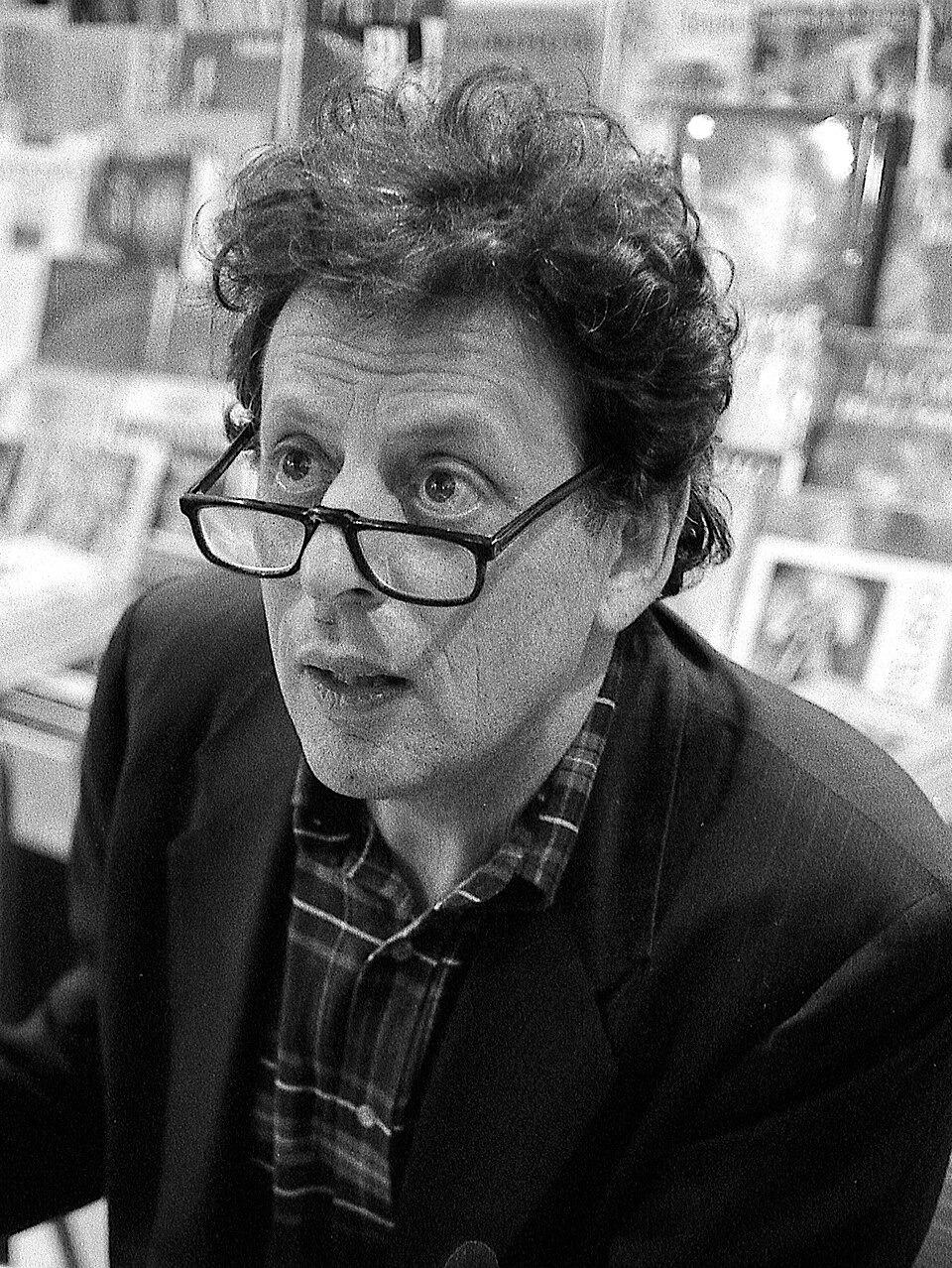
An American composer who made repetition into a structural argument, dissolving the boundary between classical concert music and the wider culture around it.
Philip Glass arrived at his mature style by discarding almost everything Western art music had accumulated since Bach — and then rebuilding from the ground up using pulse, cycle, and accumulation. The result was music that sounded unlike anything before it, and that reached audiences far outside the concert hall.
Formation and the encounter with Indian music
Glass was born in Baltimore in 1937. His father ran a record store, which gave the young Glass unusual access to recordings across genres. He entered the University of Chicago at fifteen, later studying at the Juilliard School in New York under Vincent Persichetti and Nadia Boulanger in Paris. Boulanger's rigorous instruction in counterpoint and harmony gave him the classical foundation he would later systematically unravel.
The decisive turn came in 1965–66 when Glass worked in Paris as a film score transcriber for Ravi Shankar, adapting Indian classical music into Western notation. The experience confronted him with an entirely different relationship to rhythm — not metre divided into beats, but additive patterns built from small units. He returned to New York and, with fellow composers Steve Reich and La Monte Young as context, began stripping his music back to essentials.
The ensemble and the Portrait Trilogy
In 1968 Glass formed the Philip Glass Ensemble, a group of amplified keyboards and winds designed to perform his work without the mediation of traditional orchestras. The ensemble could play louder, sustain longer, and — crucially — tour on a budget, performing in lofts and art spaces as much as concert halls. This placed Glass squarely inside the New York downtown art world rather than the uptown classical establishment.
The breakthrough came with Einstein on the Beach (1976), a five-hour opera created with director Robert Wilson. It had no conventional narrative, no intervals (audiences came and went), and a libretto of numbers, solfège, and fragments. Its premiere at the Avignon Festival and subsequent run at the Metropolitan Opera were defining events in late-twentieth-century music theatre.1
Satyagraha (1980) and Akhnaten (1984) completed what Glass called his Portrait Trilogy — three operas on figures who transformed their worlds through nonviolent force or religious vision: Gandhi, Akhenaten.
Style and method
Glass described his approach as "music with repetitive structures" rather than minimalism — a distinction he maintained partly because the label flattened differences between composers. His characteristic technique involves cyclic figures that shift phase with each other, adding or subtracting notes to create gradual harmonic movement. Tempo and pulse are constant; complexity emerges from layering rather than development.
| Feature | Description |
|---|---|
| Rhythm | Additive patterns; stable pulse |
| Harmony | Slow-moving, often modal |
| Form | Cyclic; accumulation and subtraction |
| Instrumentation | Often amplified keyboards and winds |
Film, crossover, and legacy
Glass's film scores — Koyaanisqatsi (1982), The Hours (2002), Notes on a Scandal (2006) — reached audiences in the tens of millions. His work for the Kronos Quartet, collaborations with David Bowie and Brian Eno, and appearances in pop culture demonstrated an unusually wide footprint for a composer operating within the art-music world.
Music with repetitive structures is not about minimalism — it is about the discovery of what emerges when you hold still long enough to hear it change.
Footnotes
- The Metropolitan Opera run of Einstein on the Beach was self-produced by Glass and Wilson, who reportedly went into significant personal debt to mount it. ↩