Philip Johnson
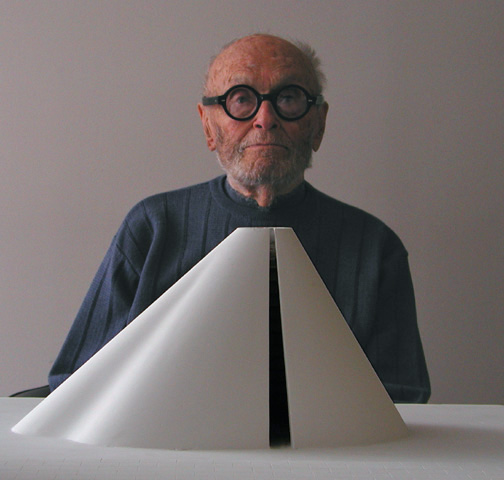
The architect who curated modernism for America, then abandoned it for postmodernism — and won the first Pritzker Prize doing both.
Philip Johnson did not invent modernism in America, but he did more than almost anyone to install it — first as a curator who put the International Style before a mass audience, then as an architect who built crisp Miesian glass boxes, and finally as a postmodernist who capped skyscrapers with Chippendale pediments. His career spanned eight decades, two movements, and one Pritzker Prize. It was also shadowed by a period of far-right and pro-Nazi sympathies in the 1930s that he later acknowledged without fully accounting for.
Critic and curator
Johnson was born in Cleveland in 1906 and read philosophy at Harvard before turning to architecture. In 1932, with Henry-Russell Hitchcock, he organised the "Modern Architecture: International Exhibition" at the Museum of Modern Art in New York and co-authored the accompanying catalogue, which introduced the term International Style to American audiences. The exhibition framed European modernism — Le Corbusier, Mies van der Rohe, Gropius — as a coherent stylistic movement defined by volume rather than mass, regularity rather than symmetry, and the rejection of applied ornament. It was an act of editorial power: Johnson and Hitchcock shaped how a generation of American architects understood what modernism was. Johnson simultaneously founded MoMA's Department of Architecture and Design, which he directed until 1934 and again from 1946 to 1954.
During the late 1930s Johnson travelled repeatedly to Germany and filed dispatches for the radio broadcaster Father Coughlin's Social Justice newspaper sympathetic to the Nazi regime. He attended the Nuremberg rallies. He later described this period as a serious moral failure, and in 1940 he returned to Harvard to study architecture under Walter Gropius — one of the European modernists he had championed, now himself in exile from National Socialism. The FBI kept a file on him. He was never charged.
Glass House and Miesian modernism
After graduating from Harvard's Graduate School of Design in 1943, Johnson built his own residence in New Canaan, Connecticut, between 1945 and 1949. The Glass House is a single-room steel-and-glass rectangle set in open landscape: four walls of floor-to-ceiling glazing, a brick cylinder containing bathroom and fireplace as the only interior division. It drew directly on Mies van der Rohe's Farnsworth House, which was under design at the same time. Johnson acknowledged the debt; the two buildings remain the defining pair of Miesian residential modernism in America. Johnson lived in the Glass House until his death and expanded the New Canaan estate over decades with guest pavilions, galleries, a library, and other structures, creating an open-air laboratory of architectural ideas.
He collaborated with Mies on the Seagram Building in New York (1958), the definitive postwar corporate tower. His contribution was chiefly the Four Seasons restaurant interiors. Throughout the 1950s and 1960s he designed buildings that adhered closely to the glass-and-steel vocabulary: the Amon Carter Museum in Fort Worth (1961), the New York State Theater at Lincoln Center (1964), the IDS Center in Minneapolis (1973).
Postmodern turn
In the late 1970s Johnson grew impatient with late modernism's austerity and began incorporating historical ornament and classical allusion into his work. The AT&T Building at 550 Madison Avenue in New York, completed in 1984, announced the shift to a broad audience: a granite-clad skyscraper whose broken-pediment top — immediately nicknamed the Chippendale — became the emblem of postmodern architecture and appeared on the cover of Time magazine. The building was controversial precisely because Johnson's authority lent postmodernism a legitimacy it might not otherwise have achieved so quickly.
He continued to design into his nineties. The Williams Tower in Houston (1983) and 190 South La Salle Street in Chicago (1987) extended the postmodern vocabulary. He also redesigned the Sculpture Garden at MoMA, first in 1953, integrating it with the museum's expansion.
Recognition and late life
Johnson received the first Pritzker Architecture Prize in 1979, in the inaugural year of the award. The citation described him as a pivotal figure in the development of contemporary architecture. He was elected to the American Academy of Arts and Letters, received the AIA Gold Medal in 1978, and held honorary degrees from institutions across the United States. He lived openly as a gay man in later life and was a significant patron of younger architects through his partnerships and his criticism. He died at the Glass House on 25 January 2007, aged 98.
"All architecture is shelter, all great architecture is the design of space that contains, cuddles, exalts, or stimulates the persons in that space."