Ravi Shankar
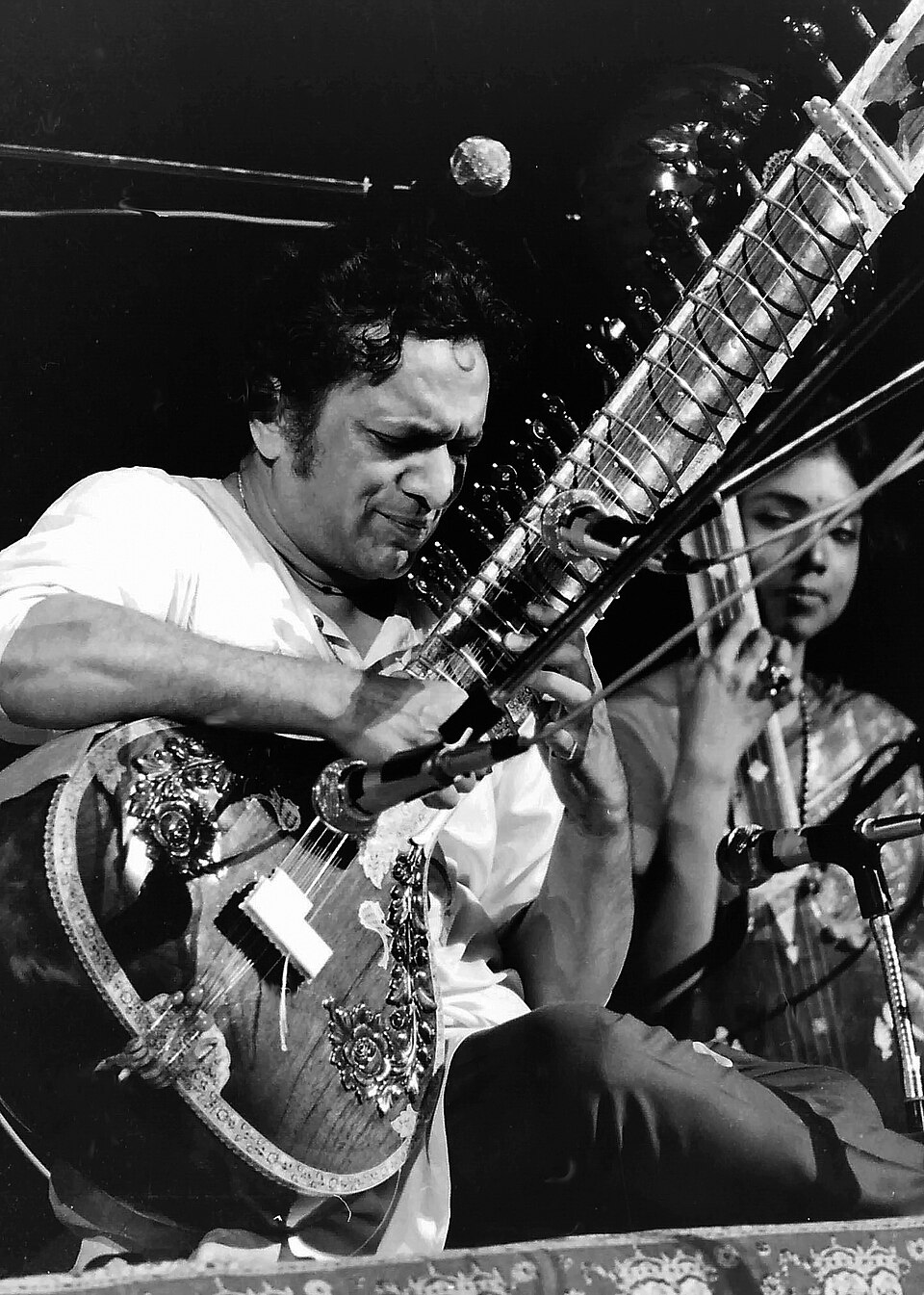
The sitarist who carried Indian classical music to global audiences and made the raga a form the world learned to hear.
Ravi Shankar did more than any other single musician to bring the Hindustani classical tradition before a worldwide audience. Over seven decades he performed as a soloist, composed for films and orchestras, taught Western musicians the logic of the raga, and received India's highest civilian honour — all without simplifying the tradition he carried.
Formation in dance and music
Shankar was born Robindra Shankar Chowdhury on 7 April 1920 in Varanasi. As a child he toured Europe and America with his elder brother Uday Shankar's dance troupe, experiencing the West before he had fully absorbed India. The meeting that shaped his life came when he encountered the multi-instrumentalist Allauddin Khan, a master of the Maihar gharana. At eighteen he left the dance troupe and moved to Maihar in Madhya Pradesh to study under Khan, living in the household as a disciple for seven years. The rigour of that apprenticeship — long hours of practice, absorption in the grammar of the raga — formed the technical foundation of everything that followed.
International recognition and the 1960s
In 1956 Shankar began regular tours of Europe and North America, performing Indian classical music to audiences encountering it for the first time. His ability to explain the architecture of a raga without condescending to his listeners made him an effective cultural ambassador. In 1966 he began teaching George Harrison of the Beatles, an association that brought Indian music into millions of households through Harrison's incorporation of sitar into rock recordings. Shankar was careful to position this exposure as a door, not a destination: he consistently urged Western listeners toward the classical tradition rather than its pop derivatives.
His performance at the Monterey Pop Festival in 1967 and his central role in the Concert for Bangladesh in 1971 — organised by Harrison to raise funds for refugees — demonstrated that Indian classical music could hold an outdoor festival audience without compromise.
A raga is not a scale, not a mode. It is a complete personality with its own ascending and descending form, its characteristic phrases, its time and season.
Composition and the late career
Beyond the concert platform, Shankar composed prolifically: film scores for Satyajit Ray's Apu Trilogy in the 1950s, concertos for sitar and orchestra, and works that explored the overlap between Hindustani and Western forms without conflating them. He founded schools of Indian music in Mumbai and Los Angeles. In 1999 he received the Bharat Ratna, India's highest civilian award. He continued performing into his nineties, giving his last concert in November 2012, weeks before his death.
He is the father of sitarist and composer Anoushka Shankar and of singer Norah Jones.