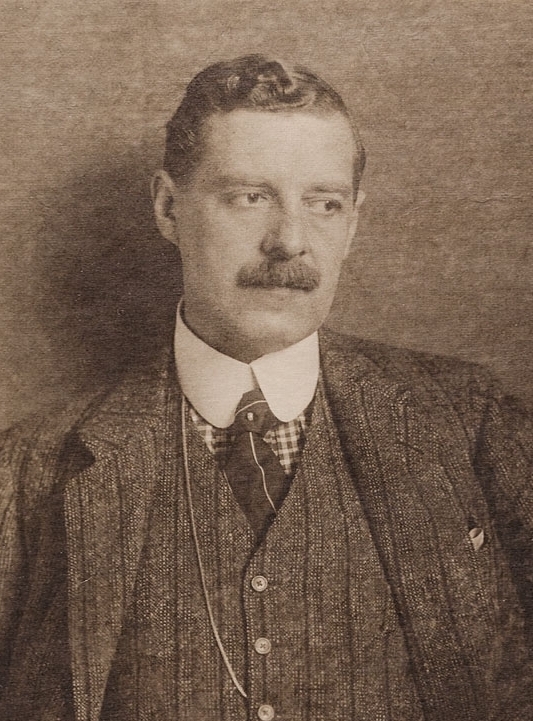
Rem Koolhaas
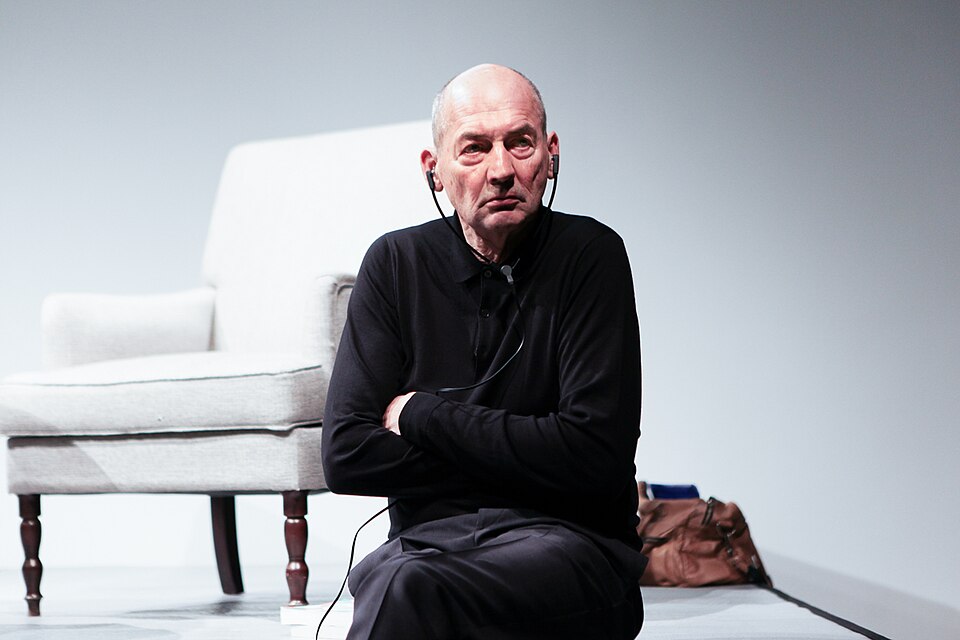
The architect who diagnosed the contemporary city as a condition to be studied rather than a problem to be solved, and built accordingly.
Rem Koolhaas trained as a screenwriter before turning to architecture, and the sensibility never left: his buildings are arguments, his books are provocations, and his office — OMA — operates more like a research institution than a conventional practice. Where most architects resist the commercial city, Koolhaas has always studied it with forensic enthusiasm, extracting the logics of the mall, the airport, and the generic tower and feeding them back as critical design.
From journalism to architecture
Koolhaas was born in Rotterdam, raised partly in Indonesia, and worked as a journalist and film-writer in the early 1960s before enrolling at the Architectural Association in London. He studied under Elia Zenghelis and spent a year at the Institute for Architecture and Urban Studies in New York, where his immersion in Manhattan's grid, density, and programmatic extravagance led to his 1978 polemic Delirious New York: A Retroactive Manifesto for Manhattan. The book argued that Manhattan had already developed a secret architectural doctrine — the Culture of Congestion — without any architect acknowledging it. It remains one of the most read and debated texts in architectural theory.
In 1975, Koolhaas co-founded the Office for Metropolitan Architecture (OMA) in London with Elia Zenghelis, Zoe Zenghelis, and Madelon Vriesendorp. The office moved to Rotterdam in 1978.
OMA and built work
For much of the 1980s OMA was more talked about than built. Then came the Kunsthal Rotterdam (1992) — a museum without a conventional programme, threaded by a public ramp that passes through every gallery — and the practice's international reputation was secured. The building's abrupt material shifts (concrete, glass, corrugated polycarbonate) and its spatial continuity through collision rather than transition defined a new kind of public building.1
Seattle Central Library (2004) applied similar thinking at civic scale: a series of differentiated platforms — the Book Spiral, the Mixing Chamber, the Living Room — wrapped in a faceted glass-and-steel mesh that reflects the sky in pieces. The building became one of the most discussed American public buildings of its decade.
In China, the CCTV Headquarters in Beijing (2012) went further: a continuous loop of two inclined towers joined at top and bottom, twisting in section, making a new kind of skyscraper that reframes the relationship between ground and sky.
| Building | Completed | Location |
|---|---|---|
| Kunsthal Rotterdam | 1992 | Rotterdam, Netherlands |
| Educatorium, Utrecht | 1997 | Utrecht, Netherlands |
| Casa da Musica | 2005 | Porto, Portugal |
| Seattle Central Library | 2004 | Seattle, USA |
| CCTV Headquarters | 2012 | Beijing, China |
Theory and research
Alongside OMA, Koolhaas runs AMO — a think tank that applies architectural thinking to media, politics, and branding — and has taught for decades at the Harvard Graduate School of Design, where the research project Project on the City produced several books examining Lagos, the Pearl River Delta, and Rome. His 1995 collection S, M, L, XL (co-authored with Bruce Mau) is one of the largest architectural books ever published, mixing essays, fiction, photographs, and manifestos.
Legacy
The Pritzker Prize in 2000 recognised a body of work that had already influenced a generation. Architects who emerged from OMA — Zaha Hadid, Bjarke Ingels, Winy Maas — have in different ways extended its logic of performative excess, programmatic mixing, and formal provocation. Koolhaas himself has grown increasingly sceptical of architecture's capacity for cultural agency, a late-career pessimism that reads in his smaller, plainer recent work.
Architecture has a past, and the past is more useful than the future.
Footnotes
- The Kunsthal's public ramp passes through the building continuously so visitors can traverse the entire museum without entering any gallery — a deliberate critique of the obligatory museum circuit. ↩