René Descartes
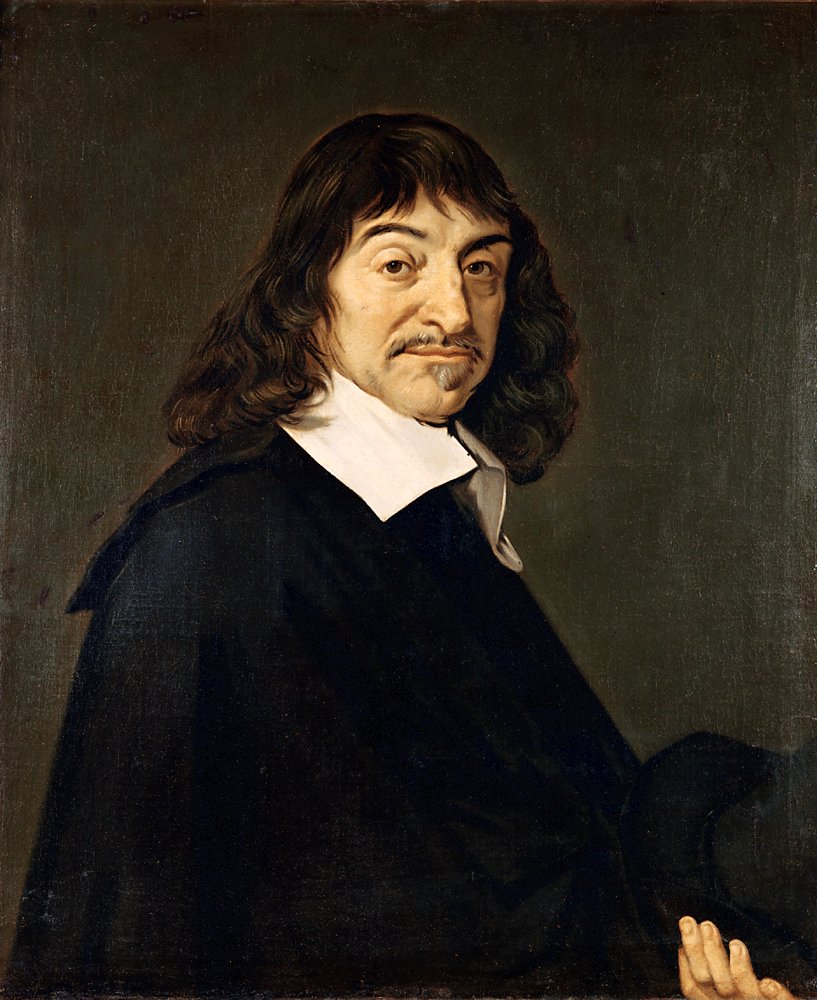
The French polymath who dissolved the foundations of medieval scholasticism and rebuilt philosophy on the single certainty of a thinking self.
René Descartes set out to demolish everything he had been taught and rebuild knowledge on indubitable ground. The method he devised — radical doubt, clear and distinct ideas, the primacy of mind over matter — defined the agenda of Western philosophy for the next three centuries and produced, as a by-product, one of the most consequential innovations in the history of mathematics.
Early life and education
Descartes was born on 31 March 1596 in La Haye-en-Touraine (now renamed Descartes in his honour), in the Touraine region of France. His mother died of tuberculosis when he was an infant; he was raised largely by a grandmother and then educated at the Jesuit college of La Flèche in Anjou, one of the finest institutions of the period. He excelled there in mathematics and later studied law at Poitiers, graduating in 1616.
Dissatisfied with the state of received knowledge, he enlisted as a gentleman soldier — first in the Dutch States Army, then in the Bavarian forces — not for the fighting, but for the liberty of travel and thought it allowed. It was during this period, on the night of 10 November 1619, that he reported a series of vivid dreams which he interpreted as a divine commission to reform human knowledge through mathematics and reason.
Method and the Meditations
Descartes spent years developing his method before publishing. The Discourse on the Method (1637), written in French rather than Latin, was intended to be accessible to educated readers outside the universities. It outlined a four-part method: accept nothing as true unless it is clear and distinct; divide problems into manageable parts; proceed from the simple to the complex; and review each step for completeness. Appended to it were essays demonstrating the method in action — including La Géométrie, which fused algebra and geometry into what we now call analytic geometry, introducing the coordinate system that bears his name.
The Meditations on First Philosophy (1641) carried the methodological programme into metaphysics. Descartes subjected every belief to systematic doubt — the senses deceive, mathematical reasoning might be manipulated by a malevolent demon — until he found one proposition resistant to all doubt: that he was thinking. Even if everything else is an illusion, the act of doubting presupposes a doubter. From this he derived his famous formulation.
The Cogito and its consequences
"Cogito, ergo sum" — I think, therefore I am — is the pivot on which Cartesian philosophy turns. From the certainty of the thinking self, Descartes reconstructed the external world, arguing that the existence of a non-deceptive God guaranteed that clear and distinct perceptions correspond to reality. This argument has been contested at every step, but its structure — grounding knowledge in subjective certainty rather than in inherited authority — inaugurated modern epistemology.
His substance dualism — the doctrine that mind and body are entirely distinct substances, the one thinking and unextended, the other extended and unthinking — exerted enormous influence and generated an enduring puzzle: how do two such different substances interact? The mind-body problem Descartes bequeathed to philosophy remains a live research question.
Mathematics and science
Descartes' contributions outside philosophy were substantial. In La Géométrie he demonstrated that any geometric curve could be expressed as an algebraic equation, unifying two previously separate mathematical traditions. He formulated an early law of conservation of motion in his physics, and his work in optics included an account of the refraction of light. His cosmological model, the vortex theory, was eventually superseded by Newtonian mechanics but dominated European natural philosophy for decades.
He died on 11 February 1650 in Stockholm, where he had been summoned by Queen Christina of Sweden to instruct her in philosophy. The northern winter and early-morning tutorial schedule are said to have broken his health; he contracted pneumonia and died at fifty-three.
I think, therefore I am.