Richard Neutra
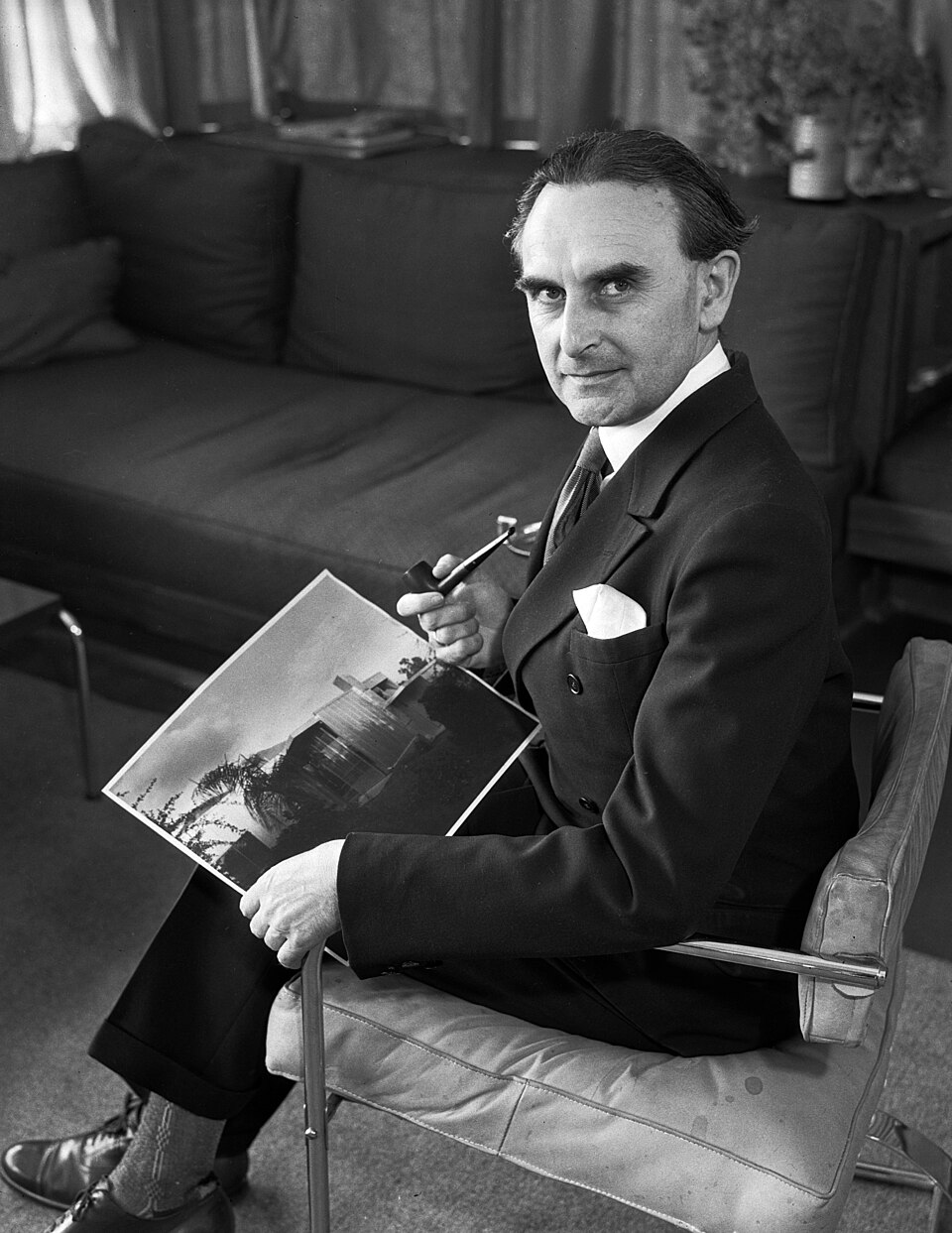
An Austrian-American architect who transplanted European modernism to Southern California and produced houses that dissolved the boundary between shelter and landscape.
Richard Neutra arrived in California in 1925 with a Viennese education in modern architecture and a conviction that buildings should support human physiological and psychological wellbeing as much as structural function. The houses he produced in the desert and hills of Southern California — glass-walled, steel-framed, oriented to light and landscape — became the visual language of California modernism.
Vienna, Europe, and emigration
Neutra was born in Vienna on 8 April 1892 into an assimilated Jewish family. He studied architecture at the Technische Hochschule Wien and came under the influence of Otto Wagner, whose functionalist rationalism left a permanent mark. He worked briefly with Erich Mendelsohn in Berlin and then, crucially, with Frank Lloyd Wright at Taliesin in Wisconsin after emigrating to the United States in 1923. Wright's integration of building and site — the idea that architecture should grow from its landscape rather than be imposed upon it — complemented what Neutra had absorbed from European modernism.
He settled in Los Angeles in 1925, drawn by the climate, the permissive building culture, and the availability of relatively flat land and light. He joined the architect Rudolf Schindler's household initially before establishing his own practice.
The California houses
Neutra's early reputation rested on the Lovell Health House in the Hollywood Hills (1929), a steel-frame structure with suspended sleeping porches and extensive glazing, commissioned by a naturopath and newspaper columnist who promoted physical fitness. The house was among the first steel-framed residential buildings in the United States and placed Neutra on the international modern architecture map, appearing in Henry-Russell Hitchcock and Philip Johnson's 1932 International Style exhibition at MoMA.
His most celebrated single work is the Kaufmann Desert House in Palm Springs (1946), built for the same Edgar Kaufmann who commissioned Fallingwater from Wright. Neutra's structure responds to the desert with long horizontal overhangs, floor-to-ceiling glass, and a gloriette — an outdoor pavilion — that blurs the distinction between inside and outside. The house photographs as a pure integration of shelter and Mojave landscape.
The human being is the measure of all things, and architecture is made for human beings.
Biorealism
In his later career Neutra developed what he called biorealism — a theory that architectural design should be grounded in human sensory and neurological responses. He wrote about the effects of light, air, sound, and material texture on human stress and wellbeing, anticipating by decades the evidence-based design research that has since become a significant field. His book Survival Through Design (1954) presented this argument at length.