Robert Schumann
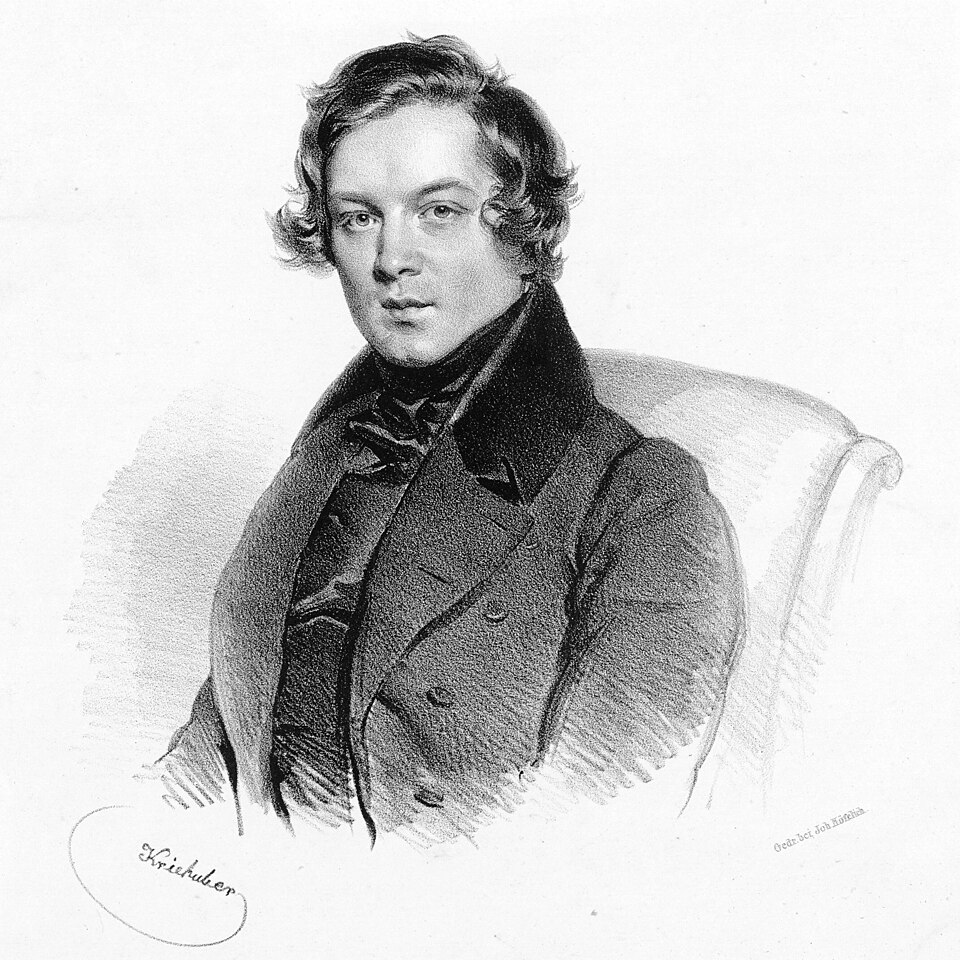
The German Romantic whose piano music and songs gave the inner life a formal home, and whose criticism fought for a generation of composers the concert world had not yet heard.
Robert Schumann wrote music of interior states — dreams, childhood, longing, anxiety — and criticism of rare perceptiveness, reviewing the early Chopin and the young Brahms with a precision that outpaced most of his contemporaries. His piano music captures emotional experience in forms he shaped himself; his song cycles compress an entire emotional arc into a sequence of minutes. The mental illness that shadowed his later years ended his composing life early and made his death, at forty-six, one of the great losses of the century.
Origins and literary formation
Schumann was born in 1810 in Zwickau, Saxony, the son of a bookseller and publisher. The literary environment was formative: he grew up reading Jean Paul Richter, E.T.A. Hoffmann, and the German Romantics, and carried their sense of the interior and the fantastic into his music. He began studying law in Leipzig and Heidelberg but had always intended music, and in 1830 he gave up the law and moved in with Friedrich Wieck, a celebrated piano teacher, to study the instrument seriously.
An injury to his right hand — reportedly from a device he used to strengthen the fourth finger, though the precise cause remains disputed — ended his career as a performer and redirected his energy entirely to composition and criticism.
Piano music and song cycles
The 1830s were his most productive decade for solo piano: Carnaval (1835), Kinderscenen (1838), Kreisleriana (1838), and Davidsbündlertänze (1837) all date from these years. The character pieces — short, titled, intensely focused — became the medium in which German Romanticism found its domestic voice. His alter egos Florestan (impulsive, extrovert) and Eusebius (dreamy, withdrawn) appear in his critical writings and in the character of the music itself.
The year 1840 — the year he finally married Clara Wieck, against her father's fierce opposition — was a Liederjahr: he composed approximately 140 songs, including the cycle Dichterliebe, settings of twenty Heinrich Heine poems that trace the arc of love, betrayal, and resignation.
To send light into the darkness of men's hearts — such is the duty of the artist.
Orchestral and chamber works
The 1840s brought the orchestral and chamber works: four symphonies, the Piano Concerto in A minor (1845), and the Piano Quintet in E-flat (1842). The symphonies have been criticised for their orchestration — too thick, the inner parts not heard clearly enough — and various conductors and editors have revised them. The Piano Concerto, however, is one of the supreme works of the Romantic concerto repertoire, its first-movement development driven by a single two-note cell through transformations of extraordinary economy.
His championing of younger composers in the Neue Zeitschrift für Musik, which he founded in 1834 and edited for a decade, was prescient: his notice of Chopin's Op. 2 variations in 1831, which opened "Hats off, gentlemen — a genius," is the most famous piece of music criticism of the century.
Legacy
Schumann's critical writings, collected and re-read, have proved as durable as his compositions. His discovery of Brahms — whom he announced in 1853 as the composer who would carry Beethoven's tradition forward — was among the most consequential acts of musical advocacy in the century. His piano cycle Kinderscenen and the song cycle Dichterliebe remain central repertoire pieces; his Piano Concerto is among the half-dozen most performed of the nineteenth century.