Sergei Prokofiev
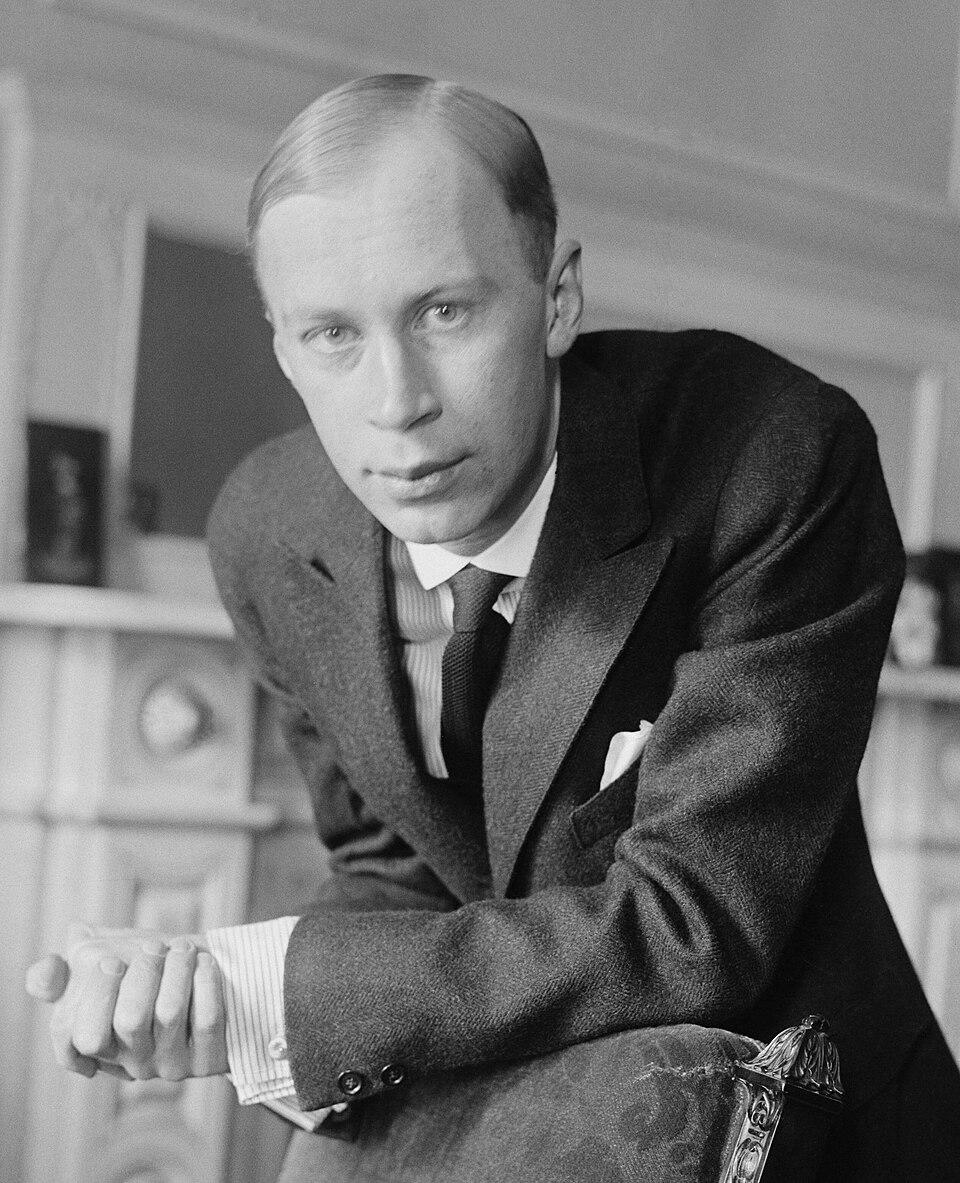
A composer of fierce irony and lyrical warmth whose seven symphonies, five piano concertos, and landmark ballets defined the contested space between Soviet doctrine and musical individuality.
Sergei Prokofiev was among the most prolific and stylistically distinctive composers of the twentieth century — sardonic, tender, and rhythmically driven by turns, capable of broad popular appeal and uncompromising complexity within the same work. His return to the Soviet Union after years in the West forced an accommodation with Socialist Realism that shaped and constrained his late career without extinguishing his inventiveness.
Prodigy and early career
Prokofiev was born in 1891 in Sontsivka in eastern Ukraine, then part of the Russian Empire. He began composing at five, under the supervision of his mother, an accomplished pianist. At thirteen he entered the St Petersburg Conservatory, studying with Rimsky-Korsakov among others, and graduated having already produced a body of work notable for its harmonic astringency and rhythmic energy. His First Piano Concerto (1912) and the ferocious Toccata for piano (1912) signalled a deliberately provocative departure from the prevailing post-Romantic style.
His early ballets commissioned by Sergei Diaghilev for the Ballets Russes — Chout (1921) and Le Pas d'acier (1927) — placed him firmly in the modernist avant-garde. The opera The Love for Three Oranges (1921), composed for Chicago, showed a gift for comic grotesque that would recur throughout his career.
Western years
After the Revolution Prokofiev left Russia in 1918, living and composing successively in the United States, Germany, and France. The period produced major works in every genre: the Third Piano Concerto (1921), among the most performed of the twentieth century; the ballet The Prodigal Son (1929); and the Symphony No. 3 (1928). He also composed the opera The Fiery Angel during these years, though it was not staged in his lifetime.
I want nothing better, nothing more flexible or more complete than the sonata form, which contains everything necessary to my structural purpose.
Return to the Soviet Union
Prokofiev returned definitively to the Soviet Union in 1936, motivated partly by personal ties and partly by the cultural prestige the Soviet state offered its artists. The move coincided with a broadening of his melodic style — Peter and the Wolf (1936), composed for Moscow's Central Children's Theatre, became his most widely heard work. The ballet Romeo and Juliet (1935–36), with its celebrated Dance of the Knights, became a cornerstone of the twentieth-century ballet repertoire.
The late 1940s brought catastrophe: in 1948 the Zhdanov Decree condemned Prokofiev alongside Shostakovich and others for "formalism" and "anti-democratic tendencies." He spent his remaining years attempting to satisfy official demands while continuing serious composition. The Symphony No. 5 (1944), written during the war, and the Seventh Symphony (1952) represent the range of his late output.
He died on 5 March 1953 — the same day as Stalin — and his death was largely unremarked in Moscow amid the official mourning.