Steve Reich
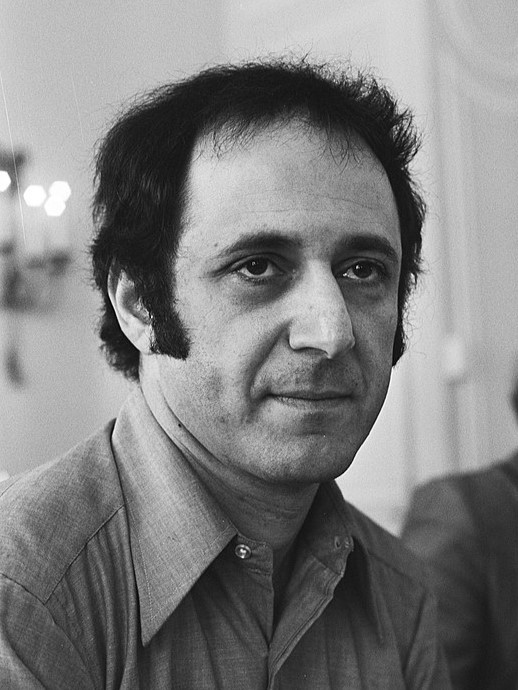
The New York composer who discovered that letting two identical phrases drift apart could generate more musical complexity than any score.
Steve Reich built a compositional system from the simplest act of listening: noticing that two identical tape loops, running at nearly identical speeds, gradually fall apart and realign in patterns that no composer could notate in advance. From that discovery in the mid-1960s he developed a body of work — phase pieces, pulse music, documentary compositions — that changed what minimal could mean and influenced producers, rock bands, and concert composers in equal measure.
Origins
Reich studied philosophy at Cornell before turning to music at the Juilliard School and then Mills College, where he worked with Luciano Berio and Darius Milhaud. His decisive break came not in the concert hall but in a San Francisco recording studio. Working with a speech fragment by a Pentecostal preacher for "It's Gonna Rain" (1965), he fed the same loop through two tape machines and watched them slip out of sync — a mechanical accident that became a compositional principle. "Come Out" (1966), built on a recorded phrase from a victim of police violence, pressed the same method into political use.
Defining work
The phase pieces that followed — Piano Phase (1967), Violin Phase (1967), Clapping Music (1972) — stripped the technique to its essentials, eliminating tape and handing the process to live performers. Music for 18 Musicians (1976) expanded the palette to harmony and sustained breath, producing his most approachable and widely heard composition: a 70-minute arc of interlocking pulses, marimba, vibraphone, strings, and voices that moves through eleven chords without obvious drama. Different Trains (1988) layered string quartet recordings against speech samples from Holocaust survivors and American train porters, inventing a form of documentary music that won a Grammy for Best Contemporary Composition. Double Sextet (2007) earned the Pulitzer Prize for Music in 2009.
Method and style
Reich's method is transparent by design. He described his aim in the 1968 essay "Music as a Gradual Process": to make the process itself audible, so the listener hears not only the result but the mechanism producing it. Pulse is constant; harmonic change is slow; the ear does work the eye might do elsewhere, tracking small differences across repetition. That insistence on perceptible process aligned him with visual Minimalism — he exhibited alongside Sol LeWitt and Richard Serra — but his music generates more warmth than the term suggests.
Legacy
Reich's influence spread quickly outside new-music circles. Brian Eno cited him, as did members of Radiohead and Kraftwerk; his pulse textures became a structural resource for electronic producers. He collaborated with video artist Beryl Korot on the documentary operas The Cave (1993) and Three Tales (2002), extending his tape-speech method to a full theatrical form. WTC 9/11 (2010) returned to the approach of Different Trains, this time recording first responders and air-traffic controllers. Across sixty years of work, the core discipline held: listen for what the material is already doing.
"I am interested in perceptible processes. I want to be able to hear the process happening throughout the sounding music."