Thelonious Monk
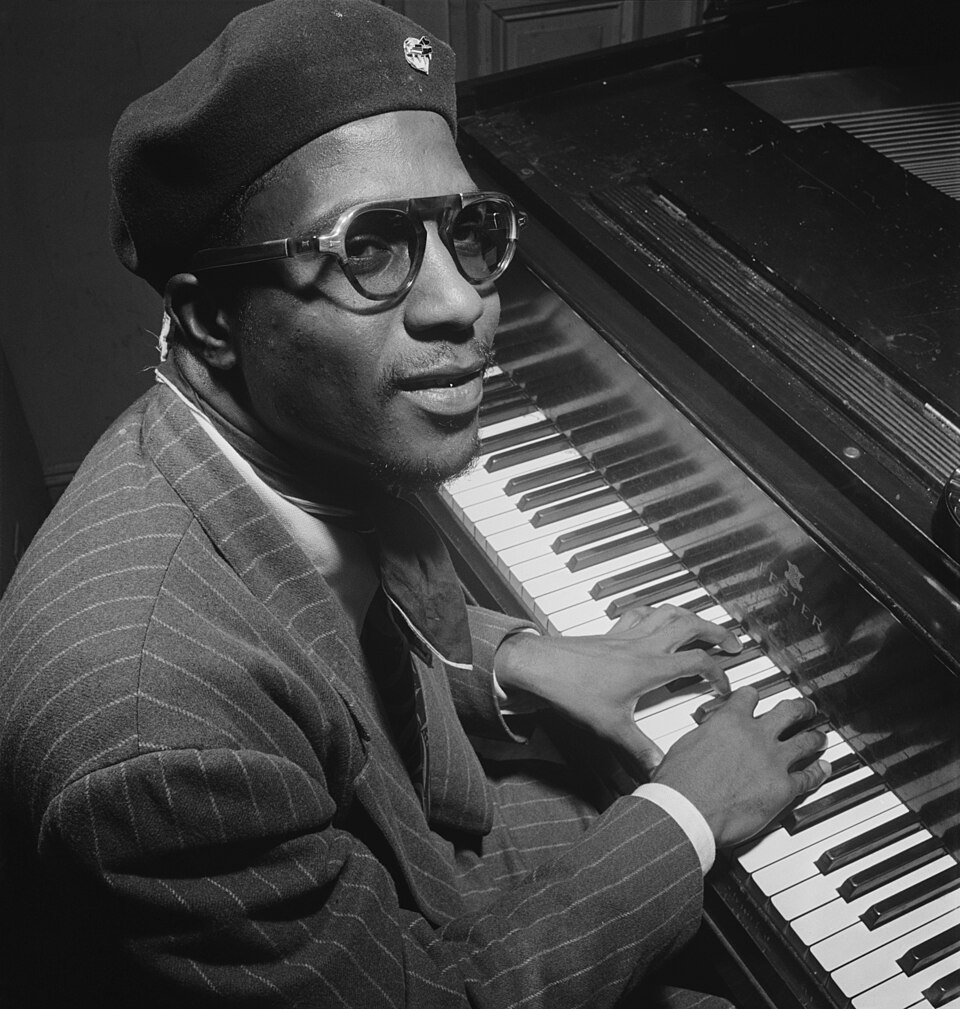
An American pianist and composer whose angular, dissonant, silence-laced style helped invent bebop and then stood so far apart from it that classification never quite caught up.
Thelonious Monk built a body of work from the notes most pianists avoided — the wrong-sounding intervals, the deliberate silences, the flattened, percussive attack that made a melody land like a struck object. He was central to the birth of bebop and then, almost immediately, a category unto himself: the second-most-recorded jazz composer after Duke Ellington, and one of the few whose compositions became standards while his playing remained unmistakably his own.
San Juan Hill to Minton's
Born in Rocky Mount, North Carolina, in 1917, Monk grew up in the San Juan Hill neighbourhood of New York City, where his family moved when he was a child. By the early 1940s he had become the house pianist at Minton's Playhouse in Harlem, the club whose after-hours sessions were the laboratory for a new music. Alongside players such as Dizzy Gillespie and Charlie Parker, Monk was central to the development of bebop — the faster, harmonically denser style that broke with the swing era. Yet even in this founding company his voice stood apart: where bebop prized velocity, Monk prized placement, letting notes hang and clash and resolve on his own timing.
An unmistakable style
Monk's piano technique was angular, percussive, and dissonant, built on unusual harmonies, flattened chords, and the pointed use of silence. He treated the keyboard almost as a set of tuned drums, striking clusters and letting space do as much work as sound. This idiosyncrasy extended to the stage, where he was known for his hats and for rising to dance while his sidemen soloed. The strangeness that later audiences prized was, for years, held against him: his music was heard as difficult by listeners expecting the fluency of his peers, though musicians recognised the internal rigour beneath it.
That difficulty was compounded by circumstance. In 1951 Monk's New York cabaret card was revoked following a drug-related arrest, barring him from performing in the city's clubs for several years — a loss of livelihood at a formative moment in his career. He continued to write and record, but the enforced absence from New York's stages narrowed his reach for much of the decade.
Recognition and withdrawal
The turn came with the Riverside Records years, roughly 1955 to 1961, which brought Monk wider recognition and reframed his catalogue as a canon rather than a curiosity. National attention followed: on 28 February 1964 he appeared on the cover of Time magazine, one of only a handful of jazz musicians ever so featured. By this point his compositions — 'Round Midnight, Blue Monk, Straight No Chaser, Ruby My Dear, Well You Needn't, In Walked Bud — had entered the standard repertoire, and remain among the most-played in jazz. As of 2009 he was reckoned the second-most-recorded jazz composer after Ellington.
In his final years Monk withdrew almost entirely from performing and public life, living quietly and rarely playing. He died in Weehawken, New Jersey, on 17 February 1982 following a stroke. The definitive account of his life, Robin D. G. Kelley's Thelonious Monk: The Life and Times of an American Original (2009), reframed the caricature of the eccentric genius as the portrait of a disciplined, deeply intentional artist whose oddities were choices, not accidents.
He played the notes other pianists left out, and left out the notes other pianists leaned on.